
In finance, traditional economic theory has long assumed that people make rational and objective decisions when it comes to investing. However, we all know that this is an oversimplification. In reality, investors are influenced by their emotions and behavioral biases, which can lead to both wise and irrational choices in the market. Let's delve into the complex world of investor psychology and explore how understanding these emotional factors can impact investment success.
Emotions in Investing: The Rollercoaster Ride
Investing can be an emotional rollercoaster, as depicted in the chart above. The market's ups and downs can trigger various emotions, from fear and greed to excitement and anxiety. While "fear and greed" are commonly emphasized in discussions of investor behavior, they represent only a fraction of the emotional landscape that drives our investment decisions.
Contrary to the assumptions of traditional economic and financial theories, humans are only sometimes rational decision-makers. People often act irrationally and predictably, falling into patterns that can harm their financial well-being.
The Emotional Investor
Many experts and commentators argue that an investor's emotional makeup plays a more significant role in their investment success than their intellectual prowess or financial knowledge. While this may seem straightforward, it's often overlooked when individuals make investments. 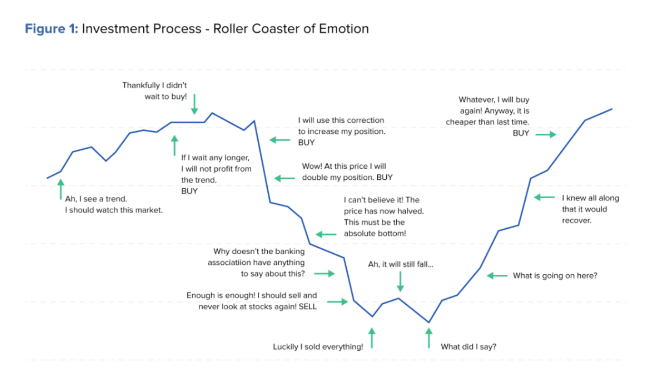
Investing is not a purely scientific endeavor, nor is it solely an art form. It's a delicate balance between form and function, where the importance of fundamental and technical analysis meets the intricacies of investor psychology. While investors may not control market movements or the essential factors affecting a stock, they can undoubtedly assess their psychology.
Creating the Right Portfolio
The most critical aspect of investing is building the right portfolio. It's not just about picking stocks or assets based on their financial fundamentals; it's also about understanding how those investments align with your psychology. We are all imperfect beings continually learning and evolving. After thorough research and due diligence, your portfolio should reflect your unique investor profile and goals.
The Psychology of Fear and Greed
Fear and greed are the two most commonly cited emotions that influence investment decisions. They often represent the extremes of investor sentiment.
Fear: When investors are gripped by fear, they may panic and make impulsive decisions, such as selling their investments during a market downturn. This fear of losses can lead to missed opportunities for long-term gains.
Greed: On the flip side, greed can drive investors to take excessive risks in pursuit of quick and substantial profits. This can result in overconfidence and impulsive actions, leading to losses.
Investor emotions are more complex than just fear and greed, though. A wide range of feelings and beliefs come into play, and these emotions can be both constructive and destructive, depending on how they are managed.
Recognizing and Managing Emotional Biases
One of the first steps in managing emotional biases is recognizing them. Common behavioral biases that affect investors include:
Confirmation Bias: Assigning greater significance to information that reinforces pre-existing beliefs.
Loss Aversion: The tendency to prefer avoiding losses over acquiring equivalent gains.
Overconfidence: Believing in one's ability to predict the market's direction.
Herd Mentality: Following the crowd's actions instead of independent analysis.
Anchoring Bias: Relying too heavily on the first piece of information encountered.
Recency Bias: Granting greater importance to recent occurrences over past experiences.
Once these biases are recognized, investors can take steps to mitigate their impact.
Techniques like diversification, setting clear investment goals, and having a well-thought-out investment plan can help manage emotional decision-making.
Understanding Your Investment Psychology
Investors need to gain insight into their investment psychology. This involves considering their risk tolerance, investment horizon, and financial goals. Different individuals have different risk profiles, and it's essential to tailor investment strategies to match personal preferences.
Incorporating Behavioral Finance
The field of behavioral finance combines psychological principles with financial theory to better understand investor behavior. It recognizes that investors aren't always rational and that emotions and biases can significantly impact financial decisions.
Final Thoughts
Investing is not just about numbers, charts, and financial data; it's also about understanding the emotions and biases that can influence investment decisions. By recognizing your psychological tendencies and learning to manage them, you can make more informed and rational choices in the complex world of finance. A well-balanced investment portfolio should not only reflect your financial goals but also harmonize with your unique investor psychology.
As the saying goes, "Know thyself." In investing, knowing yourself can be as valuable as knowing the market.