
Over the last ten years, gold has played a significant role in India beyond being just a valuable metal; it has been a part of every festival, wedding, and even financial planning. If you’ve ever wondered how the gold price in the last 10 years in Indian rupees has changed and what shaped those shifts, this blog will give you a proper understanding.
We’ll track the movement of prices from 2014 to 2025, the major factors that influence gold prices, compare gold with other investment options, and also see the 8 steps to buy gold in India.
Let’s get into it!
Summary in Points
Gold prices in India have steadily risen from around ₹27,000 in 2016 to over ₹1,04,000 in 2025.
Key factors influencing prices include global trends, rupee-dollar exchange rate, inflation, government policies, and local demand.
Over the last decade, gold outperformed fixed deposits and gave steadier returns compared to stocks and real estate.
Today, you can explore gold through physical gold, Gold ETFs, Sovereign Gold Bonds, or digital gold.
Tracking prices and understanding related charges are important before choosing the form of gold investment.
Gold Price Movement in the Last 10 Years (2014–2025)
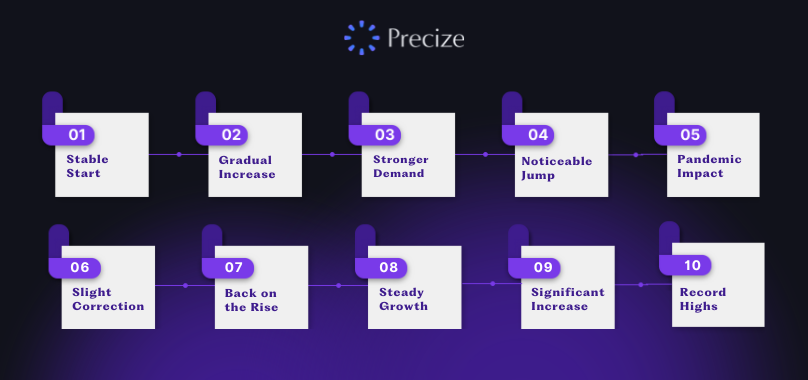
Gold prices in India have shown steady growth over the past decade, with some sharp jumps influenced by global events, currency movements, and changes in local demand. Looking at the rates of 24 Karat gold over the past 10 years gives you a good sense of how prices have changed.
1. 2016 – Stable Start
In 2016, the price of 24 Karat gold was around ₹27,445 per 10 grams. Rates were fairly stable, with slight growth supported by seasonal demand in India and small global changes.
2. 2017 – Gradual Increase
By 2017, gold touched ₹29,156. This steady rise reflected small global shifts and regular Indian demand, showing a slow but consistent upward movement.
3. 2018 – Stronger Demand
In 2018, the price rose further to around ₹31,391. A mix of higher demand during festive seasons and a weaker rupee contributed to this increase.
4. 2019 – Noticeable Jump
Gold climbed to nearly ₹39,108, marking one of the bigger jumps of the decade. Global trade tensions and a slowdown in major economies influenced this rise.
5. 2020 – Pandemic Impact
The year 2020 was a turning point, with prices averaging around ₹50,151. Global uncertainty due to the COVID-19 pandemic made gold more valuable worldwide, and India saw its prices rise sharply.
6. 2021 – Slight Correction
In 2021, rates adjusted slightly to about ₹48,099. As markets stabilized after the pandemic’s peak, gold prices saw a small dip but still remained much higher than before 2020.
7. 2022 – Back on the Rise
Prices picked up again in 2022, reaching around ₹55,017. Inflation pressures and international demand pushed gold higher once more.
8. 2023 – Steady Growth
By 2023, gold touched nearly ₹63,203. The rise reflected continued global uncertainty and strong local buying during Indian festivals.
9. 2024 – Significant Increase
In 2024, prices jumped further to about ₹78,245. Both international demand and currency fluctuations contributed to this sharp climb.
10. 2025 – Record Highs
The year 2025 saw gold hit record-breaking levels. Prices stood at around ₹85,300 in February, moved up to ₹87,550 in March, crossed ₹1,02,170 in April, and touched a new high of ₹1,04,320 by August.
Once you see the overall movement of gold prices, the next step is to understand what drives these shifts in India.
Factors Influencing Gold Prices in India
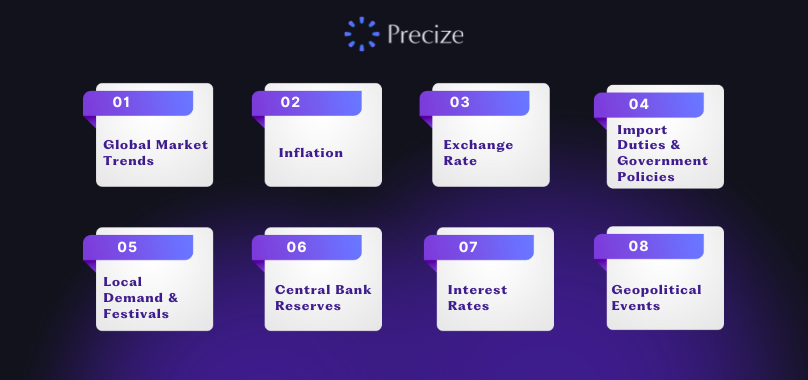
When you look at gold price trends in India over the last ten years, you’ll see that many different factors have shaped how much gold costs.
1. Global Market Trends
International events and changes in major economies play a big role in deciding global gold rates. Situations like economic slowdowns, wars, or shifts in global demand often impact the price you see in India.
2. Inflation
During times of high inflation, gold usually becomes more valuable. In India, when everyday expenses rise, people often turn to gold to protect value, which pushes prices higher.
3. Exchange Rate (Rupee vs. US Dollar)
Since gold is traded in US dollars, the strength of the rupee matters. If the rupee weakens against the dollar, imported gold becomes costlier, leading to higher prices in India.
4. Import Duties and Government Policies
India imports most of its gold, so changes in customs duties, taxes, or other government policies directly affect the price. Higher import duties mean you end up paying more.
5. Local Demand and Festivals
Gold is deeply tied to Indian culture, especially during weddings and festivals like Diwali, Akshaya Tritiya, and Dhanteras. When demand rises sharply during these times, prices often move up.
6. Central Bank Reserves
Gold is maintained as part of reserves by the RBI and other central banks globally. When these banks increase their gold holdings, the supply in the market reduces, which adds pressure on prices.
7. Interest Rates
Gold prices are also linked to interest rates. When interest rates fall, gold becomes more attractive compared to other savings options, and this increased demand raises prices.
8. Geopolitical Events
Political tension, wars, or crises, whether in India or abroad, make people turn to gold as a safer choice. This higher demand usually drives prices upward, even when other markets are unstable.
Once you know what drives gold prices, the next step is to look at how it stands against other forms of investment.
Difference Between Gold vs. Other Investment Options
When you compare gold with other popular investment options in India, you can see that each one comes with its own features, risks, and returns. Here is how each option compares:
1. Gold
Gold has been a traditional choice in India, and today it is available in many forms beyond jewelry.
You can buy gold as physical gold, digital gold, or through ETFs.
It is highly liquid because you can sell it easily whenever needed.
The risk is moderate, as prices depend on global markets and currency value.
Over the last 10 years, gold has shown steady and consistent growth.
It allows you to start with a small amount, even by buying a few grams.
Physical gold requires safe storage, while digital and ETF forms do not.
2. Fixed Deposit
Fixed deposits are one of the most common savings options in India, offered by banks for fixed terms.
A fixed deposit locks your money in the bank for a set period.
It is considered liquid, but early withdrawal usually attracts a penalty.
The risk is very low, making it a stable option.
Returns over the past 10 years have been steady but lower compared to gold.
You can begin with a small amount, usually a few thousand rupees.
There is no need for storage or maintenance.
3. Equity / Stocks
Stocks are linked to the performance of companies and are widely used by people who follow the markets.
Buying stocks means you own shares of a company.
They are liquid because you can sell them during stock market hours.
The risk is high since stock prices can rise or fall quickly.
Returns over the last 10 years have been variable, sometimes very high but also uncertain.
The starting amount depends on the price of each share.
No storage or maintenance is required.
4. Mutual Funds
Mutual funds are designed for those who want a mix of assets without directly buying individual stocks.
They pool money from many people and invest in a basket of assets.
Liquidity is generally high, though certain funds may have a lock-in period.
The risk is moderate to high, depending on the type of fund and market movements.
Returns over the past 10 years have varied with overall market performance.
You can start with a small amount, especially through SIPs (Systematic Investment Plans).
There is no need for storage or maintenance.
5. Real Estate
Real estate remains a major form of investment in India, involving properties like land, houses, or commercial spaces.
It gives you ownership of a physical asset, such as property or land.
Liquidity is low because selling property often takes considerable time.
The risk is moderate to high, depending on market demand and location.
Returns in the last 10 years have been variable and location-specific.
The starting amount is high and usually requires lakhs or crores.
Maintenance costs are also high, including registration fees, taxes, and upkeep.
Once you know the difference between gold and other investment options, it becomes easier to explore the process of buying gold in India.
8 Simple Steps to Buy Gold in India
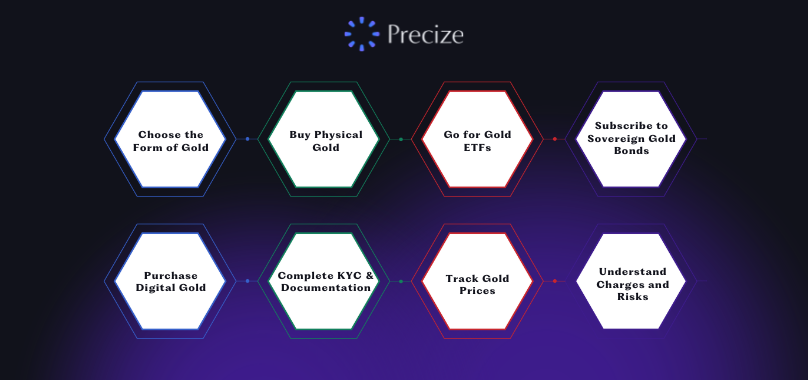
When you think of buying gold, there are different options available today apart from just jewellery. Each comes with its own process, benefits, and things to keep in mind. Here are 8 steps to buy:
Step 1: Choose the Form of Gold
The first step is to decide how you want to hold gold. You can buy physical gold (like jewellery, coins, or bars), or go for financial options such as Gold ETFs, Sovereign Gold Bonds (SGBs), or digital gold. Each form works differently and fits different needs.
Step 2: Buy Physical Gold
Physical gold is the most traditional form.
Always buy from trusted jewellers or authorised dealers.
Check the purity (24 karat is pure gold).
Keep the bill or purchase receipt safely, as it helps during resale.
Be aware of making charges, which can increase the cost.
Step 3: Go for Gold ETFs
Gold Exchange Traded Funds (ETFs) are paperless and simple.
To buy ETFs, you need a Demat account.
You can purchase them on stock exchanges just like regular shares.
They directly reflect the market price of gold and save you from storage issues.
Step 4: Subscribe to Sovereign Gold Bonds (SGBs)
SGBs are issued by the Government of India through the Reserve Bank of India.
These bonds are available only during specific subscription windows.
They not only track gold prices but also offer a small fixed interest.
You can buy them through banks, post offices, or online banking platforms.
Step 5: Purchase Digital Gold
Digital gold lets you purchase small quantities of gold easily through mobile apps or online platforms.
The gold you purchase is kept safely in secure vaults managed by the provider
You can later sell it online or request delivery in physical form.
It is flexible and convenient, but may come with storage limits or charges.
Step 6: Complete KYC and Documentation
For options like Gold ETFs, SGBs, or digital gold, you need to complete KYC (Know Your Customer) formalities. This usually involves ID proof, PAN card, and sometimes bank account verification.
Step 7: Track Gold Prices
Gold prices keep changing every day based on global and local factors. Keeping an eye on the current price helps you understand the market trend and avoid overpaying.
Step 8: Understand Charges and Risks
Each gold-buying option has its own costs and risks.
Physical gold may have making charges and storage issues.
Gold ETFs involve brokerage fees or expense ratios.
SGBs have a lock-in period until maturity.
Digital gold may have platform or storage-related charges.