Why Unlisted FMCG Businesses Can Be Interesting
One of the distinguishing features of private-market investing is that investors can potentially participate in companies before a public-market listing.
For FMCG businesses, this can be particularly relevant because brand-building is often a long-term process.
A company may first establish:
Product → Brand → Distribution → Scale → Profitability → IPO/Strategic Exit
The listed-market history of Indian consumer businesses shows that successful companies can eventually transition from private ownership to public markets.
The Other Side of the Story: FMCG Isn't Always Defensive
FMCG is often considered a defensive sector because consumers continue purchasing everyday products even during economic slowdowns.
But that does not make every FMCG company defensive.
Investors in unlisted companies should pay attention to:
Commodity Exposure
Edible oils, wheat, milk, sugar, tea and packaging materials can significantly influence costs.
Brand Investment
Building a consumer brand requires sustained spending on marketing, distribution and product development.
Profitability
Strong revenue growth does not automatically translate into attractive returns if margins remain weak or cash burn stays high.
Valuation
A great consumer brand can still be an expensive investment.
Liquidity
Unlike listed shares, unlisted securities may have limited liquidity and may take longer to exit.
What Could Define the Next FMCG Winners?
The next generation of successful consumer companies may not necessarily be the companies with the largest product portfolios.
Instead, investors could watch for businesses that combine:
Strong brand + Repeat purchases + Pricing power + Distribution + Healthy margins
A company that can build customer loyalty while expanding distribution has the potential to create a stronger competitive position over time.
This is where the distinction between “selling a product” and “building a brand” becomes important.
How Should Investors Evaluate Unlisted FMCG Companies?
Before looking at a company's potential IPO, investors should first understand the underlying business.
Ask five questions:
1. Is revenue growth translating into profit growth?
Rapid sales growth is useful only when accompanied by improving economics.
2. Does the company have pricing power?
Strong brands can potentially pass higher input costs to consumers.
3. How strong is distribution?
A good product cannot scale without efficient distribution.
4. Is the valuation reasonable?
Compare the company's valuation with its growth, profitability and relevant listed peers.
5. What is the potential exit route?
Possible exits may include an IPO, strategic acquisition, secondary transaction or other liquidity events.
The Bigger Picture
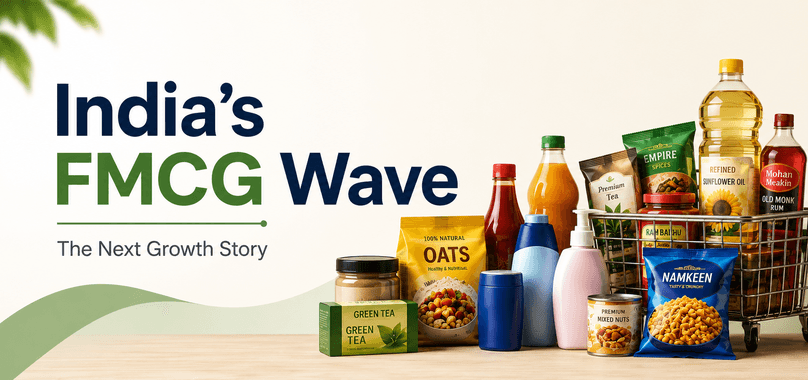
India's Food, Beverages & FMCG opportunity is gradually evolving from a simple volume-growth story into a brand-and-value story.
Rising incomes are expanding the consumer base, while premiumisation is increasing spending per consumer. Organised retail and e-commerce are helping brands expand distribution, and government support is strengthening food-processing infrastructure.
The unlisted market adds another dimension by bringing investors closer to companies that are still building their brands, expanding capacity or scaling their distribution networks.
For investors, the opportunity is therefore not simply to find the “next FMCG stock.”
It is to identify businesses where consumer demand, brand strength, financial performance and valuation come together.
To compare companies, documents, and availability explore unlisted companies on Precize. For ongoing IPO and private-market updates, browse the Precize blog. Stay updated with unlisted companies through our Precize Community. If this article was useful, you can share it with other investors through the Precize Referral Program.
Frequently Asked Questions
Is FMCG a good sector for long-term investment in India?
FMCG benefits from recurring consumption and long-term structural trends such as rising incomes, premiumisation and organised retail. However, the attractiveness of an investment depends on the individual company's valuation, profitability and competitive position.
What is premiumisation in FMCG?
Premiumisation refers to consumers moving towards higher-priced or higher-value products because of better quality, health benefits, convenience, branding or differentiated experiences.
Which FMCG categories are growing in India?
Packaged foods, premium beverages, health-oriented foods, convenience products and branded everyday-consumption products are among the categories benefiting from changing consumer preferences.
What are the risks of investing in unlisted FMCG companies?
Key risks include limited liquidity, valuation risk, raw-material inflation, competition, changing consumer preferences and uncertainty around future exits or IPOs.
How can investors evaluate an unlisted FMCG company?
Investors should assess revenue growth, profitability, margins, brand strength, distribution, working capital, debt, valuation and potential exit opportunities before investing.
Disclaimer: This article is for informational purposes only and should not be considered as investment advice. Investing in unlisted shares carries risks including illiquidity and potential loss of capital. Please consult with a qualified financial advisor before making investment decisions. Precize is not a stock exchange and is not authorized by any capital markets regulator.