
Every business, whether big or small, runs on more than just sales and profits; it runs on its ability to stay financially stable over time. That’s where the financial health of a company comes in. It shows how strong the foundation of a business really is, and whether it can meet obligations, grow, and handle challenges.
In this blog, you will learn what the financial health of a company means, why it matters to stakeholders like owners, employees, lenders, and customers, the key and non-financial indicators to measure it, tools and methods for analysis, steps to assess it, and common mistakes to avoid.
Keep scrolling to learn more!
Quick Overview
Financial health reflects a company’s stability, profitability, and ability to meet obligations.
Key indicators include profitability, liquidity, solvency, efficiency ratios, and cash flow analysis.
Non-financial factors like customer satisfaction, employee morale, brand strength, and operational efficiency also matter.
Regular analysis using financial statements, ratios, trends, and industry benchmarking provides a complete picture.
Precize, an alternative investment platform, offers unlisted shares, pre-IPO opportunities, and global trade finance options, along with detailed research including balance sheets, income statements, cash flow statements, and industry comparisons.
What Does the Financial Health of a Company Mean?
The financial health of a company simply shows how stable, strong, and capable a business is in meeting its short-term and long-term obligations. When you talk about financial health, you are looking at whether a company can pay its debts on time, manage daily operations smoothly, and still have enough strength to grow in the future. It reflects the company’s ability to generate consistent revenue, control costs, and maintain profitability over time.
Good financial health usually means the company has steady cash flow, manageable debt levels, and efficient use of its resources.
On the other hand, weak financial health could indicate problems like rising debts, irregular earnings, or poor cost management.
Once you grasp the concept of financial health, it’s important to explore why it matters to different stakeholders.
Why Financial Health Matters to Different Stakeholders?
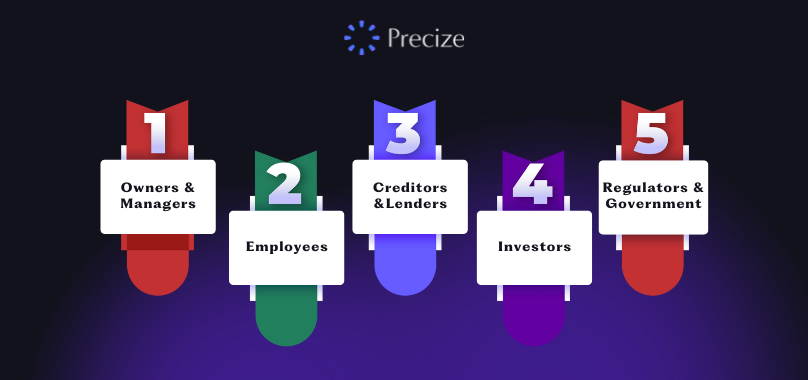
The financial health of a company plays a crucial role for various stakeholders, including owners, managers, employees, creditors, investors, and regulators, as it influences their decisions and confidence in the business.
1. For Owners and Managers
Being aware of the company’s financial condition helps you make informed decisions about running and growing the business. It indicates whether the company is stable and profitable, allowing you to plan for expansion, hiring, or expense management.
2. For Employees
A financially healthy company provides job security, timely salary payments, and other benefits. It gives you confidence in your role and the company’s long-term success.
3. For Creditors and Lenders
Financial health helps banks and lenders assess if a company can repay its debts on schedule. This helps them decide if providing loans or financial support is safe.
4. For Investors
Investors rely on a company’s financial health to assess potential risks and returns. It gives insight into whether the company is performing consistently and has prospects for steady growth.
5. For Regulators and Government
Clear financial information allows regulators to ensure that companies comply with rules and maintain transparency. It also supports policies that promote economic stability and development.
Now that you know who is affected by a company’s financial health, it’s time to explore the measurable signs that show its true condition.
Key Indicators to Measure Financial Health
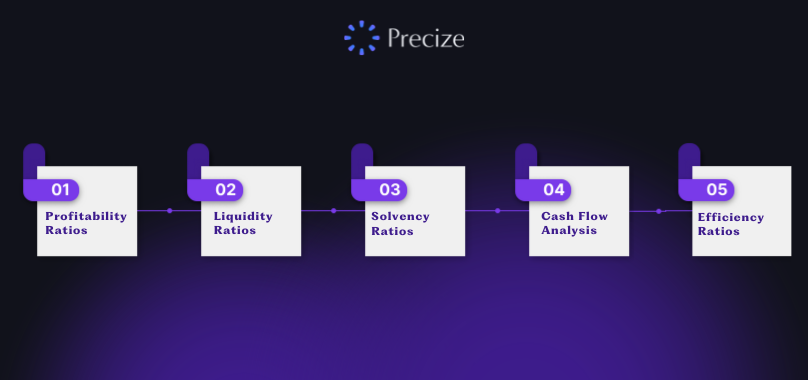
To understand the financial health of a company, you need to look at some important indicators that reveal how stable the business is and whether it can meet its financial responsibilities. These measures give you a clear view of profitability, liquidity, stability, and efficiency. The main indicators include:
1. Profitability Ratios
These show how much profit a company makes from its sales and investments.
Gross Profit Margin: This shows the profit left after subtracting the cost of goods sold from total sales.
Net Profit Margin: This represents the final profit after all expenses are deducted.
Return on Equity (ROE): This indicates how well the company uses shareholders’ money to generate profits.
2. Liquidity Ratios
These measures are used if a company has enough cash or assets to pay its short-term debts.
Current Ratio: This compares current assets with current liabilities to check if the company can meet short-term obligations.
Quick Ratio: Unlike the current ratio, this excludes inventory and focuses solely on assets that can be quickly converted into cash.
3. Solvency Ratios
These show a company’s long-term financial stability and its ability to manage debt.
Debt-to-Equity Ratio: It indicates how much of the company’s financing comes from debt versus the shareholders’ own funds.
Interest Coverage Ratio: This measures whether the company’s earnings are enough to pay interest on its debts.
4. Cash Flow Analysis
Since profit and cash are not the same, analyzing cash flow is crucial. Healthy cash flow shows the company can meet its current expenses while also investing in future growth.
Operating Cash Flow: This shows the cash generated from the company’s regular business activities.
Comparing cash flow with short-term debts helps you understand whether the company can meet its immediate obligations.
5. Efficiency Ratios
These indicate how well the company uses its assets and manages inventory.
Asset Turnover Ratio: This shows how efficiently the company generates revenue from its assets.
Inventory Turnover Ratio: This reflects how quickly inventory is sold and replaced.
Financial metrics are essential, but a complete view also requires considering other non-financial elements that influence a company’s long-term success.
Non-Financial Indicators of Financial Health
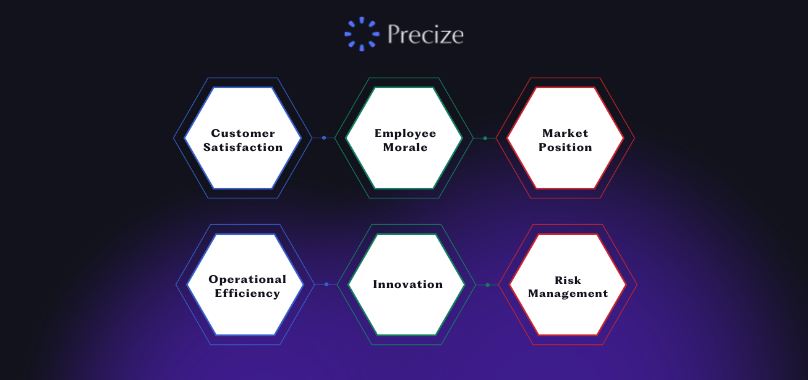
When you measure the financial health of a company, it is important not to rely only on financial numbers. Non-financial indicators give you a broader perspective on how well a business is performing and whether it can sustain itself in the long run. Here is what to look for:
1. Customer Satisfaction and Loyalty
If customers are happy and continue to return, it shows that the company is delivering value. Strong customer trust is a clear sign of long-term business health.
2. Employee Morale and Turnover
A company with motivated employees and low turnover rates usually has a positive work culture. High employee satisfaction often leads to better productivity and service quality.
3. Market Position and Brand Strength
A well-known and respected brand indicates long-term strength. A strong market position helps the company attract new customers, retain existing ones, and build reliable partnerships.
4. Operational Efficiency
The way a company manages its resources, supply chains, and processes directly impacts its performance. Efficient operations reduce costs and improve overall results.
5. Innovation and Adaptability
Companies that adopt new ideas and adapt to shifts in the market or technology remain competitive and continue to stay relevant over time.
6. Compliance and Risk Management
Following regulations and managing risks carefully protects the company from legal issues and financial setbacks.
While non-financial factors give you a broader view, analyzing actual data with the right tools ensures you understand the company’s financial position in detail.
Tools and Methods for Analyzing Financial Health
When you want to measure the financial health of a company, you need to use the right tools and methods. These not only show you how a business is performing today but also help you understand its long-term stability and efficiency. Below are the main tools and methods explained in detail:
1. Financial Statements
Financial statements are the main source of information about a company’s performance.
Balance Sheet: The balance sheet statement shows what the company owns (assets), what it owes (liabilities), and the shareholders’ equity. It helps you check whether the company has enough resources to pay its debts and how much capital is invested.
Income Statement (Profit & Loss Statement): The income statement report summarizes revenues, expenses, and profits over a specific period. It helps you understand whether the company is making money or facing losses.
Cash Flow Statement: It details how cash flows into and out of the company over a period. It highlights whether the company has enough liquidity to cover expenses and manage daily operations.
2. Cash Flow Analysis
A company may show profits but still face cash shortages. That’s why analyzing cash flow is important.
Operating Cash Flow: Tracks cash generated from core business activities, showing if operations are self-sustaining.
Investing Cash Flow: Covers money spent or earned from buying and selling assets like machinery or property.
Financing Cash Flow: Records money raised from loans or investors, as well as repayments and dividends.
3. Trend Analysis
Trend analysis involves studying financial data over several years to spot patterns.
For example, you may notice consistent revenue growth, stable profit margins, or rising debt levels.
Identifying these trends helps you understand whether the company is improving, declining, or staying steady.
Graphs and charts make these patterns easier to visualize.
4. Comparative Analysis (Benchmarking)
This method compares a company’s performance with industry standards or competitors.
For instance, if a company’s net profit margin is higher than the industry average, it shows stronger efficiency.
Benchmarking helps you see where the company stands in its sector.
5. Working Capital Analysis
Working capital shows how much a company’s current assets exceed its current liabilities, indicating its short-term financial strength.
Having positive working capital indicates that the company can meet its short-term liabilities while also having resources to invest in growth.
Negative working capital may indicate liquidity issues, meaning the company might struggle to pay immediate expenses.
6. Scenario and Sensitivity Analysis
These methods test how changes in different factors affect performance.
For example, scenario analysis checks how profits would change if sales dropped by 10%.
Sensitivity analysis studies how a change in one specific factor, like raw material costs, can impact the company’s overall performance. This approach helps businesses plan for potential risks and uncertainties.
7. Financial Modeling and Forecasting
This involves using tools like Microsoft Excel to project future revenues, expenses, and cash flows based on past data.
For example, if sales have grown steadily in the past, a financial model can forecast likely sales growth for the coming years.
Forecasting helps companies plan for both opportunities and challenges.
8. Digital Accounting and Financial Software
Many businesses, especially in India, use accounting tools like Precize.
These platforms generate real-time reports and make it easier to calculate ratios or track cash flow.
They save time, reduce errors, and provide faster insights.
9. Advanced Technologies
Large organizations often rely on advanced tools such as Artificial Intelligence (AI), Robotic Process Automation (RPA), and cloud-based dashboards.
These tools can handle vast volumes of financial data, identify potential risks or fraud, and deliver precise forecasts.
They make financial analysis more reliable and efficient.
Once you understand the key tools and methods, the next step is applying them practically to assess a company’s financial position.
Steps to Assess a Company’s Financial Health
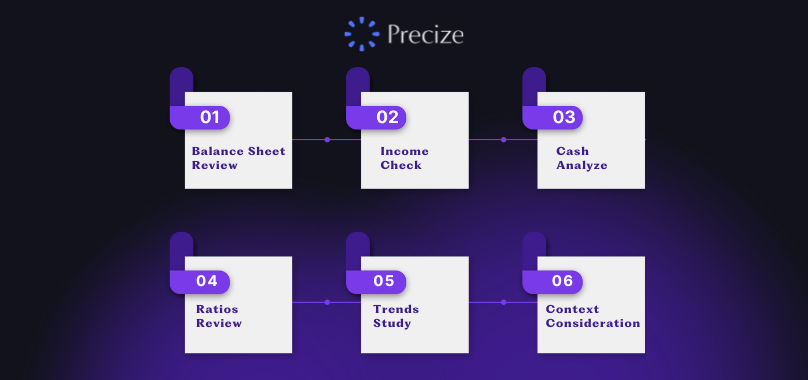
When you want to measure the financial health of a company, you can follow a few clear steps that focus on important financial documents and key ratios:
Step 1: Review the Balance Sheet
Look at the company’s assets, liabilities, and equity. Check the balance between debt and equity, and see if there are enough short-term assets to cover short-term liabilities. This helps you understand if the company can handle debts and stay liquid.
Step 2: Examine the Income Statement
Study the revenues, expenses, and profits over time. Pay attention to profit margins like gross profit and net profit to see if the company is consistently earning more than it spends. This gives you a clear idea of profitability and cost management.
Step 3: Analyze the Cash Flow Statement
Check how the company generates and uses cash in operations, investments, and financing. A healthy cash flow indicates the company has enough funds to cover its costs and support future growth. It’s important because profit on paper does not always mean actual cash in hand.
Step 4: Check Key Financial Ratios
Ratios give deeper insights into financial strength. Liquidity ratios show if short-term obligations can be met, profitability ratios reveal earnings efficiency, leverage ratios show the balance between debt and equity, and efficiency ratios highlight how well assets are used to generate revenue.
Step 5: Look at Trends Over Time
Compare these statements and ratios over multiple years to see if the company’s position is improving or declining.
Step 6: Consider Industry and Economic Context
Always assess financial health in relation to the industry and economic environment. A healthy company in one sector may look very different from a strong company in another.
Understanding the process is key, but avoiding common errors ensures your evaluation of the company’s health is accurate.