What Kind of Business Is NSE?
NSE is not just another pre-IPO company. It is core market infrastructure for India's capital markets.
Established in 1992, the exchange changed Indian markets by introducing electronic trading at scale. Today, it operates across several business lines, including:
Equity cash market.
Equity derivatives.
Currency derivatives.
Commodity derivatives.
Debt market.
Clearing services.
Market data.
Index licensing.
Technology services.
This matters because NSE benefits from strong network effects. More investors, brokers, and institutions on the platform tend to reinforce its market position. That often leads to a business model with high operating leverage, high margins, and strong cash generation.
If you want to compare NSE with other private-market opportunities, you can use the Precize screener to review unlisted companies across sectors.
One of the strongest parts of the investment case is still the business itself.
Based on the financial snapshot discussed in the article and recent public reporting, NSE has continued to post very strong revenue, EBITDA, and profit numbers:
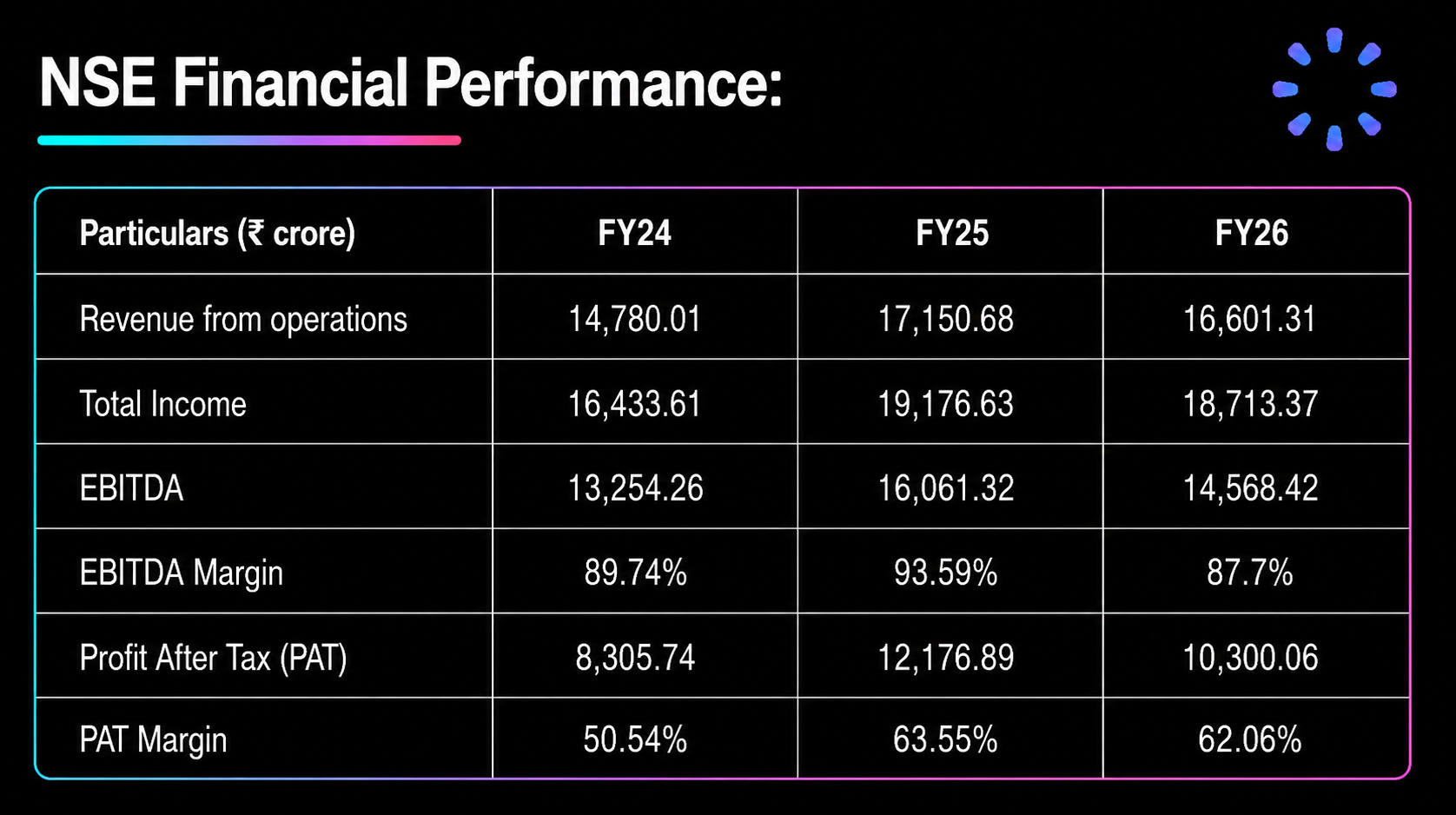
Even after moderating from an exceptionally strong FY25, these are still elite numbers. EBITDA margins of about 74% show how scalable the business model is. NSE does not need heavy incremental capital to support every extra unit of trading activity, which is one reason exchange businesses can become extremely profitable.
The bigger point for investors is this: NSE is not attractive only because an IPO may happen. It is attractive because the underlying business is already large, profitable, and difficult to replicate.
For a broader valuation and earnings lens, you can also compare NSE with other pre-IPO opportunities and review how unlisted share investing works in our FAQs.
What Does the Current NSE Share Price Mean for Investors?
Following the DRHP filing, investor interest in NSE has increased significantly. At the current NSE share price is trading around ~₹2,050 - ₹2,080, investors are effectively paying for one of India's highest-quality financial infrastructure businesses before its public listing.
However, while the company's fundamentals remain strong, investors should avoid buying purely because the IPO is approaching. The more important question is whether the current NSE unlisted share price adequately reflects the company's future earnings potential and expected IPO valuation.
A quality business does not automatically translate into superior investment returns if purchased at an expensive valuation.
Why Do Investors Like NSE Unlisted Shares?
The appeal usually comes down to four things.
1. Dominant Market Position
NSE has leadership across India's equity and derivatives ecosystem. That creates scale and trust, which are hard for competitors to match.
2. Asset-Light Economics
Once core technology and compliance infrastructure are in place, higher market activity can flow through to profit without the capital needs you would see in manufacturing or other heavy industries.
3. Strong Cash Generation
A business that regularly converts revenue into cash has more flexibility. It can invest in systems, support subsidiaries, and potentially distribute cash to shareholders.
4. IPO Optionality
Many investors are interested because a successful IPO could improve liquidity and expand the pool of buyers. But this point should be treated as a bonus, not the entire thesis.
Should You Buy NSE Unlisted Shares Before the IPO?
The short answer is: Possibly, but only if valuation still leaves room for returns.
For long-term investors, NSE checks many important boxes:
However, you should not buy NSE unlisted shares purely because the IPO feels closer.
A smart framework is to ask:
What valuation am I paying today?
How does that compare with NSE's earnings and margins?
How much of the IPO excitement is already priced in?
Would I still be comfortable holding if the IPO takes longer than expected?
Does this position fit my portfolio and liquidity needs?
If the unlisted market price is already very rich, future returns may be modest even if NSE continues to perform well. A great company bought at the wrong price can still be a poor investment.
If you are new to the process, our Precize FAQs can help with common questions on transfers, timelines, and unlisted-share investing basics.
What Risks Should Investors Watch Closely?
NSE is a strong business, but that does not mean the investment is low risk.
Regulatory Risk
NSE operates under close SEBI oversight because it is a market infrastructure institution. Any future regulatory changes, penalties, settlement requirements, or rule changes can affect profitability and sentiment.
Market Activity Risk
Exchange revenues are linked to market activity. If trading volumes cool for a long period, transaction-fee income can come under pressure.
Valuation Risk
This may be the most important risk today. If you buy at a high premium in the unlisted market, your upside may narrow even if the IPO happens smoothly.
Liquidity Risk
Unlisted shares are not as easy to exit as listed stocks. If you need quick liquidity, private-market holdings can become inconvenient at the wrong time.
Timeline Risk
The DRHP has been filed, but final IPO dates, price band, and SEBI observations are still pending. Delays can still happen.
Bottom Line
NSE's DRHP filing is a genuine milestone. It brings the long-awaited IPO much closer, improves transparency, and gives investors better information to judge the opportunity.
NSE still looks like one of India's highest-quality unlisted businesses because of its market position, high margins, diversified revenue streams, and strong cash generation. For investors who believe in the long-term growth of India's capital markets, that is a compelling foundation.
But a strong business alone is not enough. The better approach is to stay disciplined on valuation, assume the IPO timeline can still shift, and treat any pre-IPO investment as a long-term allocation rather than a quick listing-gain trade.
If you want help comparing NSE with other pre-IPO opportunities, you can explore unlisted companies on Precize or contact Precize Care. Stay updated with unlisted companies through our Precize Community. If this article was useful, you can share it with other investors through the Precize Referral Program.
Frequently Asked Questions
1. Is the NSE IPO now confirmed?
The formal IPO process has started because NSE has filed its DRHP, but the full IPO is not final until SEBI issues observations and the company announces the Red Herring Prospectus, price band, and issue dates.
2. Is NSE issuing fresh shares in the IPO?
No. The issue is entirely an Offer for Sale by existing shareholders, so NSE will not receive fresh capital from this IPO.
3. Who are the main selling shareholders in the NSE IPO?
Reported selling shareholders include SBI, CPPIB, Bank of Baroda, GIC, Stock Holding Corporation, New India Assurance, United India Insurance, National Insurance Company, Aranda Investments, and MS Strategic (Mauritius).
4. When is the NSE IPO expected?
The DRHP has already been filed, but the exact IPO timeline will depend on SEBI's review, the final offer document, and market conditions.
Disclaimer: This content is for informational purposes only and does not constitute investment advice. Investing in unlisted shares involves risks including illiquidity and potential loss of capital. Consult a qualified financial advisor before making investment decisions. Precize is not a stock exchange and is not regulated by SEBI.