India's Energy and Power Sector Outlook in 2026
Energy & Power sector remains one of the most important pillars of India's infrastructure growth. It is being shaped by four forces at once:
Rising power demand from industry, urbanization, data centers, and EV adoption.
Faster renewable capacity addition across solar, wind, hydro, and hybrid projects.
Policy support for clean energy, transmission, and EV infrastructure.
Corporate demand for renewable power procurement and ESG-linked operations.
Official data supports the scale of this transition. A Ministry of Power release notes that India is working toward 500 GW of installed electricity capacity from non-fossil sources by 2030. A Press Information Bureau update said India had installed about 283.46 GW of non-fossil fuel capacity as of 31 March 2026, including roughly 150.26 GW of solar and 56.09 GW of wind.
On the demand side, public reporting based on Central Electricity Authority commentary suggests India's peak power demand could reach around 265-270 GW in 2026. A Ministry of Power Lok Sabha statement reported in April 2026 also projected peak demand rising to 345 GW by FY 2029-30 and 388 GW by FY 2031-32.
That backdrop matters for unlisted investors because India's energy transition is no longer limited to a few listed giants. It is spreading across:
Renewable infrastructure and EPC execution.
Rooftop and distributed solar.
EV charging and battery-linked ecosystems.
Green industrial manufacturing and engineering.
Storage, hybrid systems, and localized clean-energy solutions.
This is why renewable energy unlisted shares are becoming a distinct research theme within India's broader pre-IPO market.
Why Renewable Energy Unlisted Shares Are Gaining Momentum
The renewable segment is turning into a long-term private-market theme for four connected reasons.
1. Government Renewable Push
India continues to expand renewable capacity through central schemes, state tenders, transmission planning, and annual bidding targets. The government has also outlined plans to invite bids for large renewable capacity additions over multiple years to support the 500 GW non-fossil target.
For investors, this creates a long runway for businesses involved in project execution, equipment supply, and supporting infrastructure. But policy support does not remove project risk. Tariffs, incentives, land access, and tender competitiveness still affect returns.
2. Rising Electricity Demand
Industrial growth, urban expansion, manufacturing, AI-linked data infrastructure, and EV adoption are all increasing electricity consumption. When demand rises, the system needs more generation, stronger grids, and more distributed solutions.
That supports companies across the value chain, not just developers. EPC contractors, rooftop installers, charging infrastructure players, and green industrial suppliers can all benefit if they execute well.
3. ESG and Corporate Sustainability
Large companies are increasingly buying renewable power, setting decarbonization targets, and shifting operations toward cleaner inputs. That trend supports:
Commercial and industrial rooftop solar.
Renewable-linked manufacturing.
Clean mobility and charging ecosystems.
Distributed power solutions for factories and campuses.
This is one reason investors are looking beyond traditional listed power stocks toward earlier-stage private businesses.
4. Pre-IPO Growth Potential
Many investors want to identify high-growth energy businesses before public listing. In theory, that can create valuation upside if the company scales, improves profitability, and lists at a strong market valuation.
In practice, pre-IPO energy investing is harder than the headline suggests. Project businesses can look strong on paper but remain capital-heavy, cyclical, or dependent on a few large orders. Valuations can also run ahead of fundamentals when a sector theme gets popular.
Key Renewable Energy Themes Driving the Sector
India's next phase of clean energy growth is broader than utility-scale generation alone.
The energy sector unlisted shares space can be broadly divided into five major themes.
1. Solar Expansion
This theme includes utility-scale solar projects, rooftop solar installations, EPC (Engineering, Procurement and Construction) services, solar module manufacturing, and project development. Investors are attracted to this segment because it is the largest and fastest-growing renewable energy market in India, supported by favorable government policies and increasing solar adoption.
2. EV Infrastructure
This segment covers EV charging stations, battery-related products, battery management systems, and mobility components. Investor interest is driven by the rapid growth of electric vehicles and government support through schemes such as PM E-DRIVE, which encourage EV adoption and infrastructure development.
3. Distributed Renewable Energy
Distributed renewable energy includes rooftop solar systems, commercial solar installations, and localized energy solutions for businesses and communities. The segment benefits from growing corporate sustainability commitments and the need for reliable, cost-effective clean energy solutions.
4. Green Industrial Manufacturing
This category consists of renewable-energy-linked engineering companies and manufacturers of clean industrial products. Investors see opportunities here because of increasing industrial decarbonization efforts, government support for domestic manufacturing, and rising demand for environmentally friendly industrial solutions.
5. Storage and Hybrid Systems
This theme includes Battery Energy Storage Systems (BESS), hybrid renewable energy projects, and grid-balancing technologies. As renewable energy's share in the power mix increases, energy storage and hybrid solutions are becoming essential for ensuring grid stability and efficient power management, making them an attractive long-term investment opportunity.
The PM E-DRIVE scheme, approved with an outlay of ₹10,900 crore, is especially relevant for EV-linked themes. It supports faster EV adoption and public charging infrastructure, including a dedicated outlay for EV public charging stations.
For investors, the practical question is not "Is clean energy growing?" It is: Which part of the value chain is this company actually exposed to?
Top Renewable Energy Unlisted Shares in India to Watch in 2026
Several emerging renewable-focused businesses in India's unlisted market are drawing attention because of their exposure to solar, EV ecosystems, green infrastructure, and clean-tech solutions.
Important: The companies below are discussed as sector examples based on market interest and business positioning. This is not a ranked buy list. Unlisted share prices are indicative, can change quickly, and should always be verified before any transaction.
Apollo Green Energy
Apollo Green Energy operates within India's renewable infrastructure ecosystem, with exposure to solar-led clean energy execution and project-linked services. Businesses in this segment can benefit when utility-scale and commercial renewable deployment accelerates, because developers and industrial buyers need execution partners, not just generation assets.
Why investors track it
Solar and renewable infrastructure exposure.
Potential beneficiary of rising EPC and project execution demand.
Part of the broader Energy & Power theme on private-market platforms.
What to verify
Order book quality and project execution track record.
Working capital needs and receivable cycles.
Dependence on a few large projects or clients.
Any IPO-related commentary should be treated as market speculation until supported by official filings.
GFCL EV Products
GFCL EV Products is positioned within the electric mobility and clean transportation ecosystem. India's EV transition is creating demand for battery-linked products, charging-related infrastructure, and green industrial components used across the mobility value chain.
Why investors track it
EV ecosystem exposure rather than pure generation exposure.
Potential demand tailwind from EV adoption and charging infrastructure expansion.
Useful example of how energy-sector unlisted investing is moving beyond conventional power businesses.
What to verify
Revenue linkage to EV adoption versus legacy industrial products.
Customer concentration and contract visibility.
Competitive positioning against larger listed and private players.
Policy dependence under EV incentive schemes.
Insolare Energy
Insolare Energy is among the emerging names in India's distributed solar market. The company focuses on rooftop solar and commercial clean energy adoption, segments that benefit from corporate sustainability goals and localized power demand.
Why investors track it
Rooftop and commercial solar exposure.
Direct play on distributed renewable adoption.
Less dependent on mega tender cycles than some utility-scale developers.
What to verify
Mix of residential, commercial, and industrial projects.
Installation growth, maintenance revenue, and repeat business.
Geographic concentration.
Ability to manage working capital across project rollouts.
Onix Renewable
Onix Renewable operates within the solar and renewable infrastructure ecosystem, with exposure to clean power systems and industrial renewable solutions. As more businesses shift toward renewable procurement, companies that help industrial consumers adopt clean power can benefit over time.
Why investors track it
Solar infrastructure and industrial clean energy exposure.
Potential beneficiary of commercial renewable adoption.
Fits the broader theme of energy transition beyond listed utilities.
What to verify
Project pipeline and execution capacity.
Customer profile across industrial and commercial segments.
Debt levels and capital structure.
Differentiation versus larger EPC or developer platforms.
Solar91 Cleantech
Solar91 Cleantech focuses on decentralized solar adoption and clean-tech accessibility for businesses and consumers. Distributed renewable solutions are becoming more important as India expands local solar deployment and energy-efficient infrastructure.
Why investors track it
Decentralized solar and clean-tech exposure.
Potential demand from SMEs, commercial users, and localized adoption.
Useful example of the shift from central generation to distributed energy.
What to verify
Revenue split between product sales, installations, and services.
Brand reach and distribution strength.
Working capital requirements.
Competitive pressure from larger rooftop solar brands.
How These Names Fit the 2026 Energy Pre-IPO Map
If you are building a watchlist, it helps to group companies by sub-sector rather than treating every name as a pure renewable developer.
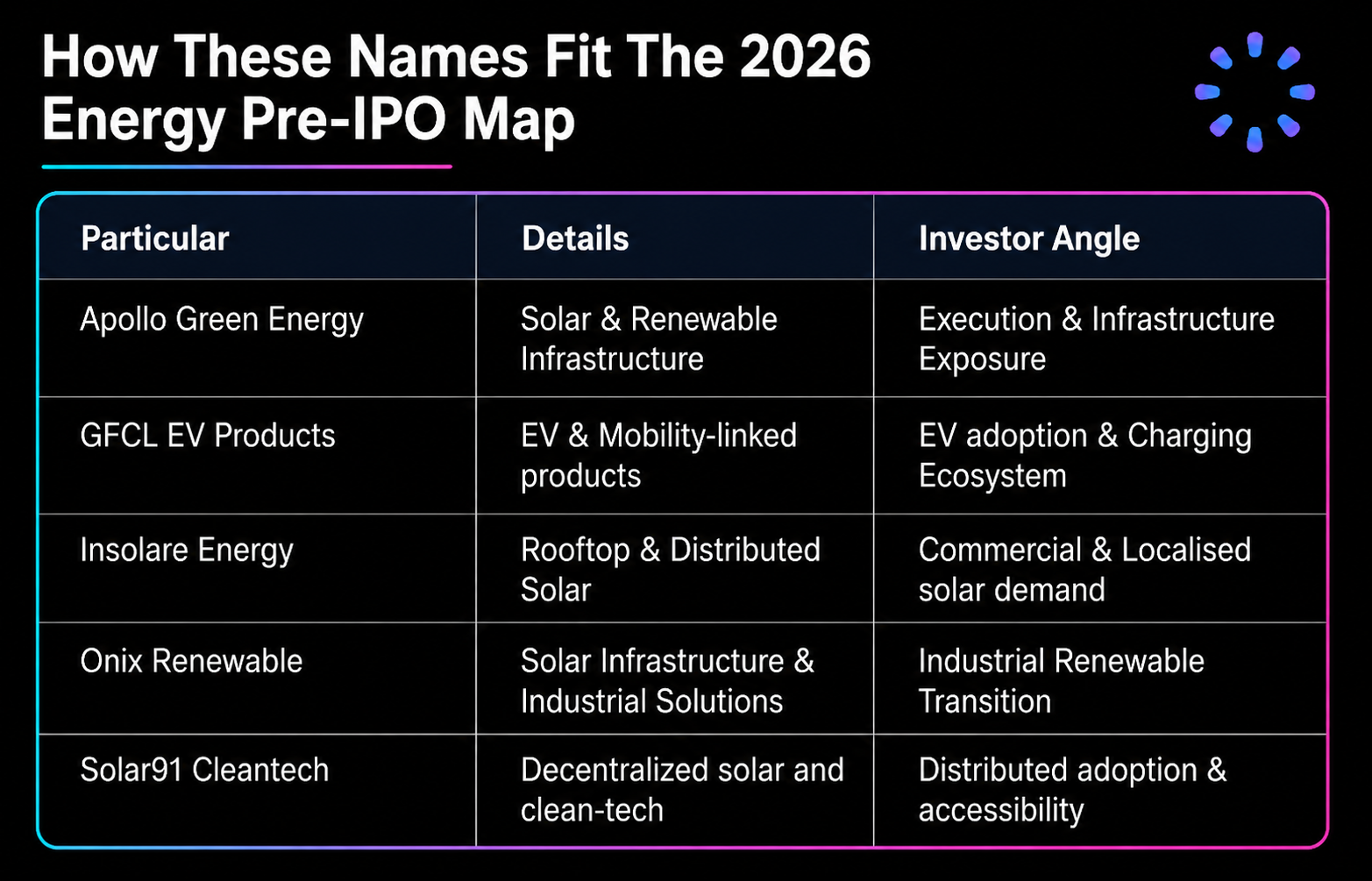
This framework is more useful than asking which name is "best." In unlisted markets, business quality, valuation, liquidity, and holding period matter more than sector hype.
For a broader list of high-interest private companies across sectors, also read top pre-IPO stocks in India for 2026.
Risks Investors Should Consider
Renewable energy unlisted shares can offer long-term thematic appeal, but the risks are real.
Liquidity Risk
Unlisted shares are harder to buy and sell than listed stocks. You may need a longer holding period, accept wider price gaps, and wait for a matching buyer when you want to exit. Energy businesses with project-heavy models can be especially hard to value during a sale.
Regulatory and Policy Dependency
The sector is influenced by renewable tariffs, state policies, EV incentives, grid regulations, and tender design. A favorable policy shift can help sentiment. An unfavorable change can hurt project economics quickly.
Capital-Intensive Operations
Renewable infrastructure, manufacturing, and EPC businesses often need heavy upfront investment. Long project cycles, delayed payments, and execution slippage can pressure cash flows even when sector demand is strong.
Valuation Volatility
Pre-IPO valuations can move sharply based on theme popularity, funding conditions, and IPO rumors. A strong narrative does not always mean a strong price. Past private-market price trends do not guarantee future outcomes.
Information and Execution Risk
Unlisted companies may disclose less information than listed peers. That makes execution quality, management credibility, and balance sheet strength even more important. If you are new to this market, review common questions in Precize FAQs before committing capital.
How to Evaluate Energy Sector Unlisted Shares
Before investing in renewable-focused unlisted companies, use a structured checklist.
1. Map the Business to the Right Sub-Sector
Ask whether the company is a developer, EPC player, manufacturer, distributor, or EV-linked supplier. Each model has different risks. A rooftop solar installer does not behave like a utility-scale developer.
2. Check Revenue Visibility
Look for repeat customers, signed contracts, order book disclosure, and geographic spread. One-off projects can inflate short-term growth without creating durable earnings.
3. Review Execution Capability
In energy businesses, execution is everything. Delayed projects, cost overruns, and weak commissioning track records can erode returns even in a growing market.
4. Study the Balance Sheet
Check debt levels, working capital needs, promoter holding, and whether the business can fund growth without constant dilution or expensive borrowing.
5. Assess IPO Visibility Carefully
IPO interest can support private-market demand, but rumors are not filings. Treat listing timelines as uncertain unless supported by official exchange or regulatory documents. For general pre-IPO process context, browse Precize blog explainers rather than relying on social media speculation.
6. Compare Valuation to Business Quality
A popular sector theme can push private-market prices up quickly. Ask whether the current valuation already prices in several years of growth. If you cannot verify financials or cash flows, treat valuation as a major unknown.
Companies aligned with long-term renewable infrastructure and clean energy themes may benefit from India's broader transition cycle. But the theme alone is not an investment case.
Energy Sector Unlisted Shares Outlook for 2026
India's renewable energy transformation is still in a long expansion phase. Clean energy adoption, EV penetration, industrial sustainability goals, and infrastructure modernization are likely to keep creating opportunities across solar, EV infrastructure, green manufacturing, and distributed power.
For private-market investors, 2026 is less about finding one perfect name and more about identifying which business models are best placed to compound through the next phase of India's energy buildout.
That likely keeps energy sector unlisted shares in India on the watchlist for investors tracking:
Solar deployment and EPC execution.
Rooftop and commercial renewable adoption.
EV charging and mobility-linked products.
Green industrial and engineering solutions.
The opportunity is real. So is the need for patience, liquidity planning, and disciplined research.
How to Research Energy Pre-IPO Opportunities on Precize
If you want to move from theme-level reading to actual company research, use a platform workflow rather than headline chasing.
Open the Energy & Power sector page to see which unlisted companies fall under the theme.
Use the Precize screener to compare availability, price references, and company profiles.
Read research materials, financial disclosures, and sector context before discussing lot size or transfer terms.
Confirm demat transfer, seller verification, and holding-period implications before placing an order.
Treat any investment as illiquid and size the position accordingly.
You can start exploring from ₹10,000 on Precize, but a low entry amount should not be confused with low risk.
If you need help with platform access, documentation, or order support, contact Precize Care.
Final Thoughts
India's energy transition is creating a new set of private-market opportunities across solar, EV infrastructure, green manufacturing, and distributed clean-tech.
Companies such as Apollo Green Energy, GFCL EV Products, Goodluck Green Energy, Insolare Energy, Onix Renewable, and Solar91 Cleantech reflect that shift. They are not just power businesses in the old sense. They are part of a wider clean-energy and sustainability growth story.
As renewable infrastructure investments keep accelerating, energy sector unlisted shares in India may remain one of the most important long-term themes in the pre-IPO market. The investors who do best will likely be the ones who combine sector enthusiasm with company-level research, realistic liquidity expectations, and clear risk limits.
Ready to explore opportunities? Use the Precize screener to review energy and renewable unlisted companies, compare research, and start building a watchlist with better context. Stay updated with unlisted companies through our Precize Community. If this article was useful, you can share it with other investors through the Precize Referral Program.
Frequently Asked Questions
1. Which are the top renewable energy unlisted shares in India in 2026?
Some emerging renewable-focused unlisted names investors are tracking in 2026 include Apollo Green Energy, GFCL EV Products, Goodluck Green Energy, Insolare Energy, Onix Renewable, and Solar91 Cleantech. These are research examples, not buy recommendations. Availability and pricing can change across platforms.
2. Why are renewable energy unlisted shares gaining popularity?
They are benefiting from India's renewable capacity expansion, rising electricity demand, EV adoption, corporate sustainability goals, and growing interest in pre-IPO investing. Investors want exposure to clean energy themes before companies list publicly.
3. How can investors evaluate renewable energy pre-IPO companies?
Focus on business model clarity, sub-sector exposure, revenue visibility, execution track record, balance sheet strength, management quality, and realistic IPO visibility. Compare companies on the Precize screener and read supporting research before investing.
4. Where can I track more energy and pre-IPO market updates?
You can monitor sector companies on Precize Energy & Power and follow broader private-market explainers on the Precize blog.
Disclaimer: This article is for informational purposes only and should not be considered as investment advice. Investing in unlisted shares carries risks including illiquidity and potential loss of capital. Please consult with a qualified financial advisor before making investment decisions. Precize is not a stock exchange and is not authorized by any capital markets regulator. This is not a recommendation to buy or sell shares of Apollo Green Energy, GFCL EV Products, Goodluck Green Energy, Insolare Energy, Onix Renewable, Solar91 Cleantech, or any other company mentioned in this article.