
NSE has officially filed its Draft Red Herring Prospectus (DRHP) with SEBI, reviving one of India's biggest IPO stories. The filing has attracted attention not only from domestic investors but also from global institutions. Adding to the excitement, global brokerage Jefferies recently described the proposed listing as the "final piece in India's exchange troika," highlighting the strategic importance of the IPO for India's financial ecosystem.
The development comes at a time when India's capital markets are witnessing record retail participation, growing domestic investments and increasing global interest. For investors tracking NSE unlisted shares, the IPO process marks an important milestone that could shape the company's next phase of growth.
NSE Finally Files Its DRHP
The filing of the Draft Red Herring Prospectus is one of the most important milestones before any company goes public.
A DRHP provides detailed information about a company's business operations, financial performance, promoters, risks, legal matters and the proposed public issue. While filing the DRHP does not guarantee an immediate IPO, it confirms that the listing process has officially begun.
For NSE, this filing is particularly significant because its IPO has been delayed for several years due to regulatory issues. The latest filing indicates that those concerns have largely been addressed and that the exchange is now progressing toward a public listing.
According to reports, the proposed IPO is expected to be an Offer for Sale (OFS), where existing shareholders will sell a portion of their holdings. Since it is an OFS, the company itself is not expected to raise fresh capital. Instead, the listing will provide liquidity to existing investors while making India's largest stock exchange accessible to public shareholders.
Although SEBI's review and approval process is still pending, the filing has substantially increased visibility around the IPO timeline.
Why Jefferies Calls NSE the "Final Piece" of India's Exchange Troika
Soon after the DRHP filing, global investment bank Jefferies initiated coverage on the upcoming IPO and described NSE as the final piece in India's exchange troika.
The phrase refers to India's three major exchange operators:
National Stock Exchange (NSE)
Bombay Stock Exchange (BSE)
Multi Commodity Exchange (MCX)
While BSE and MCX are already publicly listed, NSE has remained privately held despite being the country's largest exchange.
Jefferies believes the listing will complete India's publicly listed exchange ecosystem and offer investors exposure to one of the world's strongest exchange businesses.
The brokerage highlighted several strengths that make NSE stand out globally:
Leadership across cash equities and equity derivatives
Strong operating margins
Consistent cash generation
Asset-light business model
Diversified revenue streams
Significant long-term growth potential as Indian capital markets deepen
The report also notes that India's financial savings are steadily shifting toward equities, creating structural tailwinds for exchange businesses over the coming decade.
Understanding NSE's Business Model
Many investors know NSE as the platform where stocks are traded, but its business extends far beyond matching buy and sell orders.
NSE operates a diversified market infrastructure business with multiple revenue streams that generate stable earnings across different market cycles.
1. Trading Revenue
The exchange earns transaction fees from trading in:
Cash equities
Equity futures
Equity options
Currency derivatives
Debt securities
As trading volumes increase, transaction income generally grows alongside them.
2. Clearing and Settlement
Through its clearing subsidiaries, NSE provides clearing and settlement services, reducing counterparty risk and ensuring smooth completion of trades.
3. Listing Fees
Companies pay listing and annual compliance fees to remain listed on the exchange.
4. Market Data Services
NSE licenses real-time market data, indices and analytical products to brokers, financial institutions and data vendors.
5. Technology Solutions
The exchange also earns revenue through technology infrastructure, connectivity services and platform solutions provided to market participants.
Because these revenue streams are diversified, NSE is less dependent on any single business segment, contributing to stable profitability over time.
Market Leadership That Few Global Exchanges Can Match
One of the strongest arguments in favour of NSE is its dominant position in Indian capital markets.
Today, NSE is:
India's largest stock exchange by trading volume
The leading exchange for equity derivatives
Among the world's largest derivatives exchanges by number of contracts traded
Home to benchmark indices like Nifty 50
Its strong network effects create a powerful competitive advantage. Higher liquidity attracts more traders, which further increases liquidity, making it difficult for competitors to replicate the same scale.
This leadership position has enabled NSE to maintain strong profitability while benefiting from the rapid expansion of India's capital markets.
NSE Financial Performance Remains Robust
One of the biggest reasons behind investor interest is the company's consistently strong financial performance.
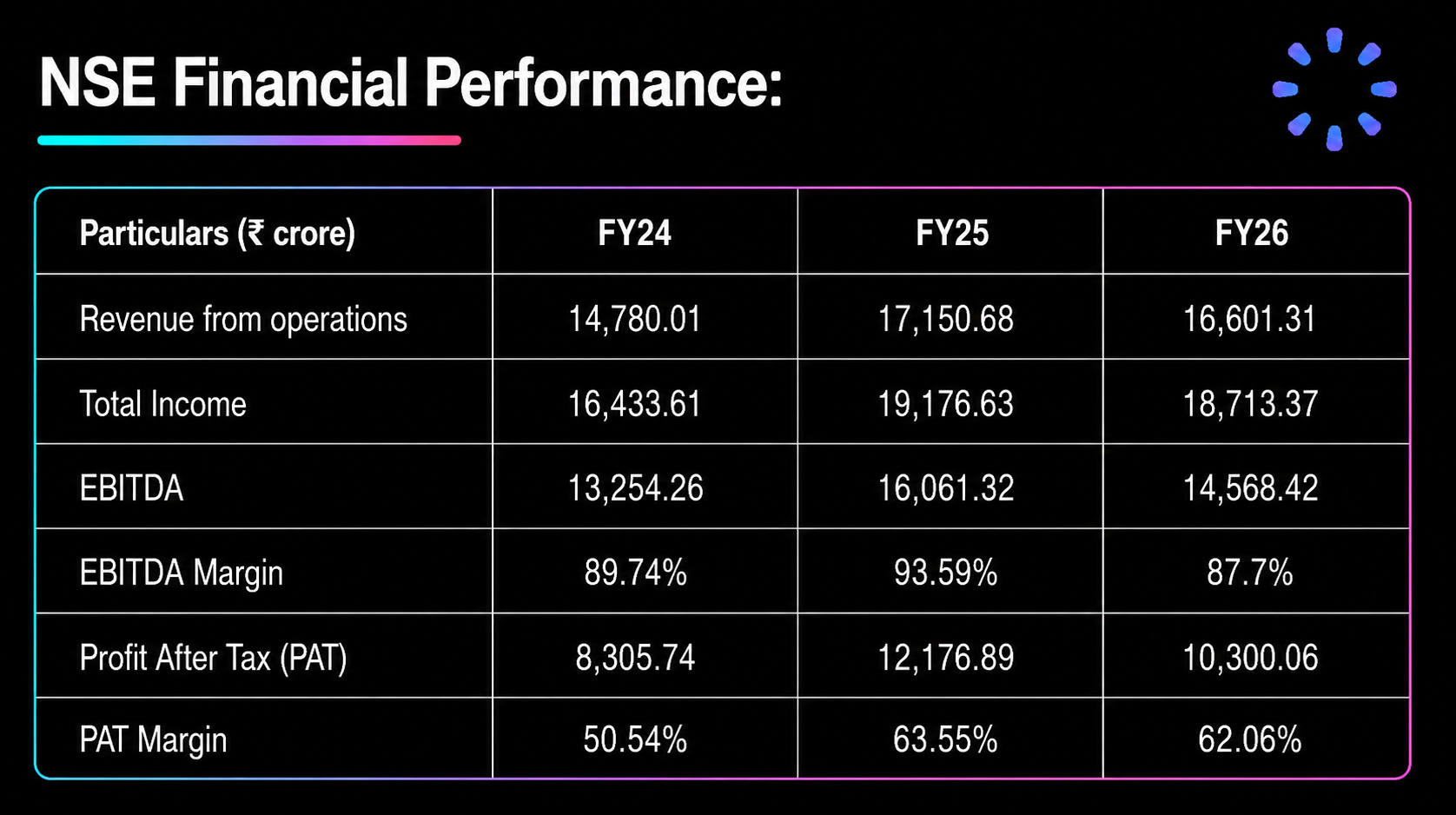
These numbers indicate several strengths:
High Profitability
An ROE of nearly 33% reflects efficient utilisation of shareholder capital, placing NSE among the stronger financial institutions in India.
Debt-Light Balance Sheet
Unlike capital-intensive businesses, stock exchanges require limited incremental capital expenditure. This allows higher cash generation and lower financial risk.
Strong Cash Generation
Exchange businesses generally benefit from recurring transaction-based income while requiring relatively low operating costs compared to traditional financial institutions.
These characteristics contribute to healthy operating margins and strong earnings visibility.
NSE Unlisted Share Price
Investor interest in NSE has increased considerably following the DRHP filing.
The latest indicative price of NSE unlisted shares is approximately ₹2,050 - ₹2100 per share, with the stock trading within a 52-week range of ₹1,867–₹2,269.
Since NSE remains an unlisted company until the IPO is completed, prices in the unlisted market are influenced by:
Demand from investors
Liquidity in the unlisted market
IPO-related developments
Company performance
Market sentiment
As the IPO process advances, investors are expected to closely monitor pricing trends.
Why the IPO Matters Beyond NSE
The proposed listing is not just important for the company—it is also significant for India's capital markets.
Over the last few years, India has witnessed:
Record demat account additions
Rising SIP inflows
Higher retail participation
Strong IPO activity
Growing institutional investments
As participation in financial markets expands, exchanges become direct beneficiaries through increased trading activity and higher transaction volumes.
The listing of NSE could therefore provide investors exposure to the underlying growth of India's financial markets rather than to a single operating business.
What Investors Should Watch Next
Although the DRHP filing is a major milestone, several important developments remain before the IPO reaches investors.
Key events to watch include:
SEBI observations on the DRHP
Announcement of the IPO dates
Price band disclosure
Offer size and shareholder participation
Institutional roadshows
Final valuation
Each of these milestones will provide greater clarity on the eventual public offering.
Why Investors Are Closely Watching NSE
Very few businesses enjoy the kind of competitive position that NSE has built over the past three decades.
Today, the exchange sits at the centre of India's financial ecosystem, connecting millions of investors, brokers, institutions and listed companies. Every increase in market participation, trading activity or new listings strengthens the exchange's business.
Unlike companies that depend on launching new products every year, stock exchanges benefit from a structural advantage: as financial markets expand, exchanges often grow alongside them.
This is one of the reasons investors have been eagerly awaiting the NSE IPO.
Understanding NSE's Valuation
One of the biggest discussions surrounding the upcoming IPO is valuation.
Based on the latest unlisted market transactions, NSE commands an implied market capitalisation of over ₹5 lakh crore, making it one of India's most valuable private companies.
Several factors contribute to this premium valuation:
1. Market Leadership
NSE commands a dominant share in India's equity derivatives market and remains the preferred platform for equity trading. High liquidity attracts more market participants, creating a strong network effect that is difficult for competitors to replicate.
2. High Return Ratios
The exchange consistently generates healthy returns on equity while maintaining minimal debt. Such financial characteristics are often rewarded with premium valuations.
3. Asset-Light Business Model
Unlike manufacturing or infrastructure businesses, exchanges require relatively limited capital expenditure. Once technology infrastructure is established, additional trading volumes can be handled with comparatively lower incremental costs, supporting operating leverage.
4. Predictable Cash Flows
Transaction fees, listing charges, clearing services and market data subscriptions provide recurring sources of revenue. This makes earnings relatively resilient compared with many cyclical businesses.
India's Capital Markets Continue to Expand
One of the strongest investment arguments for NSE is not just the company itself—but the market it operates in.
India's capital markets have undergone a dramatic transformation over the past decade.
Several trends continue to support long-term growth:
Rising Retail Participation
The number of demat accounts has grown rapidly as more individuals invest directly in equities and mutual funds. Improved financial awareness, digital investing platforms and increasing disposable incomes have broadened the investor base.
Record SIP Investments
Monthly systematic investment plan (SIP) contributions have consistently reached new highs, reflecting growing household participation in financial assets rather than traditional savings avenues.
Strong IPO Pipeline
India continues to witness healthy IPO activity across sectors including financial services, manufacturing, technology and consumer businesses. Every new listing expands opportunities for exchanges through listing fees, trading volumes and post-listing activity.
Growing Institutional Participation
Domestic mutual funds, insurance companies, pension funds and foreign institutional investors continue to deepen liquidity across Indian markets, creating additional trading activity.
Together, these structural trends create a favourable backdrop for exchange businesses over the long term.
What Makes Exchange Businesses Attractive?
Exchange businesses possess several characteristics that investors often associate with high-quality companies.
Network Effects
Liquidity attracts liquidity. As more investors and institutions trade on a particular exchange, it becomes increasingly attractive for new participants to join.
Scalability
Technology-driven operations allow exchanges to handle significantly higher transaction volumes without proportionate increases in operating costs.
Strong Cash Generation
Exchange businesses generally generate healthy operating cash flows due to recurring fee-based income and relatively modest capital expenditure requirements.
Diversified Revenue Sources
NSE earns income from multiple segments, including:
Cash market trading
Equity derivatives
Currency derivatives
Clearing and settlement
Listing services
Market data products
Technology services
Diversification reduces dependence on any single business segment.
Key Growth Drivers for NSE After Listing
Although NSE already enjoys market leadership, several opportunities could support future growth.
Continued Financialisation of Savings
Indian households are gradually allocating a greater proportion of savings toward financial assets such as equities and mutual funds. This long-term shift increases trading activity and supports exchange revenues.
Expansion of India's Equity Markets
As more private companies choose to raise capital through public markets, exchanges benefit from higher listing activity and increased investor participation.
Technology-Led Innovation
NSE continues to invest in trading infrastructure, risk management systems and digital capabilities to enhance market efficiency and support future growth.
New Products and Market Segments
Over time, exchanges can introduce new products, indices and services that diversify revenue streams and improve profitability.
Risks Investors Should Consider
Despite its strong position, no investment is free from risk.
Before evaluating the NSE IPO, investors should keep the following factors in mind.
Regulatory Oversight
As a market infrastructure institution, NSE operates under extensive regulatory supervision. Changes in regulations relating to trading, clearing, market structure or compliance requirements may influence business operations.
Dependence on Market Activity
Although diversified, exchange revenues remain linked to market participation. Extended periods of weak trading activity could affect transaction-based income.
Increasing Competition
While NSE maintains leadership in several segments, competition from other exchanges and evolving financial market structures could influence market share over time.
Technology and Cybersecurity
Given the critical role exchanges play in financial markets, maintaining uninterrupted operations and protecting against cyber threats remain essential priorities.
What Comes Next in the IPO Journey?
Filing the DRHP is a significant milestone, but several important steps remain before NSE becomes a listed company.
Investors should watch for:
SEBI's observations on the DRHP
Final approval for the public issue
Announcement of the IPO dates
Price band and valuation details
Offer size and shareholder participation
Institutional investor demand during roadshows
These developments will provide greater clarity on the eventual listing process.
Why Jefferies Remains Positive
Global brokerage Jefferies believes NSE stands out among exchange operators due to its combination of scale, profitability and long-term growth opportunities.
According to the brokerage, the exchange benefits from:
Leadership across multiple trading segments
Strong operating margins
High return ratios
Diversified revenue streams
Structural growth in India's capital markets
Robust cash generation
Its report suggests that India's growing participation in financial markets could continue supporting exchange businesses for many years.
Final Thoughts
The NSE IPO is more than just another public offering—it represents the potential listing of India's largest stock exchange and one of the country's most strategically important financial institutions.
The company's dominant market position, scalable business model, strong financial performance and favourable long-term industry trends explain why it continues to attract attention from both domestic and global investors.
At the same time, investors should remember that the IPO process is still underway. Regulatory approvals, valuation, issue details and broader market conditions will all play an important role in shaping the final investment opportunity.
For those tracking India's pre-IPO market, NSE remains one of the most closely watched companies. As more details emerge in the coming months, its journey toward listing is likely to remain a key theme in India's capital markets.
Looking to track NSE before its IPO? Stay updated with the latest NSE unlisted share price, financials, corporate developments and IPO news on Precize as the company progresses toward its public listing.
To compare companies, documents, and availability explore unlisted companies on Precize. For ongoing IPO and private-market updates, browse the Precize blog. Stay updated with unlisted companies through our Precize Community. If this article was useful, you can share it with other investors through the Precize Referral Program.
Frequently Asked Questions (FAQs)
1. Has NSE filed its DRHP?
Yes. NSE has filed its DRHP with SEBI, marking a key milestone in its IPO journey.
2. When is the NSE IPO expected?
The IPO date has not been announced yet. It will be finalized after SEBI's review and regulatory approvals.
3. Why is the NSE IPO important?
The listing will provide investors an opportunity to invest in India's largest stock exchange and complete the listed exchange ecosystem alongside BSE and MCX.
4. Can investors buy NSE shares before the IPO?
Yes. Investors can buy NSE unlisted shares through platforms dealing in the pre-IPO market, subject to availability.
5. Why is Jefferies positive on NSE?
Jefferies highlights NSE's market leadership, strong profitability, diversified revenue streams, and long-term growth potential as key reasons for its positive outlook.
Disclaimer: This article is for informational purposes only and should not be considered as investment advice. Investing in unlisted shares carries risks including illiquidity and potential loss of capital. Please consult with a qualified financial advisor before making investment decisions. Precize is not a stock exchange and is not authorized by any capital markets regulator.