About SBI Funds Management
Founded in 1987, SBI Funds Management is among the oldest mutual fund companies in India and has grown into the country's largest asset manager.
The company operates through a diversified product portfolio that includes:
Its biggest competitive advantage lies in its distribution reach. Leveraging SBI's vast banking network, the AMC has access to thousands of branches across India, helping it penetrate both metropolitan and smaller cities.
This extensive distribution has enabled SBI Funds Management to consistently attract new investors and grow its assets faster than many peers.
Financial Performance Remains Strong
SBI Funds Management has continued to deliver healthy financial growth while maintaining industry-leading profitability.
For FY26, the company reported:
Revenue from operations: ₹4,389.49 crore (up 22.0% YoY)
Profit After Tax: ₹3,067.38 crore (up 20.8% YoY)
EBITDA Margin: Above 81%
Return on Net Worth (RoNW): Over 43%
The company's business model requires relatively little capital expenditure. Instead of investing heavily in physical assets, its earnings are driven by management fees collected on assets under management.
This asset-light structure allows SBI Funds Management to convert a large portion of its revenue into profits, resulting in one of the highest profitability profiles in the Indian financial services sector.
Another positive indicator is the consistency of earnings. As mutual fund assets continue to grow through both market appreciation and fresh inflows, AMCs benefit from recurring fee income, making the business highly scalable.
India's Mutual Fund Story is Still in Its Early Stages
One of the biggest reasons investors are optimistic about SBI Funds Management is the long-term growth potential of India's asset management industry.
Despite rapid growth over the past decade, mutual fund penetration in India remains significantly lower than in many developed economies.
Several structural trends continue to support future growth:
Rising financial awareness among retail investors
Increasing SIP (Systematic Investment Plan) participation
Shift from physical assets like gold and real estate towards financial assets
Higher disposable incomes
Digital investing platforms expanding market reach
As India's household savings continue shifting toward market-linked investments, leading AMCs like SBI Funds Management stand to benefit the most.
Why SBI Funds Management Stands Out
SBI Funds Management isn't just India's largest asset management company by assets under management—it also has several structural advantages that strengthen its competitive position.
1. Market Leader in the AMC Industry
With over ₹12.5 lakh crore in Quarterly Average Assets Under Management (QAAUM), SBI Funds Management holds the largest share of India's mutual fund industry.
Its scale provides several benefits, including better operating leverage, stronger brand recall, and the ability to launch new products across different investor segments.
2. Backed by Two Global Financial Giants
The company is jointly promoted by:
While SBI contributes its extensive customer base and nationwide distribution network, Amundi brings global expertise in investment management, research, risk management, and product innovation.
This combination gives SBI Funds Management a significant competitive edge over many peers.
3. Extensive Distribution Network
Distribution remains one of the biggest growth drivers for any mutual fund company.
SBI Funds Management benefits from SBI's presence across thousands of branches throughout India, enabling it to reach investors in both urban and rural markets.
In addition to traditional banking channels, the company has strengthened its digital distribution through online investment platforms, fintech partnerships, and direct investment channels.
This diversified distribution model reduces dependence on any single sales channel.
4. Highly Profitable Business Model
Asset management companies operate with relatively low capital requirements.
Once assets under management increase, revenue grows without a proportional increase in operating costs, resulting in strong operating leverage.
SBI Funds Management has consistently maintained:
These characteristics make the business attractive from a long-term investment perspective.
Valuation: Is the IPO Fairly Priced?
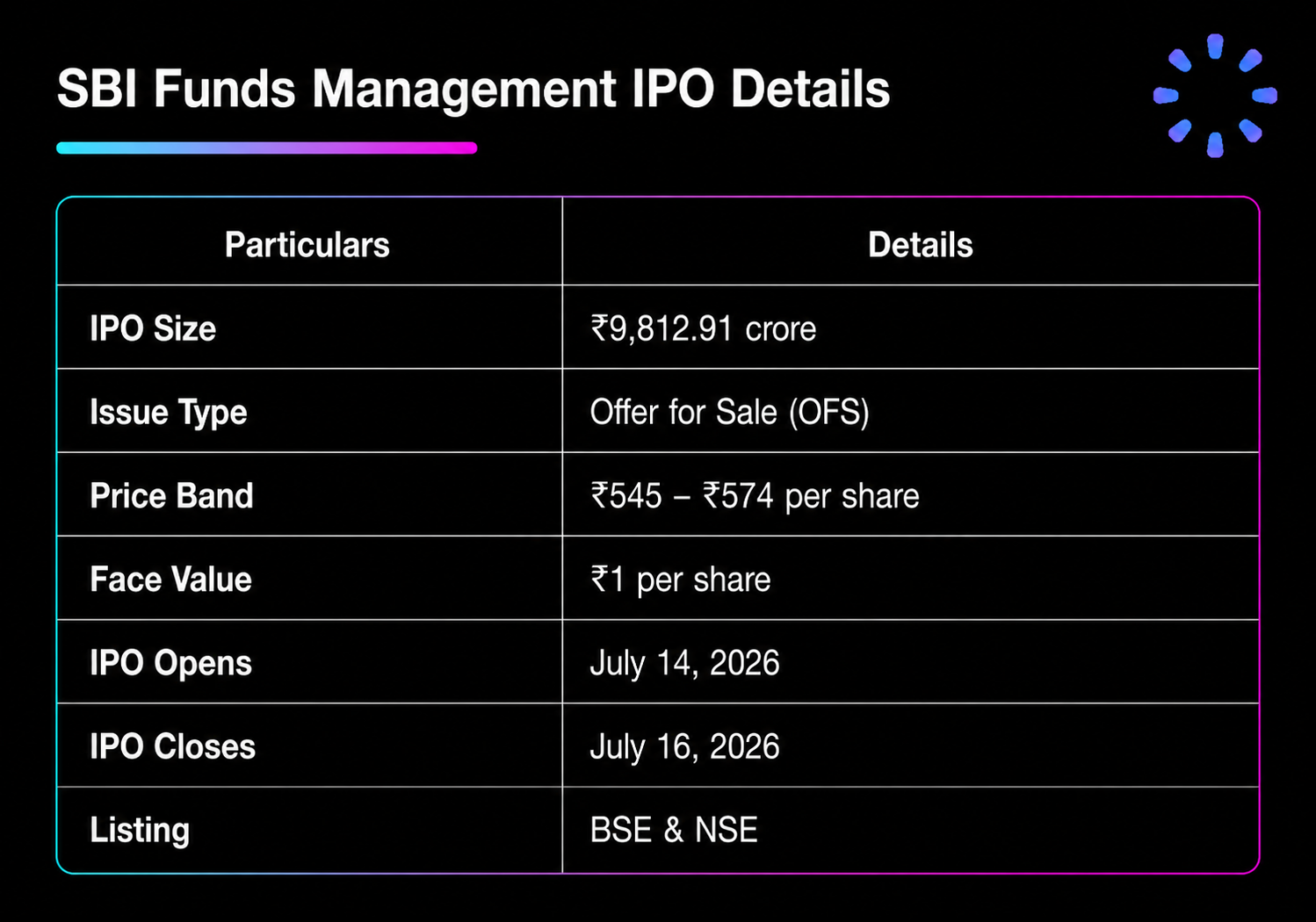
At the upper price band of ₹574 per share, SBI Funds Management is valued at approximately 38.1x FY26 earnings.
According to brokerage reports, this valuation is slightly below the average valuation of listed asset management companies, which currently trade around 41.6x earnings.
Given the company's:
many analysts believe the valuation appears reasonable rather than expensive.
However, because the company is already being valued at a premium compared to many financial services businesses, expectations for future growth are also high.
Grey Market Premium (GMP)
Ahead of listing, SBI Funds Management has been commanding a Grey Market Premium (GMP) of around ₹90–₹93 per share.
Based on the upper price band, this suggests an estimated listing premium of nearly 16%.
A healthy GMP generally indicates positive investor sentiment before listing. However, investors should remember that grey market prices are unofficial, unregulated, and can change significantly depending on market conditions.
Therefore, GMP should be viewed only as an indicator of sentiment rather than a guarantee of listing performance.
Strong Institutional Interest
Investor confidence was visible even before the IPO opened.
The company raised ₹2,663 crore from 129 anchor investors, with participation from several leading global institutions.
Some of the notable investors include:
A strong anchor book often reflects institutional confidence in the company's long-term business prospects, although it should not be considered the sole investment criterion.
Key Risks Investors Should Consider
While SBI Funds Management has several strengths, investors should also evaluate the associated risks.
Dependence on Equity Markets
The company's earnings are closely linked to assets under management. A prolonged correction in equity markets can reduce AUM, impacting fee income and profitability.
Increasing Industry Competition
India's mutual fund industry has become increasingly competitive, with both established players and new entrants launching innovative investment products and digital offerings.
Sustaining market share will require continuous product innovation and strong customer engagement.
Regulatory Changes
The asset management industry is regulated by SEBI. Any future changes in expense ratio limits, commission structures, or compliance requirements could impact profitability.
Market Sentiment
Although mutual fund penetration is growing, investor inflows remain influenced by market conditions. Weak market sentiment could temporarily slow SIP inflows and new investments.
Final Thoughts
SBI Funds Management represents one of the strongest businesses entering the public markets in recent years.
Its leadership in India's rapidly expanding mutual fund industry, combined with a highly profitable asset-light business model and the backing of SBI and Amundi, provides a solid foundation for long-term growth.
As financialization of household savings continues and mutual fund participation increases across the country, leading asset managers are expected to remain key beneficiaries of this structural trend.
While short-term listing gains may depend on market sentiment, the company's strong fundamentals, consistent profitability, and industry leadership make it an IPO worth tracking for investors with a long-term perspective.
To compare companies, documents, and availability explore unlisted companies on Precize. For ongoing IPO and private-market updates, browse the Precize blog. Stay updated with unlisted companies through our Precize Community. If this article was useful, you can share it with other investors through the Precize Referral Program.
FAQs
1. Is SBI Funds Management India's largest asset management company?
Yes. Based on Quarterly Average Assets Under Management (QAAUM), SBI Funds Management is the largest mutual fund company in India.
2. Is the IPO a fresh issue or an Offer for Sale?
The IPO is entirely an Offer for Sale (OFS), meaning the proceeds will go to existing shareholders rather than the company.
3. What is the Grey Market Premium (GMP)?
On the opening day, the IPO was trading at a GMP of around ₹90–₹93, implying an estimated listing premium of approximately 16%.
4. What are the biggest strengths of SBI Funds Management?
Its key strengths include market leadership, a trusted SBI brand, extensive distribution, high profitability, and a scalable asset-light business model.
Disclaimer: This article is for informational purposes only and should not be considered as investment advice. Investing in unlisted shares carries risks including illiquidity and potential loss of capital. Please consult with a qualified financial advisor before making investment decisions. Precize is not a stock exchange and is not authorized by any capital markets regulator.