Revenue Crosses ₹600 Crore: What's Driving Growth?
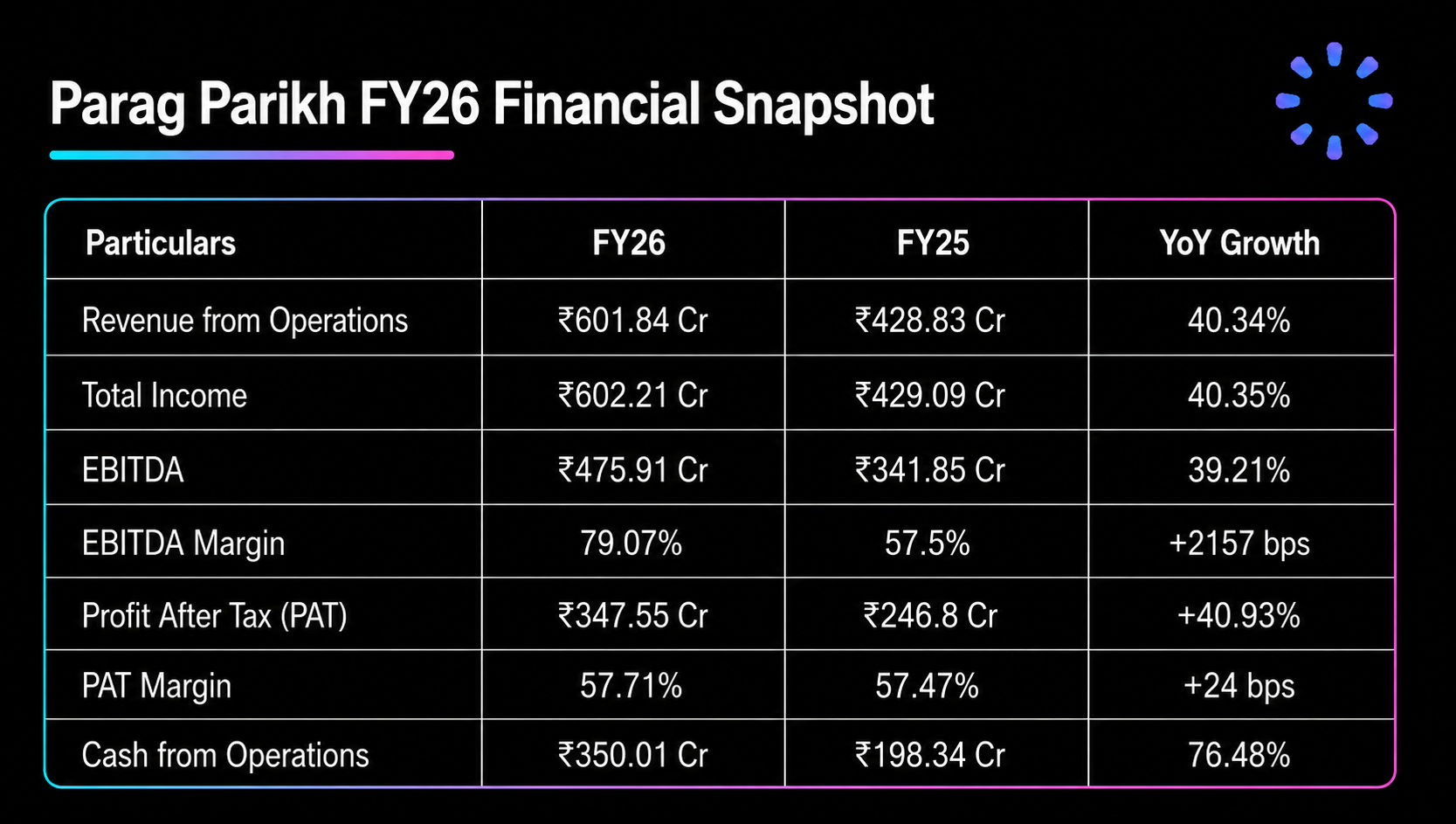
Parag Parikh reported ₹601.84 crore in revenue from operations during FY26, compared with ₹428.83 crore in FY25.
For an asset management company, revenue primarily depends on average assets under management (AUM) and management fee income. During FY26, several favourable factors supported revenue growth:
Rising assets under management across equity-oriented mutual fund schemes.
Continued growth in SIP inflows as retail participation increased.
Higher management fee income resulting from expanding investor assets.
Strong brand recognition supported by the company's disciplined long-term investment philosophy.
India's mutual fund industry continues to benefit from increasing financial awareness, digital onboarding, and the shift of household savings towards financial assets. As one of the country's well-recognized active fund managers, PPFAS continues to benefit from these long-term structural trends.
Profit After Tax Grows Over 40%
PPFAS reported ₹347.55 crore in profit after tax, representing a 40.94% year-on-year increase over FY25.
The company's profitability remained strong as higher revenue translated into earnings without a proportionate increase in operating costs. This operating leverage is one of the biggest strengths of the asset management business model.
Unlike capital-intensive industries, asset management companies require relatively low capital expenditure. As assets under management increase, incremental revenue contributes significantly to profitability, allowing margins to remain consistently high.
Use the Precize screener to compare financial profiles across unlisted companies in adjacent sectors, from fintech to consumer brands, using the same margin-and-cash-flow lens.
Operating Margins Continue to Lead the Industry
PPFAS reported an EBITDA margin of 79.07% during FY26, compared with 79.67% in FY25.
Although margins moderated marginally, they remain among the highest in India's financial services industry. The company's ability to consistently generate EBITDA margins near 80% reflects disciplined cost management, efficient operations, and the scalability of its business model.
Its PAT margin also improved slightly to 57.71%, demonstrating that strong profitability continues even as the business expands.
Cash Flow, Balance Sheet, and the ₹25 Dividend
Healthy Operating Cash Flow
The company generated ₹350.01 crore in cash from operating activities during FY26, compared with ₹198.34 crore in FY25.
Strong operating cash flow indicates that reported earnings are backed by healthy cash generation rather than accounting adjustments. This provides financial flexibility to invest in technology, expand operations, and continue rewarding shareholders.
Balance Sheet Snapshot (March 31, 2026)
PPFAS continues to maintain a financially strong and low-leverage balance sheet.
Total Assets: ₹1,072.12 crore
Total Equity: ₹1,009.68 crore
Total Liabilities: ₹62.43 crore
Current Assets: ₹1,002.63 crore
A strong equity base and limited liabilities provide resilience during periods of market volatility while supporting future business expansion.
Dividend Announcement
The Board of Directors has recommended a final dividend of ₹25 per equity share (face value ₹10) for FY26, subject to shareholder approval.
The proposed dividend reflects management's confidence in the company's cash generation capabilities and its continued focus on creating long-term shareholder value.
Dividend yield on unlisted shares depends on your entry price, which is negotiated in the pre-IPO / unlisted market rather than displayed on an exchange ticker. That makes entry valuation as important as FY26 growth rates. Read our FAQs on unlisted shares for how pricing, settlement, and demat transfer typically work.
What Is PPFAS, and Why Do Unlisted Investors Care?
Parag Parikh Financial Advisory Services (PPFAS) is the holding company behind Parag Parikh Mutual Fund. Most retail investors interact with the fund house through schemes such as Parag Parikh Flexi Cap Fund. A smaller set of investors seek exposure to the company itself through unlisted equity.
That distinction matters:
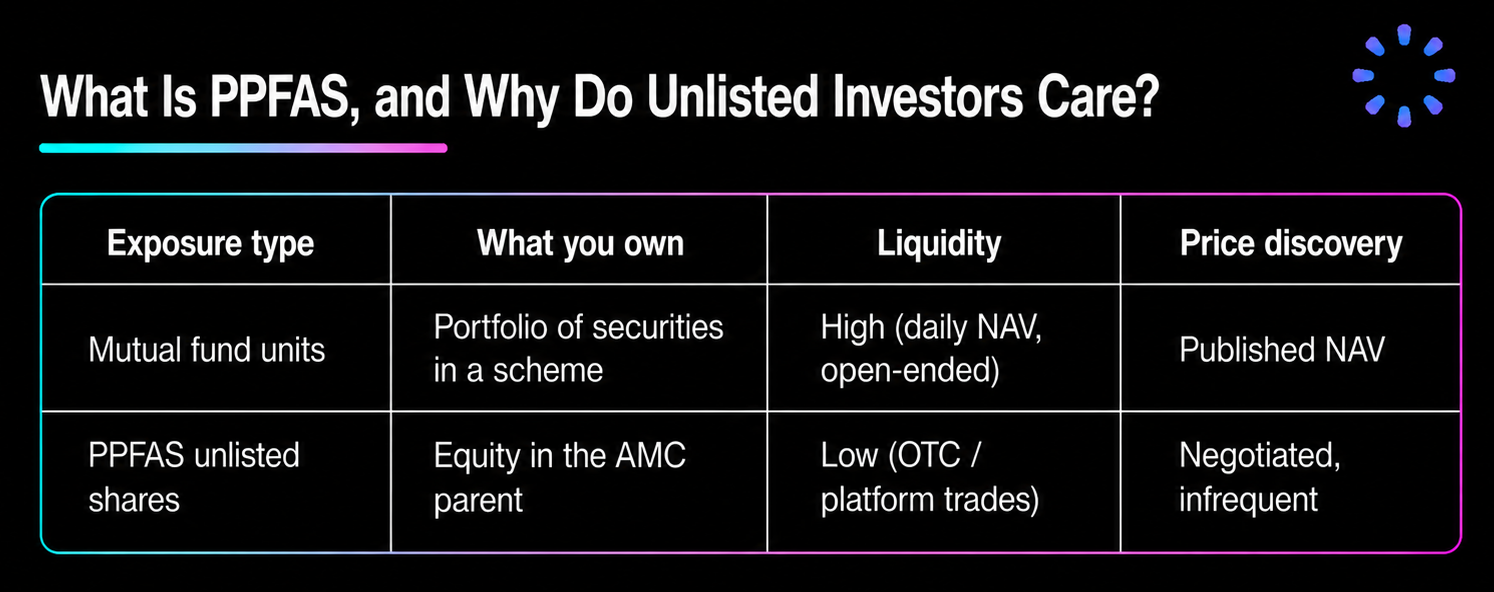
Unlisted PPFAS shares appeal to investors who want direct ownership in the AMC business model rather than fund-level returns alone. The trade-off is familiar in private markets: potentially attractive long-term economics, but illiquidity, limited public disclosure cadence, and price opacity relative to listed peers.
FY26 results give unlisted investors fresh fundamentals to underwrite: Margins, Cash, and Capital return policy.
Industry Context: Why AMCs Are Winning the SIP Era
PPFAS did not grow in isolation. India's asset management industry has been supported by structural trends that extend beyond any single fund house:
Rising retail participation through systematic investment plans (SIPs).
Financial awareness spreading via digital onboarding and direct plans.
Shift from physical savings (real estate, gold) toward financial assets.
Long equity bull phases that expand AUM bases (with cyclical risk attached).
SEBI's mutual fund regulations govern expense ratios, disclosures, and distributor commissions. Regulatory stability has helped the industry scale, though rule changes can alter economics overnight. Active managers like PPFAS compete not only with other active houses but also with passive index funds pushing fee rates lower across the market.
How to Read Parag Parikh FY26 Results as an Unlisted Investor
Before you react to headline growth rates, run FY26 numbers through a simple four-point checklist:
Revenue vs AUM growth: Fee income should broadly track average AUM. If revenue outpaces industry AUM trends, the fund house may be gaining share or benefiting from mix shift toward higher-fee equity schemes.
Margin trajectory: Expanding EBITDA and net margins suggest operating leverage is intact. Flat or falling margins despite AUM growth can signal rising compliance, technology, or distribution costs.
Cash conversion: Compare PAT to operating cash flow. Large gaps can flag working-capital swings or one-off items worth investigating in full statements.
Capital return policy: Dividend size relative to earnings and cash reserves tells you how management balances shareholder payouts with reinvestment.
FY26 scores well on all four points: Revenue and PAT growth, Margin expansion, ₹350 crore operating cash flow, and a ₹25/share dividend recommendation. That does not eliminate market or regulatory risk, but it confirms the underlying AMC economics remain healthy.
Risks Unlisted Investors Should Weigh
Strong FY26 numbers do not eliminate structural risks. If you are evaluating Parag Parikh unlisted shares, balance the growth story against these headwinds:
Market dependency: AMC revenue ties to AUM, and equity-heavy AUM falls when markets correct. A prolonged bear phase can slow both inflows and fee income.
Competition: Passive funds, direct plans, and digital-first AMCs compete on cost and convenience. Market share is never guaranteed, even for respected brands.
Regulatory change: SEBI periodically revisits expense ratios, commission structures, and disclosure norms. A rule change that compresses fees would flow straight to margins.
Liquidity and valuation: Unlisted shares can be hard to exit quickly. Without daily market pricing, you need a clear view of fair value before you buy; FY26 profits are one input, not the whole model.
Concentration: Fund-house fortunes often rest on a handful of flagship schemes. Performance slippage in key strategies can affect flows disproportionately.
Precize publishes research to help investors weigh opportunities and risks together, not hype alone. If you want help evaluating a specific unlisted name, Precize Care can walk through process and documentation questions.
FY26 Parag Parikh Results: Outlook for Investors
India's AMC sector still sits in a long runway story: under-penetrated relative to developed markets, rising SIP books, and growing financial literacy. PPFAS enters that backdrop with strong brand equity, a disciplined investment identity, and FY26 financials that demonstrate scale.
Near-term earnings will still move with market cycles. Longer term, the Parag Parikh FY26 results show 35%+ revenue growth, expanding margins, ₹350 crore operating cash flow, and a ₹25 dividend recommendation, painting a company executing well within a favourable industry structure.
For investors already in mutual funds, FY26 results are a reminder that the fund house itself can be a separate investment thesis from the funds it manages. For those exploring that path, start with verified financials, understand illiquidity, and compare entry price against normalized earnings power.
Explore unlisted opportunities on Precize and use our research tools before you commit capital. Stay updated with unlisted companies through our Precize Community. If this article was useful, you can share it with other investors through the Precize Referral Program.
Frequently Asked Questions
1. What were Parag Parikh's FY26 revenue and profit?
Parag Parikh Financial Advisory Services reported ₹601.84 crore in revenue from operations and ₹347.55 crore in profit after tax for FY26. Revenue grew 40.34% and PAT grew 40.35% compared with FY25.
2. How much dividend did Parag Parikh announce for FY26?
The board recommended a final dividend of ₹25 per equity share (face value ₹10) for FY26. The payout is subject to approval at the annual general meeting.
3. Is Parag Parikh Financial Advisory Services a listed company?
No. PPFAS is unlisted. It is the parent company of Parag Parikh Mutual Fund. Investors can buy mutual fund schemes through standard channels; ownership in the company itself is available only through unlisted / pre-IPO equity markets.
4. What drove Parag Parikh's strong FY26 performance?
Higher assets under management, sustained mutual fund inflows (including SIPs), operating leverage in a low-capex AMC model, and disciplined cost management were the primary drivers. Industry-wide retail participation in mutual funds also provided a tailwind.
Disclaimer: This article is for informational purposes only and should not be considered investment advice. Investing in unlisted shares carries risks including illiquidity, limited disclosures, and potential loss of capital. Please consult a qualified financial advisor before making investment decisions. Precize is not a stock exchange and is not authorized by any capital markets regulator.