About SBI Funds Management
SBI Funds Management is India's largest asset management company (AMC) by assets under management (AUM). The company is jointly promoted by State Bank of India, India's largest public sector bank, and Amundi, one of Europe's leading asset managers.
The company manages investments across:
Equity mutual funds
Debt funds
Hybrid funds
Exchange Traded Funds (ETFs)
Index funds
Passive investment products
Portfolio management services
With an AUM exceeding ₹12.5 lakh crore, SBI Funds Management serves millions of investors through one of the country's widest distribution networks, including SBI's extensive branch network, independent financial advisors, banks, and digital investment platforms.
Its strong brand recall and nationwide presence have enabled it to consistently maintain leadership in India's fast-growing asset management industry.
Why This IPO Matters
The listing of SBI Funds Management is significant for multiple reasons.
India's Largest AMC Goes Public
Very few large, profitable asset management companies are available for public investors in India. SBI Funds Management's listing offers investors an opportunity to participate in the country's expanding wealth management ecosystem.
Financialization of Savings
Indian households are steadily shifting from traditional savings instruments such as fixed deposits and gold towards equity investments through mutual funds.
Monthly SIP contributions continue to remain near record highs, while the number of mutual fund folios has grown significantly over the last few years. This structural shift creates a long runway for asset management companies.
Asset-Light Business Model
Unlike banks or NBFCs, asset management companies generally require limited capital to scale operations.
Their revenues primarily depend on assets under management rather than lending activity, making the business highly cash generative with relatively lower balance sheet risk.
Strong Parentage
The SBI brand continues to be one of the biggest competitive advantages for the company.
Its access to SBI's massive customer base provides a significant distribution edge that is difficult for competitors to replicate.
Financial Performance Remains Robust
Over the years, SBI Funds Management has consistently delivered healthy profitability, supported by growing assets under management and strong operating leverage.
Some key strengths include:
Consistent growth in AUM
High operating margins
Strong return ratios
Debt-free balance sheet
Healthy cash generation
As India's mutual fund industry expands, a significant portion of incremental AUM is expected to benefit large, established players like SBI Funds Management.
Growth Drivers Going Forward
Several long-term trends support the company's future growth prospects.
Rising Retail Participation
India recently crossed 20 crore demat accounts, while monthly SIP registrations continue to increase.
This expanding retail investor base creates a favorable environment for mutual fund companies.
Increasing Mutual Fund Penetration
Despite rapid growth, India's mutual fund penetration remains relatively low compared to developed markets.
As financial awareness improves and disposable incomes rise, assets managed by AMCs are expected to grow steadily over the coming decade.
Expansion of Passive Investing
Index funds and ETFs continue to gain popularity among investors due to lower costs and increasing awareness.
SBI Funds Management already has a strong presence across passive investment products, positioning it well to benefit from this trend.
Digital Distribution
The rise of online investment platforms has made mutual fund investing easier than ever before.
Along with SBI's physical distribution network, digital channels provide an additional avenue for customer acquisition and AUM growth.
Risks Investors Should Consider
While the company enjoys a leadership position, investors should also keep certain risks in mind.
Market Volatility
Asset management companies earn management fees based on assets under management.
A sharp correction in equity markets can reduce AUM and consequently impact revenue.
Increasing Competition
The mutual fund industry continues to attract new players, including domestic institutions, global asset managers, fintech platforms, and passive investment providers.
Competitive pressure could affect future market share and pricing.
Regulatory Changes
The asset management industry operates under SEBI regulations.
Changes in expense ratio limits, distribution commissions, or compliance requirements may affect profitability.
Investor Interest Remains Strong
The IPO has already generated considerable attention from institutional investors and market participants.
Market observers have also been tracking the grey market premium (GMP), which reflects prevailing investor sentiment ahead of listing. While GMP should never be considered a reliable predictor of listing gains, it often indicates the level of market enthusiasm surrounding an IPO.
Eligible shareholders of State Bank of India will also benefit from a dedicated shareholder reservation category in the public issue.
What This Means for Existing Unlisted Shareholders
For investors who accumulated SBI Funds Management shares in the unlisted market before the IPO announcement, the pricing marks an important milestone.
Once listed, the shares will become freely tradable on the stock exchanges after applicable regulatory procedures.
The IPO also represents the transition of one of India's largest unlisted financial services companies into the public markets, potentially improving liquidity and price discovery for shareholders.
Final Thoughts
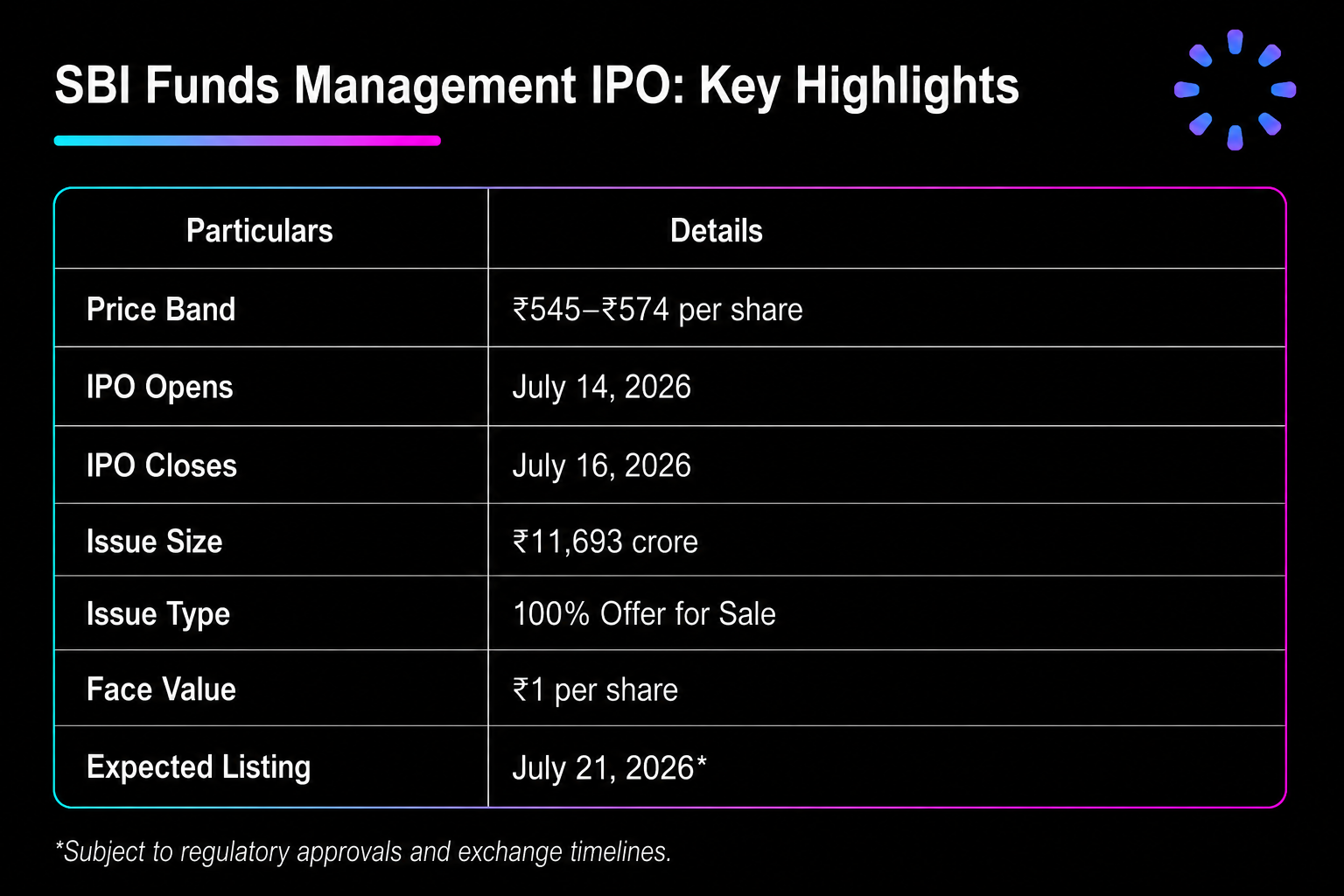
The announcement of the ₹545–₹574 price band officially kickstarts one of India's most anticipated IPOs of 2026.
Backed by India's largest bank, a leadership position in the mutual fund industry, an asset-light business model, and long-term structural growth drivers, SBI Funds Management enters the public markets with strong fundamentals.
That said, investors should look beyond the excitement surrounding the IPO. Evaluating the company's valuation, competitive positioning, financial performance, and long-term growth prospects remains essential before making any investment decision.
As India's wealth management industry continues to evolve, the listing of SBI Funds Management is likely to become one of the defining IPOs of the year and an important milestone for the country's capital markets.
To compare companies, documents, and availability explore unlisted companies on Precize. For ongoing IPO and private-market updates, browse the Precize blog. Stay updated with unlisted companies through our Precize Community. If this article was useful, you can share it with other investors through the Precize Referral Program.
Frequently Asked Questions (FAQs)
1. What is the price band of the SBI Funds Management IPO?
The SBI Funds Management IPO has a price band of ₹545–₹574 per share. Investors can place bids within this range during the IPO subscription period.
2. When will the SBI Funds Management IPO open and close?
The IPO will open for subscription on July 14, 2026, and close on July 16, 2026. The shares are expected to be listed on the stock exchanges shortly after the allotment process is completed.
3. What is the size of the SBI Funds Management IPO?
The IPO size is ₹11,693 crore, making it one of the largest public issues in India in 2026. The issue is entirely an Offer for Sale (OFS) by existing shareholders.
4. Is the SBI Funds Management IPO a fresh issue?
No. The IPO is 100% an Offer for Sale (OFS), which means the company will not receive any proceeds from the issue. The funds raised will go to the existing shareholders selling their stake.
5. Who are the promoters of SBI Funds Management?
SBI Funds Management is jointly promoted by State Bank of India (SBI) and Amundi Asset Management, one of Europe's leading asset managers.
Disclaimer: This article is for informational purposes only and should not be considered as investment advice. Investing in unlisted shares carries risks including illiquidity and potential loss of capital. Please consult with a qualified financial advisor before making investment decisions. Precize is not a stock exchange and is not authorized by any capital markets regulator.