
Investing in unlisted shares gives investors an opportunity to own a company before it becomes publicly traded. With India's growing pre-IPO market, more investors are exploring unlisted companies that may eventually launch an Initial Public Offering (IPO).
However, one question remains common among investors:
What happens to your unlisted shares once the company gets listed?
Do your shares automatically become listed? Can you sell them on listing day? Is there a mandatory lock-in period? How are they taxed?
What Are Unlisted Shares?
Unlisted shares are equity shares of companies that are not listed on stock exchanges like NSE or BSE. These companies may be high-growth startups, established private businesses, or firms preparing for an IPO.
Many investors buy unlisted shares with the expectation that the company's valuation may increase as it approaches a public listing.
At Precize, investors can discover curated pre-IPO opportunities, access detailed research reports, and invest digitally in eligible unlisted companies.
What Happens When a Company Announces Its IPO?
Even after a company files its Draft Red Herring Prospectus (DRHP), your investment does not change immediately.
Your holdings continue to remain unlisted shares until the company officially lists on the stock exchange.
Here's how the journey typically works:
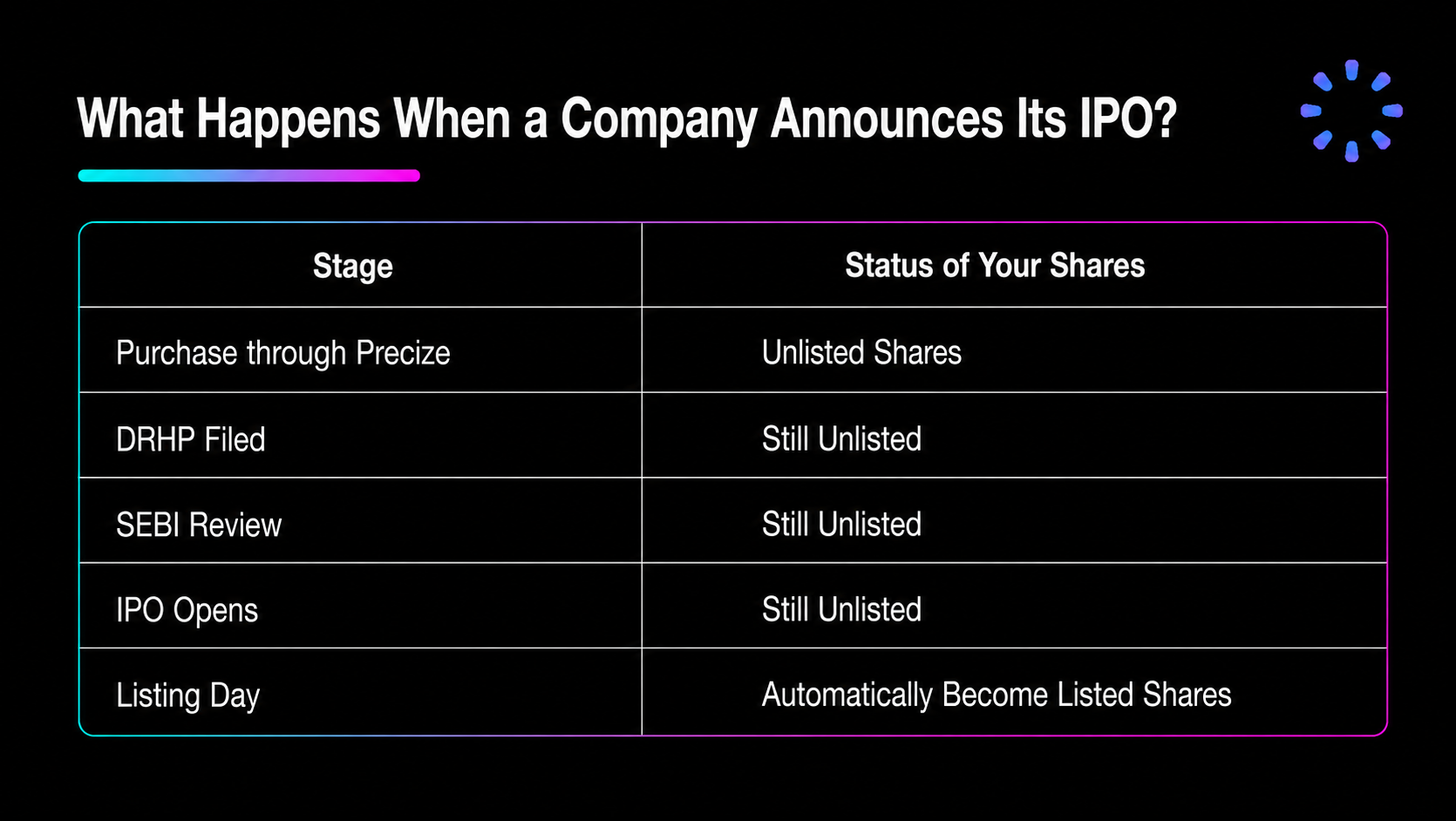
Throughout the IPO process, your ownership remains unchanged.
Do Unlisted Shares Automatically Become Listed?
Yes.
Once the company is officially listed on the stock exchange, your existing holdings automatically become listed shares in your demat account.
There is no need to:
Convert your shares manually
Apply separately in the IPO
Submit fresh documentation
Exchange certificates
If you have invested through Precize, your shares are already transferred to your demat account after settlement, ensuring a seamless transition from unlisted to listed shares once the IPO is complete.
Is There a Mandatory Lock-in Period?
Yes.
Under the current SEBI framework, pre-IPO shareholders are generally subject to a mandatory six-month lock-in period from the company's listing date.
The purpose of this lock-in is to:
Prevent immediate selling pressure after listing
Support orderly price discovery
Improve market stability
Protect public investors during the initial trading period
During this lock-in period, investors cannot sell their locked-in shares on the stock exchange.
Once the six-month period ends, the shares become eligible for trading, subject to applicable laws and exchange regulations.
While the six-month lock-in generally applies to pre-IPO shareholders under the current framework, investors should always review the company's Red Herring Prospectus (RHP) and applicable SEBI regulations for the specific terms governing their holdings.
Why Does SEBI Introduce a Lock-in Period?
A newly listed company often experiences high trading activity and price volatility in its initial months.
Without a lock-in period, large shareholders could sell immediately after listing, creating significant selling pressure that may affect the stock price.
The six-month lock-in helps:
Promote investor confidence
Reduce excessive volatility
Encourage long-term participation
Support smoother price discovery after listing
It also aligns the interests of early investors with the company's long-term growth.
What Happens During the Lock-in Period?
Although your shares are visible in your demat account after listing, they remain locked during the prescribed period.
This means:
You continue to own the shares.
You benefit from any increase in the market price.
You continue to receive eligible corporate actions, if declared.
However, you cannot sell the locked-in shares until the lock-in period expires.
For many investors, this period provides an opportunity to monitor the company's performance as a listed entity before deciding on their exit strategy.
What Happens After the 6-Month Lock-in Ends?
Once the mandatory 6-month lock-in period is over, your shares become eligible for trading on the stock exchange.
At this stage, you have complete flexibility to decide what to do with your investment. Depending on your financial goals and market outlook, you may choose to:
Sell your entire holding and book profits.
Sell a portion of your shares while continuing to hold the rest.
Continue holding your investment if you believe the company has long-term growth potential.
Unlike the lock-in period, there are no additional restrictions on selling once the prescribed period ends, unless specified otherwise under applicable regulations.
Should You Sell After the Lock-in?
There isn't a universal answer. The right decision depends on your investment objectives and the company's long-term prospects.
Many investors sell their holdings after the lock-in period to realize gains, especially if the stock has appreciated significantly since listing.
Others continue holding because they believe the company can create long-term shareholder value.
Before making your decision, consider factors such as:
Revenue and profit growth after listing
Future expansion plans
Industry outlook
Current valuation
Overall market conditions
Your investment horizon
Rather than focusing only on short-term gains, evaluating the company's fundamentals can help you make a more informed investment decision.
Taxation of Pre-IPO Shares After Listing
Taxation is an important consideration for every pre-IPO investor.
Selling Before the Company Lists
If you sell your shares before the IPO, the transaction is treated as a sale of unlisted equity shares. The applicable capital gains tax depends on the holding period and the prevailing provisions of the Income-tax Act.
Selling After Listing
Once the company is listed and the lock-in period has expired, any sale through a recognized stock exchange is generally taxed under the provisions applicable to listed equity shares, subject to the conditions prescribed under the Income-tax Act.
Since tax laws may change over time, investors should always refer to the latest tax provisions or consult a qualified tax advisor before planning their exit.
Example: From Pre-IPO Investment to Exit
Let's understand the process with a simple example.
Suppose you invested in a company's unlisted shares through Precize.
After the company lists:
Your shares automatically become listed shares in your demat account.
A 6-month lock-in period begins.
During this period, you cannot sell the shares.
Once the lock-in expires, you are free to sell or continue holding based on your investment strategy.
This allows investors to participate in the company's listed journey while complying with the applicable lock-in requirements.
How Precize Simplifies Pre-IPO Investing
Investing in unlisted shares involves documentation, due diligence, settlement, and regulatory processes. Precize simplifies this journey by providing a seamless investment experience.
Access to Curated Opportunities
Explore carefully selected pre-IPO companies across diverse sectors through a single platform.
Detailed Research
Every investment opportunity is backed by research that includes:
Business model
Financial performance
Industry outlook
Growth drivers
Risks to consider
Recent corporate developments
This helps investors make informed investment decisions.
Secure Demat Transfer
Once your transaction is completed, the shares are transferred directly to your demat account, ensuring a smooth transition when the company eventually lists.
End-to-End Investment Support
From discovering opportunities to documentation and settlement, Precize provides support throughout the pre-IPO investment process.
Common Myths About Unlisted Shares After an IPO
Myth 1: I can sell my shares on listing day.
Reality: Under the current SEBI framework, pre-IPO shareholders are generally subject to a 6-month lock-in period from the company's listing date.
Myth 2: I need to convert my unlisted shares into listed shares.
Reality: No. Once the company is listed, your eligible holdings automatically become listed shares in your demat account.
Myth 3: The lock-in means I lose ownership of my shares.
Reality: Not at all. You continue to own the shares throughout the lock-in period. The restriction only applies to selling them during that time.
Myth 4: Every IPO delivers strong listing gains.
Reality: Listing performance depends on market conditions, company fundamentals, valuation, and investor sentiment. Pre-IPO investments should be made with a long-term perspective rather than solely for listing gains.
Final Thoughts
Investing in unlisted shares allows investors to participate in a company's growth before it enters the public markets. Once the company completes its IPO, your holdings automatically transition into listed shares in your demat account.
However, it's equally important to understand what happens after listing. Under the current SEBI framework, pre-IPO shareholders are generally subject to a mandatory six-month lock-in period, during which the shares cannot be sold. Once the lock-in expires, investors can decide whether to book profits or continue holding based on the company's long-term potential.
Whether you're investing for listing gains or long-term wealth creation, understanding the IPO journey, lock-in rules, and taxation can help you make better investment decisions.
If you're looking to explore India's growing pre-IPO market, Precize offers curated unlisted investment opportunities, in-depth company research, and a seamless investment experience—from discovery to demat transfer.
For more detail understanding of what happens after the listing visit Precize guides.
To compare companies, documents, and availability explore unlisted companies on Precize. For ongoing IPO and private-market updates, browse the Precize blog. Stay updated with unlisted companies through our Precize Community. If this article was useful, you can share it with other investors through the Precize Referral Program.
Frequently Asked Questions (FAQs)
1. What happens to my unlisted shares after an IPO?
Your shares automatically become listed shares in your demat account once the company is listed on the stock exchange.
2. Can I sell my pre-IPO shares immediately after listing?
Generally, no. Under the current SEBI framework, pre-IPO shareholders are generally subject to a 6-month lock-in period from the date of listing.
3. What happens after the 6-month lock-in period?
Once the lock-in expires, your shares become eligible for trading on the stock exchange, allowing you to sell or continue holding them.
4. Are listed shares taxed differently from unlisted shares?
Yes. The taxation of listed and unlisted equity shares differs under the Income-tax Act and depends on the applicable provisions at the time of sale.
5. Why invest through Precize?
Precize provides access to curated pre-IPO investment opportunities, comprehensive company research, secure demat transfers, and end-to-end support, helping investors participate confidently in India's growing unlisted market.
Disclaimer: This article is for informational purposes only and should not be considered as investment advice. Investing in unlisted shares carries risks including illiquidity and potential loss of capital. Please consult with a qualified financial advisor before making investment decisions. Precize is not a stock exchange and is not authorized by any capital markets regulator.