Zepto IPO Timeline
Zepto's IPO journey has been closely followed by investors over the past year. Here's a timeline of the major milestones:
December 2025: Zepto confidentially filed its Draft Red Herring Prospectus (DRHP), marking the beginning of its IPO journey.
June 2026: The company submitted its Updated Draft Red Herring Prospectus (UDRHP) with SEBI, providing detailed information about its business, financials, and proposed public issue.
Current Status: The UDRHP is under review by the Securities and Exchange Board of India (SEBI), and the approval process is currently underway.
IPO Dates: The company has not yet announced the official IPO opening and closing dates. These are expected to be disclosed after receiving SEBI's approval.
Expected Listing: Following the successful completion of regulatory approvals and the IPO process, Zepto is expected to list its shares on the National Stock Exchange (NSE) and the Bombay Stock Exchange (BSE).
The company has chosen the confidential filing route, allowing it to complete the regulatory review before publicly disclosing all details. This approach has become increasingly popular among high-growth technology companies preparing for public listings.
About Zepto
Founded in 2021 by Aadit Palicha and Kaivalya Vohra, Zepto was established with a simple but ambitious goal—to redefine grocery shopping through ultra-fast deliveries.
The company introduced a quick commerce model that promises deliveries within minutes, powered by a network of strategically located dark stores. These micro-fulfillment centers allow Zepto to process and dispatch orders much faster than conventional e-commerce warehouses.
Today, Zepto operates across several major Indian cities, serving millions of customers with a wide assortment of products, including:
The platform's focus on convenience, technology, and efficient logistics has helped it become one of India's fastest-growing consumer internet companies.
Zepto Business Model
Unlike traditional marketplaces, Zepto follows an inventory-led quick commerce model.
Instead of relying on third-party sellers, the company operates its own network of dark stores stocked with thousands of high-demand products. Customers place orders through the Zepto app, and the nearest fulfillment center processes the order immediately.
The process is simple:
Customer places an order
↓
Nearest dark store receives the request
↓
Inventory is picked and packed
↓
Delivery partner collects the order
↓
Order reaches the customer within minutes
This operating model allows Zepto to maintain greater control over inventory availability, delivery speed, and customer experience.
How Zepto Makes Money
Zepto generates revenue through multiple channels:
Product Sales
The primary source of revenue comes from selling groceries and daily essentials directly to consumers.
Delivery Charges
Customers may pay delivery fees based on order value, distance, or service availability.
Advertising Revenue
Brands pay Zepto to improve product visibility through sponsored listings and promotional campaigns.
Membership Programs
Subscription-based offerings provide customers with additional benefits such as reduced delivery charges and exclusive offers.
Private Label Products
Zepto has also expanded into private labels, enabling the company to improve margins while strengthening customer loyalty.
This diversified revenue model helps the company increase monetization as order volumes continue to grow.
India's Quick Commerce Opportunity
India's quick commerce industry has evolved rapidly over the past few years.
Changing consumer preferences, increasing smartphone penetration, urbanization, and improved digital payment infrastructure have accelerated the adoption of instant delivery services.
Consumers today increasingly value convenience over planned grocery shopping. Instead of weekly supermarket visits, customers now expect groceries and essentials to be delivered within minutes.
Several trends continue to support industry growth:
This has resulted in significant investments across the sector, with companies racing to expand their fulfillment networks and improve delivery efficiency.
Major players include:
Zepto
Blinkit
Swiggy Instamart
BigBasket
Flipkart Minutes
Despite growing competition, the market remains underpenetrated, providing significant long-term growth opportunities for leading players.
Zepto DRHP Highlights
Zepto's Updated Draft Red Herring Prospectus provides investors with valuable insights into the company's operations and future strategy.
Some of the major highlights include:
Proposed Fresh Issue
The company plans to raise approximately ₹8,010 crore through a fresh issue of equity shares.
Offer for Sale (OFS)
Existing shareholders will partially monetize their holdings through the Offer for Sale component. Importantly, the founders are not participating in the OFS, reflecting their continued commitment to the business.
Listing Exchanges
The shares are proposed to be listed on both:
Purpose of the IPO
The proceeds from the fresh issue are expected to support:
General corporate purpose
One of the biggest takeaways from the DRHP is Zepto's rapid revenue growth.
While the company continues to report losses, this is largely due to aggressive investments aimed at expanding its market presence.
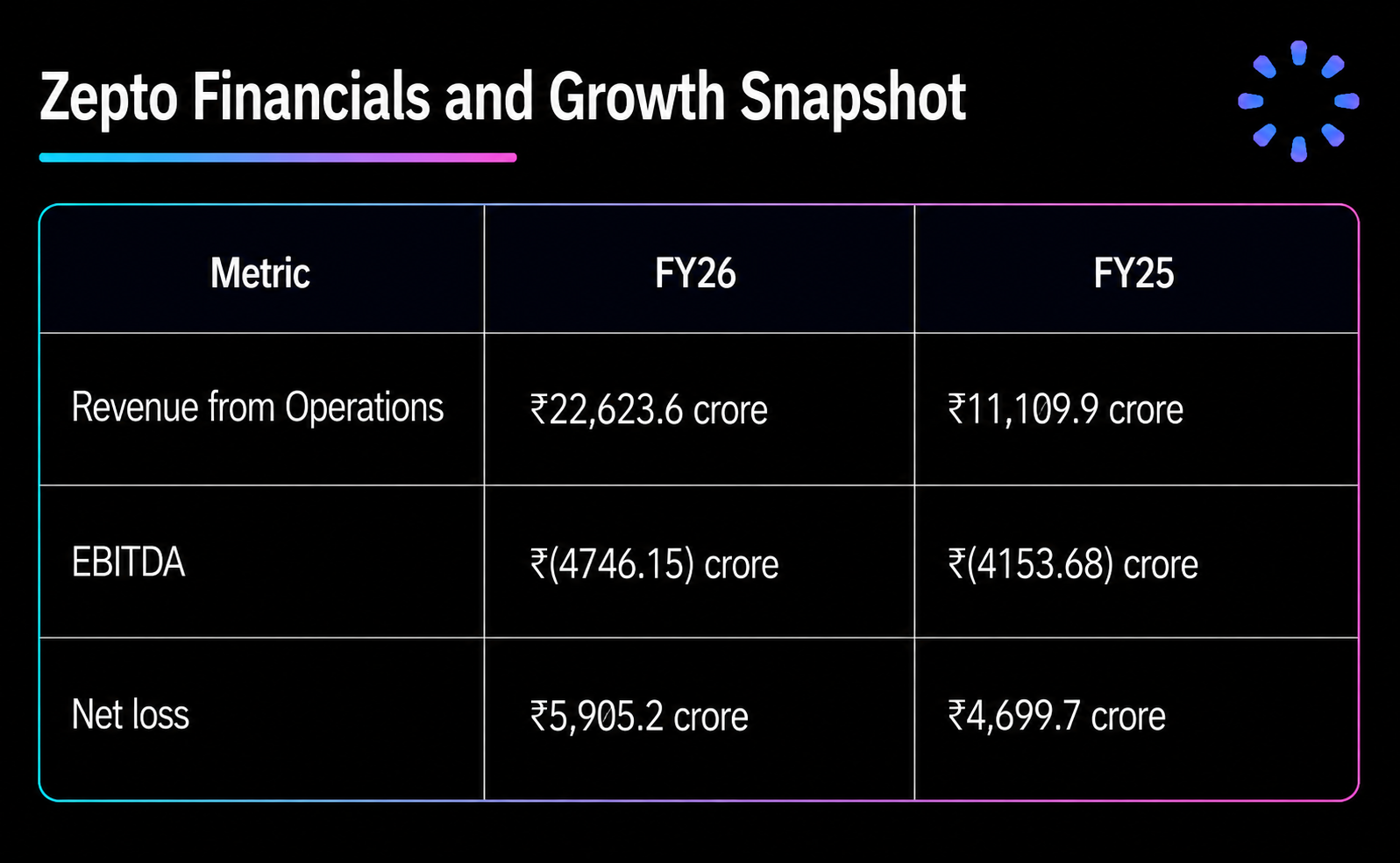
The financials indicate that Zepto is prioritizing scale over short-term profitability, a strategy commonly adopted by technology-driven consumer businesses during periods of rapid expansion.
Its investments in infrastructure, customer acquisition, technology, and logistics are expected to support future growth as the quick commerce market matures.
Revenue & Growth Analysis
Zepto's growth story is closely tied to India's expanding quick commerce market. The company has consistently increased its order volumes by expanding its network of dark stores, entering new cities, and broadening its product assortment.
Several factors have contributed to this growth:
Rapid expansion of fulfillment centers
Strong customer acquisition
Higher repeat purchase rates
Growth in average order values
Expansion into higher-margin product categories
Increasing monetization through advertising and private labels
However, scaling a quick commerce platform requires substantial investments. Building and operating dark stores, maintaining inventory, paying delivery partners, and offering promotional discounts all contribute to higher operating expenses. As a result, investors should evaluate Zepto not only on its impressive revenue trajectory but also on its ability to improve margins and move toward sustainable profitability over the long term.
Quick Commerce Industry Outlook
The quick commerce industry has transformed the way Indian consumers purchase groceries and daily essentials. Unlike traditional e-commerce platforms that focus on next-day delivery, quick commerce companies promise deliveries in as little as 10–20 minutes through strategically located dark stores.
Several macroeconomic and demographic trends continue to support the industry's growth:
Rising Urban Population
India's urban population continues to expand, creating greater demand for convenience-driven services. Busy professionals and nuclear families increasingly prefer instant deliveries over planned grocery shopping.
Increasing Digital Adoption
The widespread adoption of smartphones, affordable internet, and UPI-based digital payments has accelerated online grocery purchases across major cities.
Higher Consumer Spending
With rising disposable incomes and changing lifestyles, consumers are becoming more willing to pay for convenience, particularly for emergency grocery purchases and everyday essentials.
Expansion Beyond Groceries
Quick commerce platforms are no longer limited to grocery deliveries. Companies now offer electronics, beauty products, medicines, pet supplies, kitchen essentials, toys, and even fashion accessories. This diversification increases average order values and creates additional revenue opportunities.
Although the industry remains highly competitive, analysts believe that the market is still in its early stages, leaving room for multiple players to grow as consumer adoption continues to increase.
What Differentiates Zepto?
Unlike marketplace-led grocery platforms, Zepto follows an inventory-led operating model. This enables better control over product availability, faster order fulfilment, and improved customer experience.
Some of Zepto's competitive advantages include:
Technology-first operating model
Dense network of dark stores
Strong customer retention
Data-driven inventory management
Expanding private label portfolio
Well-recognized consumer brand among urban users
However, maintaining leadership requires continuous investments in logistics, technology, and customer acquisition, making operational efficiency a key factor for long-term success.
Zepto Shareholding Pattern
Over the years, Zepto has attracted investments from several global venture capital firms and institutional investors.
The company has completed multiple funding rounds that have supported its rapid expansion across India.
Its investor base includes prominent global investment funds, sovereign wealth funds, family offices, and technology-focused venture capital firms.
A diversified institutional shareholding provides several benefits:
Access to long-term capital
Strategic guidance from experienced investors
Strong corporate governance practices
Improved credibility ahead of the IPO
The founders continue to retain a meaningful ownership stake in the company, and according to the DRHP, they are not selling shares through the Offer for Sale, indicating confidence in Zepto's future growth.
Zepto Valuation Analysis
One of the biggest questions among investors is whether Zepto's valuation is justified.
Like most high-growth technology companies, Zepto is not valued solely based on current earnings. Instead, investors focus on several qualitative and quantitative factors, including:
The company has consistently attracted capital at higher valuations over multiple funding rounds, reflecting investor confidence in India's quick commerce opportunity.
However, valuation remains an important consideration for pre-IPO investors. A higher valuation could limit listing gains if market expectations are already priced in, while a reasonable valuation may offer greater upside over the long term.
How Will Zepto Use the IPO Proceeds?
According to the DRHP, Zepto intends to use the fresh issue proceeds primarily to strengthen its operational capabilities and support long-term growth.
The proposed utilization includes:
Expansion of Dark Store Network
Increasing the number of dark stores will allow Zepto to serve additional cities, improve delivery speed, and increase order capacity.
Technology Investments
The company plans to enhance its technology platform by investing in artificial intelligence, automation, demand forecasting, and supply chain optimization.
Strengthening Logistics
Additional investments in fulfilment infrastructure and delivery capabilities are expected to improve operational efficiency and customer experience.
Strategic Acquisitions
Zepto may evaluate acquisitions that complement its existing business and accelerate growth.
General Corporate Purposes
A portion of the proceeds will also be allocated toward working capital requirements and other corporate initiatives.
Investment Highlights
1. Strong Revenue Growth
Zepto has recorded exceptional revenue growth over the last few years, driven by increasing customer adoption and rapid expansion of its dark store network.
2. Large Addressable Market
India's quick commerce industry is still evolving, offering substantial long-term growth opportunities as online grocery penetration continues to rise.
3. Strong Brand Recognition
Zepto has established itself as one of the most recognizable quick commerce brands in India within a relatively short period.
4. Technology-Driven Business Model
Its investment in technology enables efficient inventory management, faster deliveries, and better customer experience.
5. Institutional Investor Backing
The company's strong institutional shareholder base provides financial stability and confidence in its long-term growth strategy.
6. Multiple Revenue Streams
Beyond grocery sales, Zepto generates revenue from:
Advertising
Delivery charges
Subscription programs
Private label products
This diversified business model can support margin expansion over time.
Risks Investors Should Consider
While Zepto presents an attractive growth story, investors should also evaluate the associated risks.
Continued Losses
Despite impressive revenue growth, the company continues to report significant losses due to expansion-related investments.
Intense Competition
Competition from Blinkit, Swiggy Instamart, BigBasket, and new entrants could affect market share and pricing power.
Execution Risk
Successfully scaling operations while maintaining service quality remains a significant challenge.
High Capital Requirements
Quick commerce requires continuous investments in dark stores, inventory, technology, and logistics.
Regulatory Risks
Any changes in e-commerce regulations, labour laws, taxation, or data privacy requirements could impact operations.
Should You Buy Zepto Unlisted Shares Before the IPO?
This is perhaps the most important question for prospective investors.
Investing in pre-IPO companies can provide an opportunity to participate in a company's growth before it becomes publicly listed. However, such investments also involve higher risks due to lower liquidity, valuation uncertainty, and longer holding periods.
Investors may consider Zepto if they:
Have a long-term investment horizon.
Want exposure to India's fast-growing quick commerce sector.
Understand startup investing and pre-IPO risks.
Believe Zepto can improve profitability over time.
Investors should remain cautious if they:
Prefer companies with consistent profitability.
Have a low risk tolerance.
Need high liquidity.
Are investing solely for short-term listing gains.
As with any investment, Zepto should be evaluated within the context of your overall portfolio, risk appetite, and financial goals.
How to Buy Zepto Unlisted Shares
Investors looking to participate before the IPO can explore Zepto's unlisted shares through regulated platforms that facilitate transactions in the pre-IPO market.
The typical process includes:
Complete KYC verification.
Review the latest available share price.
Confirm the number of shares to purchase.
Complete payment and documentation.
Receive shares in your demat account after settlement.
Before investing, investors should carefully evaluate the company's financials, valuation, business model, and associated risks.
To compare companies, documents, and availability explore unlisted companies on Precize. For ongoing IPO and private-market updates, browse the Precize blog. Stay updated with unlisted companies through our Precize Community. If this article was useful, you can share it with other investors through the Precize Referral Program.
Frequently Asked Questions (FAQs)
1. Has Zepto filed its DRHP?
Yes. Zepto has filed its Updated Draft Red Herring Prospectus (UDRHP) with SEBI as part of its IPO process.
2. What is the expected Zepto IPO date?
The exact IPO opening date has not yet been announced. The company is awaiting regulatory approvals before announcing the final schedule.
3. What is the size of Zepto's IPO?
According to the DRHP, Zepto plans to raise approximately ₹8,010 crore through a fresh issue, along with an Offer for Sale by existing shareholders.
4. Is Zepto profitable?
No. The company continues to report losses as it invests aggressively in expansion, technology, and customer acquisition.
Disclaimer: This article is for informational purposes only and should not be considered as investment advice. Investing in unlisted shares carries risks including illiquidity and potential loss of capital. Please consult with a qualified financial advisor before making investment decisions. Precize is not a stock exchange and is not authorized by any capital markets regulator.