
Imagine checking your portfolio one morning, only to see stock prices plummet overnight; that’s the reality of a stock market crash. For investors, these sudden market shocks can be shocking, stressful, and sometimes confusing.
In this blog, you’ll understand exactly what a stock market crash is, explore the main causes behind these dramatic declines, and review the biggest stock market crashes in trading history. We’ll also highlight significant crashes in India and explain how investors can navigate such turbulent times.
Let’s get started!
At a Glance
A stock market crash is a sudden, sharp drop in stock prices caused by economic, political, or global events.
Major crashes in history include the 1929 Great Crash, 1987 Black Monday, Dotcom Bubble (2000–2002), 2008 Financial Crisis, and 2020 Coronavirus Crash.
India has experienced notable crashes, such as the 1992 Harshad Mehta scam, 2015 China market turbulence, and the 2024–2025 market decline.
Key causes include speculative bubbles, panic selling, economic shocks, high leverage, and loss of confidence.
What Is a Stock Market Crash?
A stock market crash happens when a significant portion of the market experiences a sudden and sharp drop in stock prices. It happens when investor confidence drops rapidly, resulting in a large number of sell-offs within a short period.
Crashes are often unexpected and can result from economic issues, political events, or financial crises. During a crash, stock values can fall dramatically, sometimes in just a few days, creating panic among traders and investors.
Once you know what a stock market crash looks like, it’s important to understand the factors that can trigger such sudden market drops.
Causes of Stock Market Crashes
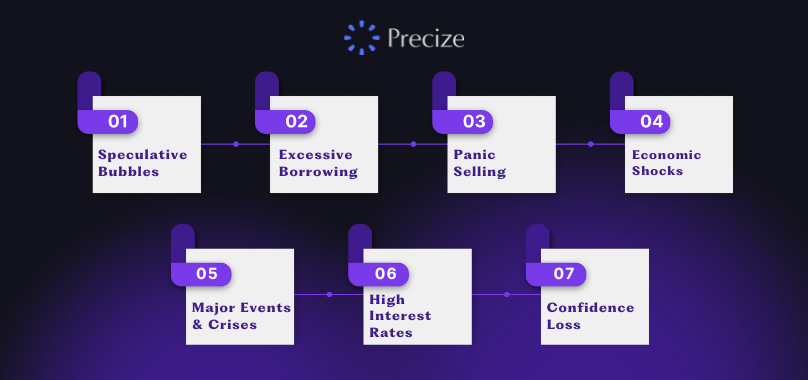
When you examine the biggest stock market crashes in history, you will notice that several key factors often combine to trigger these sudden, sharp declines. Understanding these causes helps you see why markets can fall so quickly and dramatically.
1. Speculative Bubbles
A crash often follows a period when stock prices rise far beyond their real value, creating a speculative bubble. Investors get overly optimistic, expecting prices to keep climbing. When confidence fades, the bubble bursts, and prices drop rapidly.
2. Excessive Borrowing
Many investors buy stocks using borrowed money to increase potential profits. While leverage can amplify gains, it also magnifies losses. When prices start to fall, these investors may be forced to sell quickly to repay loans, which accelerates the decline.
3. Panic Selling
Falling stock prices often trigger fear among investors, leading to mass selling. This panic selling creates a domino effect, pushing prices down even faster in a short time.
4. Economic Shocks
Sudden negative news about the economy, such as a recession, banking crisis, or major financial scandal, can shake investor confidence. These shocks often result in widespread selling and steep market drops.
5. Major Events and Crises
Natural disasters, wars, political instability, or pandemics like COVID-19 can create uncertainty and fear. Investors often respond by selling stocks and seeking safer assets, which can trigger a crash.
6. High Interest Rates and Tight Credit
When central banks raise interest rates or tighten credit, borrowing becomes more expensive. This can slow economic growth, reduce corporate profits, and prompt investors to cut stock holdings, contributing to market declines.
7. Loss of Confidence and Scams
Sometimes a crash is caused by a sudden loss of trust in financial systems due to scams or fraud. When confidence in institutions or governments is shaken, investors may sell off stocks rapidly, intensifying the market fall.
With the causes in mind, it’s useful to see how these factors played out in some of the largest market crashes over time.
Biggest Stock Market Crashes in Trading History

Knowing the largest stock market crashes in history helps you see how markets can shift dramatically and the impact these events have on economies and traders alike. Here’s a clear, chronological list of some of the most significant stock market crashes:
1. 1929: The Great Crash (Wall Street Crash)
The 1929 stock market crash, often remembered as one of the most significant in history, took place in late October, with Black Thursday on October 24, followed by Black Monday and Black Tuesday on October 28 and 29.
Stock prices fell sharply over the next few years, dropping nearly 89%.
This crash triggered the Great Depression, which lasted more than a decade and caused widespread unemployment and economic hardship worldwide.
It took around 25 years for markets to return to their previous peak.
2. 1987: Black Monday
In 1987, known as Black Monday, the Dow Jones Industrial Average (DJIA) experienced its steepest single-day decline in history, falling more than 22.6% in just one day.
This sudden decline was largely driven by computerized trading and panic selling.
Despite its severity, the market recovered relatively quickly compared to the 1929 crash.
3. 2000–2002: Dotcom Bubble Burst
The late 1990s saw rapid growth in internet-related companies, with the Nasdaq index rising sharply due to heavy speculation in tech stocks.
Beginning in 2000, the bubble burst, and by 2002, the Nasdaq had lost nearly 80% of its value.
Many tech companies failed, and the market correction lasted for several years.
4. 2008: Global Financial Crisis
This crisis was triggered by problems in the US housing market and the collapse of major financial institutions.
It triggered a severe global recession, causing stock markets worldwide to plunge and volatility to spike.
It was one of the worst crashes since the Great Depression, and markets began recovering after 2009.
5. 2020: Coronavirus Crash
In March 2020, global markets fell sharply as the COVID-19 pandemic spread worldwide.
Lockdowns and uncertainty led to panic selling, resulting in one of the fastest market crashes in history.
The Dow fell nearly 13% in a single day on March 16, 2020.
Markets rebounded within months, aided by government stimulus measures and hopes for economic recovery.
While global markets have faced some dramatic crashes, India’s stock market has also seen its share of sudden declines that shaped local investing history.
Stock Market Crashes in India

India’s stock market has faced several major crashes over the years, with sudden and sharp drops in key indices like the Sensex and Nifty. These crashes have often been caused by a mix of domestic issues and global events, creating market volatility and widespread losses. In more recent times, some of the most notable crashes include:
1. 1992: Harshad Mehta Scam
This scandal involved a stockbroker exploiting loopholes to manipulate the market, leading to a 12.7% single-day drop in the Sensex. The event caused significant losses for investors and led to lasting changes in market regulations.
2. 2015: China Stock Market Turbulence
Global market unrest in China triggered a sharp decline of around 6% in Indian markets, highlighting how international events can directly affect India’s stock performance.
3. 2024–2025 Crash
Following unexpected election results and global economic concerns such as US tariffs and rising inflation, Indian markets experienced a sharp decline. From late September 2024, the Sensex and Nifty have fallen by over 17% and 18% respectively. This crash also led to significant foreign investor withdrawals and affected multiple sectors across the country.
Looking at how Indian markets have reacted to crashes shows why it’s essential to have strategies in place to manage risks.
How Investors Can Protect Themselves During Major Stock Market Crashes
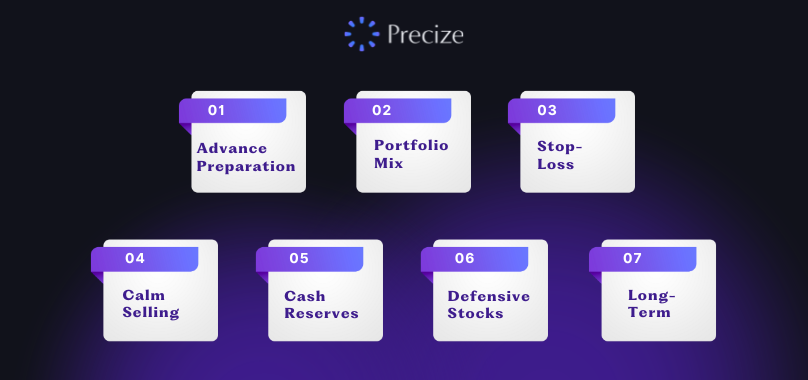
A major stock market crash can be stressful and unsettling. However, understanding practical ways to safeguard your money can help you stay composed and make more informed decisions during turbulent times. Here are some key approaches:
1. Prepare in Advance
While crashes may seem sudden, they are often preceded by warning signs, such as economic slowdown, rising inflation, political uncertainty, or global events like trade tensions or crises.
Being aware of these indicators allows you to stay alert and plan your actions carefully, rather than reacting impulsively.
2. Diversify Your Investments
Putting all your money into a single stock or sector can increase risk during a crash.
Spreading investments across multiple industries, asset classes like bonds, or even commodities like gold, can reduce overall risk.
If one sector or stock falls sharply, the impact on your total portfolio will be limited.
3. Use Stop-Loss Orders
A stop-loss order automatically sells a stock when it reaches a predetermined price. This helps limit losses during sudden price drops and ensures that a declining stock does not erode your capital too quickly.
4. Stay Calm and Avoid Panic Selling
During market declines, emotional decisions like selling all your stocks can amplify losses.
Instead, try to remain calm, avoid checking your portfolio too frequently, and do not react to every negative news report.
Measured responses help prevent unnecessary financial damage.
5. Keep Cash Reserves
Maintaining some cash reserves allows you to manage day-to-day expenses without needing to sell investments at a loss. It also provides flexibility to make thoughtful decisions once the market stabilizes.
6. Consider Defensive Stocks
Stocks of companies offering essential goods and services like healthcare, utilities, and everyday consumer products, usually remain more stable during market declines.
Including such stocks can provide stability to your portfolio when other sectors experience sharp declines.
7. Maintain a Long-Term Perspective
Fluctuations in stock prices are a natural part of market cycles. Focusing on a long-term perspective helps you avoid fear-driven decisions and gives your investments time to recover, even after periods of volatility.