
When planning your finances, finding investment options that offer both safety and tax benefits can be a priority. Tax-free bonds have become a popular choice among many Indian investors seeking steady income without the burden of tax on interest earnings.
In this blog, you’ll explore what Tax Free Bonds are, who issues them, their important features and benefits, as well as the different types available. You’ll also learn the step-by-step process to explore these bonds, and how they differ from traditional saving fixed deposits.
This blog aims to give you a clear and practical understanding of Tax-Free Bonds to help you make informed decisions.
Let’s get started!
What are Tax-Free Bonds?
Tax-Free Bonds are fixed-income securities issued by government-backed organizations where the interest earned is exempt from income tax. These bonds represent a loan made by an investor to the issuer, usually for a long-term period, during which the issuer pays periodic interest. The principal amount is returned to the investor at maturity.
Now that you know what tax-free bonds are, let’s look at who actually issues them.
Issuer of Tax-Free Bonds
Tax-Free Bonds in India are mainly issued by government-backed institutions and public sector undertakings (PSUs), including:
National Highways Authority of India (NHAI)
Indian Railway Finance Corporation (IRFC)
Power Finance Corporation (PFC)
Rural Electrification Corporation (REC)
Housing and Urban Development Corporation (HUDCO)
Indian Renewable Energy Development Agency (IREDA)
Airports Authority of India (AAI)
National Housing Bank (NHB)
Once you’re familiar with the issuers, let’s explore the important features of tax-free bonds you should keep in mind.
Key Features of Tax-Free Bonds

Tax-free bonds come with several important features that make them distinct and worth understanding before considering them as an investment option.
Tax-Exempt Interest Income
A major feature of tax-free bonds is that the interest you earn is completely exempt from income tax under Section 10(15) of the Income Tax Act, 1961.
This means you don’t have to pay any tax on the interest income, making these bonds especially appealing to investors in higher tax brackets.
Fixed Interest Rates
Tax-free bonds come with a fixed interest rate determined at the time of issuance, which remains constant throughout the bond’s tenure.
Mainly, interest rates range between 5.5% and 7.5% per annum, with interest payments usually made annually.
Form of Holding
You have the option to hold tax-free bonds either in physical form or electronically through a demat account, offering flexibility based on your preference.
No Tax Deducted at Source (TDS)
No TDS is deducted on the interest earned from tax-free bonds. Nonetheless, it is recommended to disclose this interest income while filing your income tax return, even though it is exempt from tax.
Capital Gains Tax
If you sell tax-free bonds on the stock exchange before maturity and make a profit, the gains may be subject to capital gains tax as per the Income Tax Act.
Now that you know the key features of tax-free bonds, let’s look at the benefits they offer.
Benefits of Tax-Free Bonds
When you explore tax-free bonds, you get several benefits that can support your long-term financial planning. Here are the key benefits you should know about:
High Safety and Low Risk
Issued by government-supported organizations like NHAI, REC, or PFC, tax-free bonds carry very low risk of default. The backing of these government entities makes them one of the safest fixed-income investment options available in India.
Long-Term Investment Option
With typical maturities ranging from 10 to 20 years, tax-free bonds are suited for investors looking for steady returns over an extended period, such as retirees or those planning for long-term financial goals.
Portfolio Diversification
Adding tax-free bonds to your investment portfolio helps diversify your assets. As fixed-income instruments, they can help balance the risks associated with other investments, such as stocks or mutual funds.
Easy Liquidity
Since tax-free bonds are listed on stock exchanges, you have the option to buy or sell them if you need access to funds before maturity. This feature provides flexibility and liquidity to your investments.
Ideal for High-Income Individuals
For those in higher tax brackets, tax-free bonds can offer better post-tax returns compared to many other fixed-income investments, as the interest income is completely tax-exempt.
With these advantages in mind, it’s helpful to understand the various types of tax-free bonds available to you.
Types of Tax-Free Bonds
When you explore different tax-free bonds in India, you’ll find that they are grouped based on the sectors they support and the organisations that issue them.
Infrastructure Bonds
These bonds are issued by government-backed infrastructure companies to raise money for large-scale projects such as highways, airports, and urban development.
Some well-known issuers include the National Highways Authority of India and Indian Infrastructure Finance Company Limited.
Housing Bonds
Housing bonds are issued by organisations like the National Housing Bank and the Housing and Urban Development Corporation Limited.
The funds collected through these bonds are used to support affordable housing initiatives and urban planning projects.
Power Bonds
Power bonds are offered by companies such as Power Finance Corporation Limited, Rural Electrification Corporation Limited, and Indian Renewable Energy Development Agency Limited.
These bonds help finance the development and upgrade of power plants and electricity infrastructure across the country.
Railway Bonds
Railway bonds are issued to fund the expansion and modernisation of India’s railway network.
They are usually offered by government-backed railway organisations.
Public Sector Undertaking Bonds
These bonds are issued by various public sector companies and government-owned entities to finance different development initiatives.
Examples of issuers include NTPC Limited (National Thermal Power Corporation) and NHPC Limited (National Hydroelectric Power Corporation).
With a clear idea of the bond types available, the next step is understanding how you can purchase these bonds.
9 Effective Steps to Invest in Tax-Free Bonds

Exploring tax-free bonds in India involves a clear set of steps that you can follow to participate in this government-backed investment option:
Step 1: Check Your Eligibility
You need to confirm if you qualify, as tax-free bonds are available for retail investors, High Net-Worth Individuals (HNIs), trusts, and institutional buyers.
Make sure you meet the criteria for the specific bond issue you’re interested in.
Step 2: Open Demat and Trading Accounts
Since tax-free bonds are traded on stock exchanges, you’ll need a Demat account to hold the bonds electronically and a trading account to buy or sell them.
Step 3: Look for New Issues or Bonds on the Secondary Market
Tax-free bonds are released periodically by government entities like NHAI, IRFC, PFC, and REC.
You can apply for new bond issues during their subscription period through your bank or broker.
Alternatively, you can purchase existing bonds from the secondary market via the stock exchange.
Step 4: Know the Minimum Purchase Amount
The minimum investment is usually Rs. 1,000, while the maximum can range up to several lakhs or even crores, depending on the issuer.
Step 5: Choose Bonds Based on Tenure and Interest Rate
These bonds generally have long tenures, typically between 10 to 20 years, with fixed interest rates. Pick bonds that match your financial timeline and income requirements.
Step 6: Apply or Place an Order
For new bonds, submit your application through your bank or broker during the subscription period. For bonds already listed, place a buy order on the stock exchange using your trading account.
Step 7: Receive Interest Payments and Principal at Maturity
Once you hold the bonds, you will get fixed interest payments at regular intervals (usually annually or semi-annually), which are tax-exempt.
The principal amount will be returned to you when the bond reaches maturity.
Step 8: Keep Liquidity in Mind
You can sell tax-free bonds on the secondary market before maturity, but the market may not be very active. This might affect how quickly you can sell and the price you get.
Step 9: Understand Limits on How Much You Can Put In
There is usually no upper limit on the amount you can put into tax-free bonds, so both small and large buyers can participate.
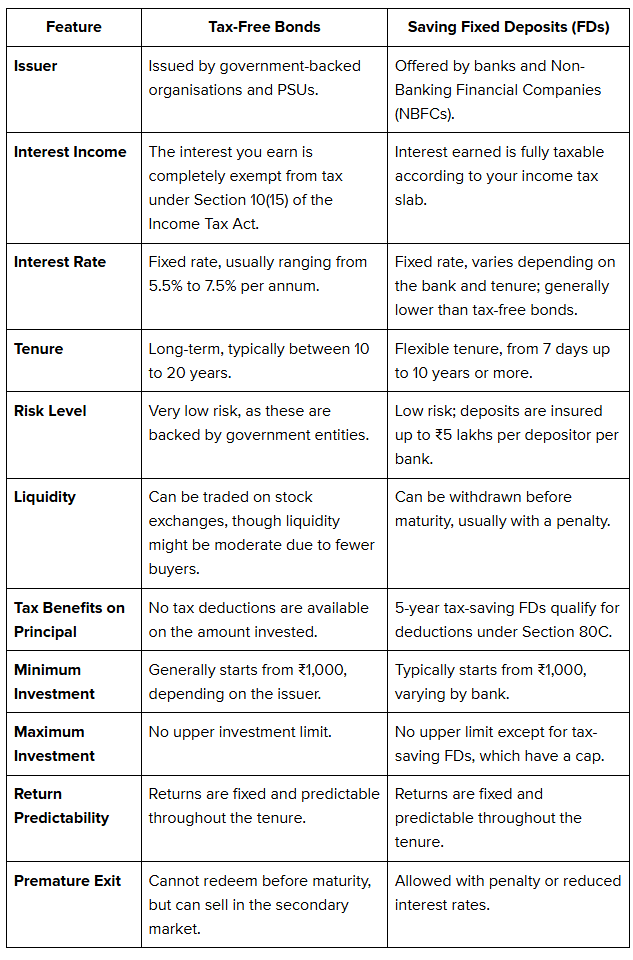
Difference Between Tax-Free Bonds vs. Saving Fixed Deposits
When comparing tax-free bonds and fixed deposits, it’s important to understand the key differences in features, benefits, and risks between these two popular investment options.
Conclusion
Now that you’ve got a good grasp of tax-free bonds, it’s clear they offer a safe and steady choice, especially if you prefer low-risk, long-term options and fall into a higher tax bracket. These bonds not only give you tax-free income but also help government-backed organizations fund important infrastructure projects that support India’s growth.
If you’re thinking about diversifying your portfolio beyond the usual investments, platforms like Precize provide easy access to alternative opportunities in private equity and private credit.
You can reserve your access today and explore how adding different asset types can help strengthen your overall portfolio!
Disclaimer
This blog is just to help you understand tax-free bonds better and is for informational purposes only. It’s not financial or legal advice. Before making any decisions about your money, it’s a good idea to talk to a financial expert who knows your situation. Remember, all investments come with some risk, and past results don’t guarantee what will happen in the future. Neither the author nor the publisher is responsible for any losses that might occur because of using this information.