If you often find yourself comparing ownership versus leasing costs or analyzing how lease decisions affect cash flow, you’re not alone. Many financial strategists and wealth managers face the same challenge, understanding which types of lease deliver the best financial outcomes.
With multiple structures like operating, finance, and hybrid leases, it can be tricky to decide which one aligns with your client’s goals or business model. The right choice can optimize balance sheets and liquidity, while the wrong one can distort financial ratios and long-term performance.
In this blog, you’ll learn what a lease actually means, why lease agreements hold such importance in financial analysis, the main types of lease used in India, and how to choose the right one. By the end, you’ll have a practical understanding of how each lease type influences financial planning and overall profitability.
Overview
A lease allows you to use an asset or property for a set period in exchange for regular payments.
The main types of leases include finance, operating, sale and leaseback, leveraged, gross, net, and fixed-term leases.
Each lease type differs in ownership rights, payment terms, and maintenance responsibilities.
Choosing the right lease depends on your budget, duration needs, and level of control or risk you’re comfortable with.
What Is a Lease?
A lease is a contractual agreement where the lessor (owner) grants the lessee (user) the right to use an asset for a specified period in exchange for regular payments. It outlines key details such as duration, payment terms, and responsibilities of both parties. Leases are widely used for assets like property, vehicles, and equipment. This arrangement helps businesses manage cash flow and access assets without large upfront expenses, making it a vital part of modern financial and operational planning.
Once you understand what a lease is, the next step is to see why a formal agreement is crucial for smooth and transparent transactions.
Importance of Lease Agreements
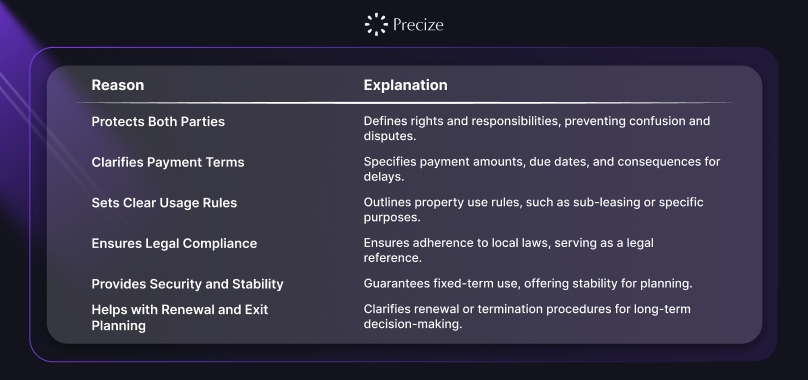
A lease agreement isn’t just a formality, it’s what keeps things clear, fair, and secure between you and the other party. Here is why having a solid lease agreement really matters:
Protects Both Parties
A lease agreement gives legal protection to both you and the lessor by clearly defining rights and responsibilities. It helps avoid confusion, keeps communication transparent, and prevents unnecessary disputes down the line.
Clarifies Payment Terms
You get a clear idea of how much you need to pay, when payments are due, and what happens if they’re delayed. This clarity makes it easier to manage your cash flow and stay on top of your financial commitments.
Sets Clear Usage Rules
Every property or asset comes with certain conditions. The lease outlines what you can and can’t do, like making changes, sub-leasing, or using it for specific business purposes, so both sides are on the same page from the start.
Ensures Legal Compliance
A written lease keeps everything in line with local laws such as the Indian Rent Control Act or commercial leasing rules. If any issue arises, this document becomes your go-to reference for settling matters smoothly.
Provides Security and Stability
A lease gives you the assurance that you can use the property or asset for a fixed period without interruptions. This sense of stability makes it easier to plan your business operations or living arrangements confidently.
Helps with Renewal and Exit Planning
It also mentions how renewals or terminations work, so you can plan ahead, whether you want to continue the lease or move on when the time comes. This clarity supports better long-term decision-making.
Once you know how lease agreements protect both parties, it becomes easier to understand the major lease types and decide which one suits your needs.
Main Types of Leases
When it comes to leasing, not every agreement works the same way. Different types of leases serve different business and financial needs. Here are the most common lease types, how they function, and what to keep in mind before you sign one.
1. Finance Lease
A finance lease lets you use an asset for most of its useful life. You take on nearly all the responsibilities, like maintenance and insurance, just like an owner, but the ownership stays with the lessor until the lease term ends.
Advantages of Finance Lease
Great for high-value assets without paying the full amount upfront.
Lease payments can be claimed as tax deductions.
The asset appears on your balance sheet, strengthening your financial profile.
You can spread payments over several years for better cash management.
Works best for long-term use of durable assets.
Disadvantages of Finance Lease
You handle all maintenance and insurance costs.
Payments can feel heavy if the asset isn’t used efficiently.
Most finance leases can’t be canceled easily.
You bear the risk if the asset’s value drops.
Buying the asset at the end usually comes with an extra cost.
2. Sale and Leaseback
In a sale and leaseback arrangement, you sell your asset, like property or machinery, and lease it back immediately. This helps you release locked-up funds while continuing to use the same asset.
Advantages of Sale and Leaseback
Frees up capital for other business needs.
You can keep using the same asset without disruption.
Improves short-term cash flow.
Keep your operations running smoothly.
Lease payments may qualify for tax benefits.
Disadvantages of Sale and Leaseback
You give up ownership of the asset.
Total lease payments may exceed the original asset value.
Less control over the asset in future transactions.
Renewal terms may not always be favorable.
Not ideal for assets that hold sentimental or strategic importance.
3. Leveraged Lease
A leveraged lease involves three parties: you, the lessor, and a lender. The lender funds a portion of the asset’s cost, reducing your initial payment and allowing you to use expensive equipment or property.
Advantages of Leveraged Lease
Access to costly assets with a smaller upfront payment.
Possible tax benefits from interest deductions.
Financial risk is shared among multiple parties.
Ideal for large-scale or infrastructure projects.
Flexible repayment terms are often available.
Disadvantages of Leveraged Lease
Requires more paperwork and lender involvement.
Higher risk if the asset’s value decreases.
Any default affects all parties involved.
It can be complex to understand and manage.
Credit checks are often strict.
4. Gross Lease
In a gross lease, you pay a fixed rent while the owner covers all other expenses, such as property tax, insurance, and maintenance.
Advantages of Gross Lease
Simple and predictable, one rent payment covers everything.
No surprise bills for maintenance or repairs.
Easy to understand and manage.
Reduces stress about hidden costs.
Ideal for offices, shops, or service spaces.
Disadvantages of Gross Lease
Rent is usually higher compared to other lease types.
Limited control over how the property is managed.
Rent may increase if the owner’s costs rise.
The quality of maintenance depends on the owner.
Less clarity on how expenses are distributed.
5. Net Lease (Single, Double, or Triple Net)
A net lease requires you to pay rent along with some or all property-related expenses, like taxes, insurance, and maintenance.
Advantages of Net Lease
Base rent is generally lower than a gross lease.
Expenses are clearly divided between both parties.
Offers transparency about actual costs.
Can be customized based on your needs.
Works well for long-term commercial leases.
Disadvantages of Net Lease
Extra costs can fluctuate, which can affect budgeting.
You handle more financial responsibilities.
Managing expenses can be time-consuming.
Requires careful financial planning.
Risk increases if taxes or maintenance costs rise.
6. Operating Lease
An operating lease allows you to use assets like vehicles, machinery, or office equipment for a shorter period while ownership remains with the lessor.
Advantages of Operating Lease
Low commitment, you can return or replace the asset when needed.
Easy to upgrade to newer models or equipment.
Maintenance is usually handled by the owner.
Doesn’t appear as a long-term liability on your balance sheet.
Ideal for businesses that need flexibility.
Disadvantages of Operating Lease
No option to own the asset later.
It can become expensive for short-term usage.
Limited control over modifications or usage.
It may come with restrictions in the lease terms.
Not suitable for essential or core business assets.
7. Fixed-Term Lease
A fixed-term lease allows you to use an asset or property for a set period, often one, three, or five years, under agreed terms. It’s common in both residential and commercial use.
Advantages of Fixed-Term Lease
Stability, terms and payments remain constant throughout.
Predictable costs make budgeting easier.
Often comes with lower rates than flexible leases.
Straightforward and simple to understand.
Renewal terms can be agreed upon in advance.
Disadvantages of Fixed-Term Lease
Limited flexibility to end the lease early.
Penalties apply if you break the lease before time.
Not suitable if your requirements might change soon.
You can’t take advantage of market rent drops.
May restrict upgrades or changes during the lease term.
With a clear idea of the different lease options, the next step is figuring out which type aligns best with your financial goals and usage plans.