
Prior to making investment decisions in either listed or unlisted markets, it is imperative to conduct a comprehensive analysis. Investors utilize a variety of analytical methods when evaluating unlisted shares. Some concentrate on key indicators such as the price-to-earnings (P/E) ratio, market capitalization, and post-tax profits. Additionally, both fundamental and technical analyses are essential tools in assessing potential investment opportunities.
There are two main approaches that investors rely on when analyzing stock markets: fundamental analysis and technical analysis. While both aim to assess the value of an investment or trade, they often employ contrasting methods.
Each of these methods has its own set of qualities that attract different types of investors. Therefore, understanding the differences between fundamental and technical analysis is crucial for effectively using both approaches.
What is technical analysis?
Technical analysts delve into historical unlisted share prices, returns, and investing volumes to formulate their insights. By scrutinizing these data points, they aim to predict future price movements of an unlisted share or unlisted market. They operate under the premise that all pertinent fundamentals are already embedded in the current unlisted share price and remain unaltered.
In simple terms, technical analysis centers on identifying recurring price patterns.
Interpretation:
Using this approach, analysts derive price levels from the historical trends of an unlisted share, identifying them as buying and selling signals, often known as support and resistance levels.
When an unlisted share’s price approaches its support level or the lower end of its price range, it signals a buying opportunity. Technical analysts believe that the price is likely to bounce back once it reaches this level.
On the other hand, if an unlisted share’s price is nearing its resistance level or the upper end of its price range, it indicates a selling opportunity. Technical analysts anticipate that the price will likely decline after reaching this peak.
Limitations:
However, if the actual price trend deviates from these expected levels, it may continue to rise or fall, resulting in significant losses for investors. Technical analysis demands both experience and an in-depth understanding of advanced stock market concepts. It is more suitable for investors interested in short-term gains rather than for beginners or those aiming for long-term investment growth. Therefore, relying solely on technical analysis can be riskier.
What is Fundamental Analysis?
Fundamental analysis and technical analysis approach stock evaluation differently. While technical analysis focuses on price patterns & market trends, fundamental analysis aims to uncover an unlisted share’s intrinsic value by examining various influencing factors.
Approach:
Fundamental analysis is a detailed process that leaves no stone unturned. Analysts meticulously assess every factor that could impact an unlisted share’s price to determine its fair value relative to the overall market.
This method considers a broad spectrum of factors, both macroeconomic and microeconomic. Analysts look at national economic conditions, industry trends, and even a company's management quality to gauge the potential value of its unlisted share.
Furthermore, fundamental analysis blends qualitative and quantitative metrics, portraying a comprehensive picture of a company's financial health.
Qualitative Factors:
Management quality
Intangible assets
Competitive advantage
Business model
Corporate governance
Industry growth prospects
Customer loyalty
Economic cycles
Quantitative Factors:
Annual revenue
Net earnings
Tangible assets
Key financial ratios
In addition to these, fundamental analysts monitor socio-economic and political developments that could influence an unlisted share’s future value.
Interpretation:
In fundamental analysis, if an unlisted share’s intrinsic value is lower than its current unlisted market price, it is considered undervalued. Conversely, if its intrinsic value surpasses its market price, it is seen as overvalued.
Investors who subscribe to fundamental analysis principles tend to buy undervalued unlisted shares, anticipating long-term gains. Conversely, they might short-sell overvalued unlisted shares, expecting a price correction.
In summary, fundamental analysis advocates for a "buy and hold" strategy. Investors employing this approach base their decisions on a deep understanding of a company's fundamentals and typically hold onto their investments for an extended period.
Limitations
Despite its thoroughness, fundamental analysis is not foolproof. Overlooking or misinterpreting a single crucial factor can alter the valuation, emphasizing the need for careful and nuanced analysis.
Difference between Fundamental and Technical Analysis:
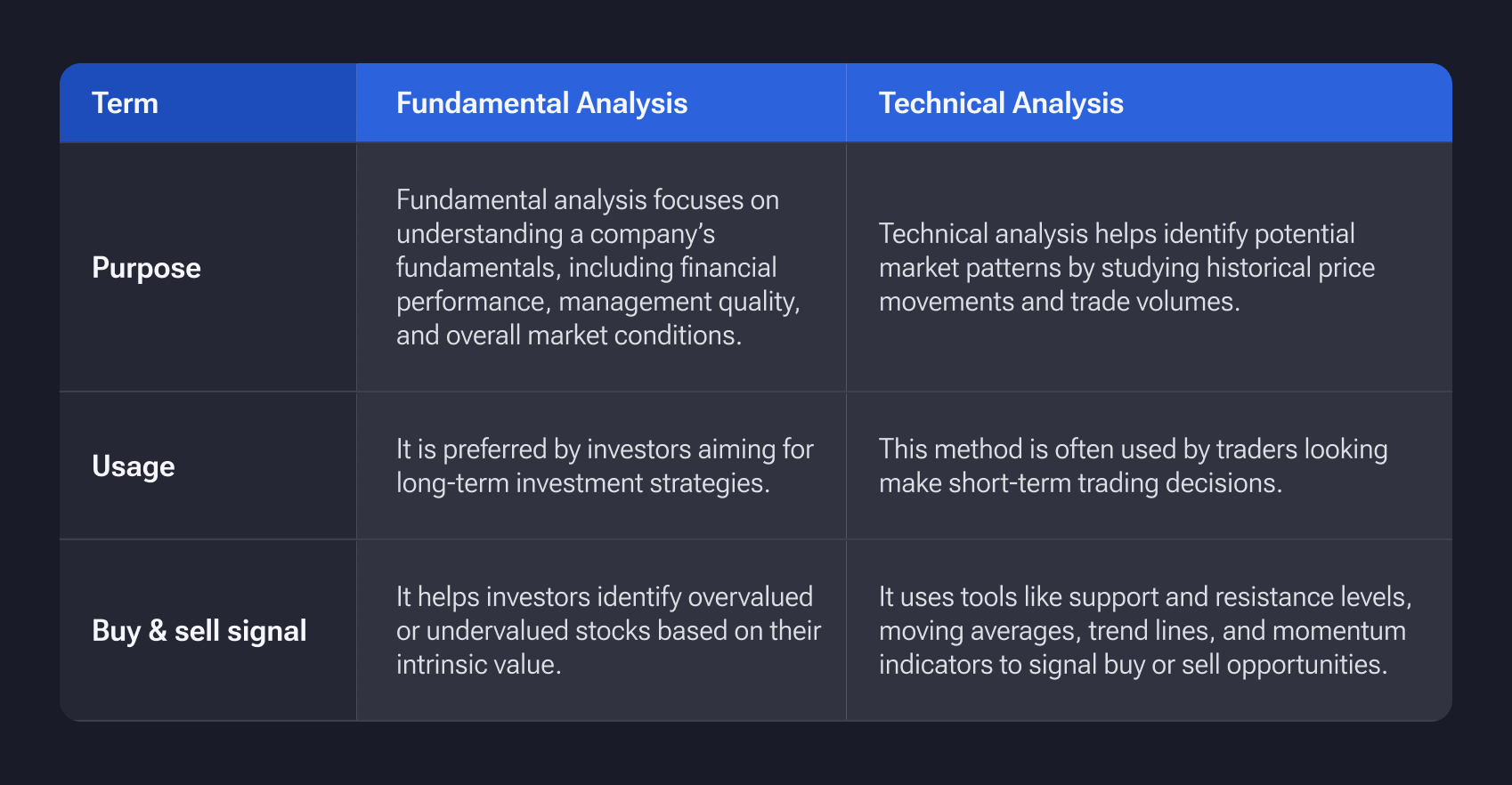
In conclusion, both fundamental and technical analyses are important for investors. Technical analysis looks at short-term market trends, while fundamental analysis focuses on a company's long-term value. Combining insights from both can help investors make better investment decisions.
*Disclaimer: This information is for private use only and does not constitute investment advice. Recipients must assess risks and seek advice from financial, legal, and tax professionals. Private market investments carry risks, and there are no guarantees of returns or capital protection. We are not liable for investment decisions.