Every business, big or small, faces the challenge of keeping money flowing smoothly to meet day-to-day needs. Understanding the working capital cycle can help you see how cash, inventory, and receivables move through your business and how to manage them efficiently.
In this blog, you’ll learn what the operating cycle is, how to calculate it, and why it is crucial. We’ll also discuss strategies to optimize it, highlight common challenges businesses face and show the key distinctions between the operating cycle and the net operating (cash) cycle.
By the end, you’ll have a clear understanding of the working capital cycle and its impact on business operations.
The operating cycle shows how fast a business converts inventory and receivables into cash.
A shorter cycle improves cash flow and reduces the need for extra borrowing.
Cycle length varies across industries; retail is usually shorter, and manufacturing is longer.
Managing inventory, payments, and collections well keeps the business financially stable.
The operating cycle is the time a business takes to buy raw materials, turn them into finished goods, sell them, and collect cash from customers. It shows how long it takes for money invested in operations to return as cash.
As a part of the working capital cycle, it highlights how well a company manages inventory and receivables to maintain steady cash flow. A shorter cycle reflects quicker recovery of funds, while a longer one may point to delays in production, sales, or collections.
Defining the operating cycle is only the beginning; let’s explore its key stages.

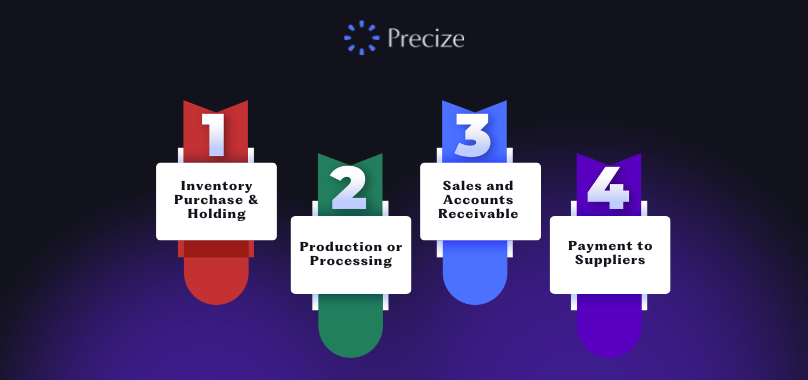
Every business in India, whether large or small, goes through certain stages in this cycle. The main ones include:
1. Inventory Purchase and Holding
This stage begins with purchasing raw materials or stock, either through upfront payment or on credit terms such as net 30 or net 60.
The longer the inventory remains unsold, the more capital gets locked in.
That’s why effective inventory management is crucial to keep the cycle moving quickly.
2. Production or Processing
For manufacturing businesses, this stage involves converting raw materials into finished products.
The faster and more efficient the production process, the shorter the cycle, as materials don’t remain idle for long.
3. Sales and Accounts Receivable
Once goods or services are sold, businesses often extend credit to customers.
The time it takes to collect payments from these sales is called the receivables period.
Speeding up collections helps recover cash faster and strengthens liquidity.
4. Payment to Suppliers (Accounts Payable)
This stage covers the time taken to pay suppliers. Smart management here means taking full advantage of credit terms without straining supplier relationships.
Delaying payments within the allowed period can improve cash flow and support business stability.
Knowing the stages gives you clarity on the process, but calculation helps you track performance and spot areas for improvement.
When you want to measure how quickly your business turns investments in inventory into cash, calculating the operating cycle becomes important. Here is how you calculate it:
Inventory Period: This is the average time your business takes to convert raw materials or stock into sold products. It is calculated using the formula:
Inventory Period = (Average Inventory ÷ Cost of Goods Sold) × 365
This shows the average number of days your inventory remains in stock before it is sold.
Accounts Receivable Period: This measures how many days it takes to collect payments from customers after making a sale. The formula is:
Accounts Receivable Period = (Average Accounts Receivable ÷ Credit Sales) × 365
It reflects how effectively your business collects cash from sales.
Operating Cycle Formula: Once you have both periods, you can calculate the total operating cycle as:
Operating Cycle = Inventory Period + Accounts Receivable Period
Let’s take a simple example for a small business in India:
Average Inventory: ₹2,00,000
Cost of Goods Sold (COGS): ₹10,00,000
Average Accounts Receivable: ₹1,50,000
Credit Sales: ₹9,00,000
= (2,00,000 ÷ 10,00,000) × 365
= 73 days
This means your inventory stays unsold for about 73 days.
= (1,50,000 ÷ 9,00,000) × 365
= 61 days
This means you collect payments in about 61 days, on average.
= 73 + 61
= 134 days
So, your business takes around 134 days from buying inventory to finally receiving cash from customers. A shorter operating cycle means faster recovery of cash, while a longer one shows that money is tied up for more time.
Before exploring strategies to optimize the operating cycle, let’s first see what working capital management entails and why it matters.

Working capital management is the process of efficiently managing a company’s short-term assets and liabilities to ensure smooth day-to-day operations and maintain liquidity. It involves monitoring and controlling elements such as cash, inventory, accounts receivable, and accounts payable to strike a balance between profitability and operational efficiency.
Now that we know what working capital management entails, let’s explore why it’s vital for business success.
A well-managed operating cycle can strengthen your cash position, improve efficiency, and help your business stay prepared for both routine needs and unexpected demands. Here are the key reasons why it matters in working capital management:
Cash Flow Awareness: It shows how long your funds stay tied up in inventory and receivables before turning into cash, helping you track liquidity needs.
Identify Blocked Funds: You can see where cash is getting stuck, whether in unsold stock or unpaid invoices, and act before it causes a shortage.
Smooth Daily Operations: By managing inventory, sales, collections, and supplier payments effectively, you keep your business running without disruptions.
Faster Access to Cash: A shorter cycle means you get cash quicker, which supports regular expenses and future growth.
Avoid Cash Shortages: Good cycle management prevents situations where you have profits on paper but no cash for salaries, bills, or raw materials.
Better Financial Flexibility: Businesses with shorter cycles can respond faster to opportunities and unexpected challenges.
Spot Inefficiencies Early: Regular tracking of the cycle highlights gaps in credit policies, inventory holding, or collections, allowing quick fixes.
Less Dependence on Loans: A well-managed cycle ensures smooth internal cash flow, reducing reliance on external borrowing.
Stronger Business Relationships: The cycle helps you set fair payment terms, negotiate better with suppliers, and reduce customer defaults.
Measure of Financial Health: It serves as a key indicator of your company’s efficiency and stability, guiding better business decisions.
Recognizing its value is essential, but learning the right strategies to optimize the operating cycle is what keeps your business running smoothly.

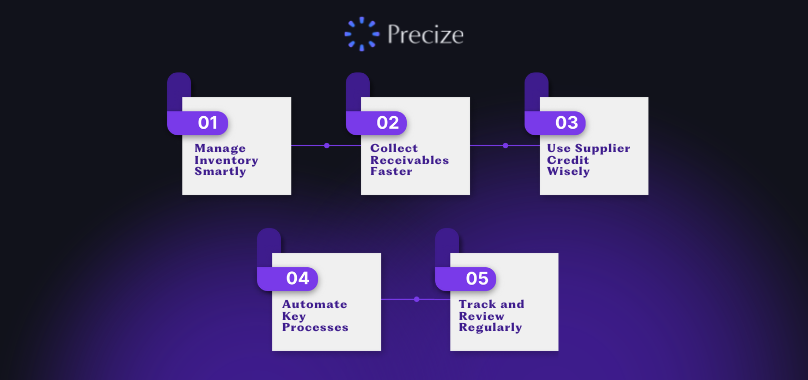
To manage the operating cycle well, you need to focus on reducing the time it takes to convert your resources into cash. Here are some effective strategies:
Try to maintain only the stock that is necessary to meet demand instead of piling up excess goods. Methods like just-in-time (JIT) inventory can help lower storage costs and prevent your money from getting stuck in unsold products.
Make sure your credit policies are clear and send invoices on time. Following up regularly with customers, offering flexible payment terms, and providing multiple payment options can speed up collections and improve cash flow.
Negotiate favourable payment terms with your suppliers, but do it without damaging business relationships. Using the full credit period available allows you to keep cash in hand for longer, giving your business more flexibility.
Using technology to automate tasks like invoicing, payment reminders, and inventory tracking can save time, reduce errors, and make your cash cycle more efficient.
Monitor important metrics such as Days Inventory Outstanding (DIO), Days Sales Outstanding (DSO), and Days Payables Outstanding (DPO). Regularly reviewing these numbers helps you identify gaps and make the necessary adjustments to improve efficiency.
Even with the best strategies in place, businesses often face practical hurdles while managing their operating cycle.
Managing the operating cycle is an important part of working capital, but businesses often face challenges that can affect cash flow and liquidity. Some of the most common ones include:
Keeping too much stock increases storage costs and locks up your cash, making the cycle longer. On the other hand, keeping too little stock can lead to shortages and missed sales opportunities.
When customers take longer to pay their dues, your cash inflow slows down. This extends the operating cycle and creates pressure on liquidity.
Negotiating longer credit terms from suppliers can help you hold on to cash temporarily, but it may also stretch the cycle. Striking the right balance without hurting supplier relationships is often difficult.
Seasonal demand or sudden changes in sales volume can make your inventory and receivables unpredictable. This leads to variations in your operating cycle.
Delays in production, procurement, or order processing slow down inventory turnover, keeping cash tied up for longer periods.
Shifts in market demand or broader economic changes can directly affect how quickly you are able to turn inventory and receivables into cash.
While challenges can slow down the operating cycle, it’s equally important to see how it compares with the net operating cycle, often called the cash cycle.
While both terms may sound similar, the operating cycle and the net operating cycle focus on slightly different aspects of cash movement in your business. Comparing them side by side helps you understand not just how money flows in, but also how supplier credit impacts your overall cash position.
 vs Operating Cycle_v1762003435133.png)
The operating cycle is an important part of working capital management because it shows how quickly your business can turn inventory and receivables into cash. By keeping track of this cycle, you can better manage inventory, customer payments, and supplier obligations, which helps maintain steady cash flow and smooth daily operations. Since the duration of the operating cycle varies across industries, understanding your own cycle becomes essential for financial efficiency and stability.
If you’re looking for deeper insights beyond basic financial metrics, Precize can be a helpful partner. Precize is an alternative investment platform in India that gives you access to private equity and private credit opportunities.
It also provides detailed research reports, including balance sheets, cash flow statements, income statements, and peer comparisons, so you can rely on clear data before making decisions.
Reserve your access with Precize today and start building a diversified portfolio!
1. What role does the operating cycle play in working capital management?
The operating cycle shows you how quickly money tied up in stock and credit sales comes back as cash. It helps you manage inventory and customer payments in a way that keeps daily operations running without interruption.
2. How can the operating cycle affect your business cash flow?
A long operating cycle means your money stays blocked in stock or unpaid bills for a longer time, leading to cash shortages. If managed well, the cycle ensures smooth payments and faster collections, which keeps your business stable.
3. Can the operating cycle be different for different industries?
Yes, it varies across industries. For example, retail usually has a shorter cycle because sales move faster, while manufacturing often has a longer cycle due to production time and credit terms.
4. What is considered a good operating cycle duration?
There isn’t a single number that applies to all. It mainly depends on your industry. Still, having a cycle that’s shorter compared to others in the same industry usually helps maintain stronger cash flow.
5. What happens if the operating cycle becomes too long?
A very long cycle can cause cash flow gaps, force you to depend on costly borrowing, or delay payments to suppliers. Over time, this can strain business relationships and affect your ability to grow smoothly.
This blog is for informational purposes only and should not be considered financial advice. The content is intended to explain concepts related to working capital management and the operating cycle in simple terms. Readers are advised to consult qualified professionals before making any financial or business decisions.

Join our newsletter for exclusive access to thoughtfully curated content and we promise, no spam
Company
Our Office
Office No. 1219, The Summit Business Park, Andheri Kurla Road, Andheri East, Mumbai, Maharashtra - 400093
Find us on Googlesupport@precize.in
+91 7738336457
All trademarks and logos or registered trademarks and logos found on this Site or mentioned herein belong to their respective owners and are solely used for informational and educational purposes.
The material presented in this advertisement is for informational purposes only and should not be construed as investment advice or investment availability. It is not a recommendation of, or an offer to sell or solicitation of an offer to buy, any particular unlisted share, security, strategy, or investment product. Investing in the private market and securities involves risks, including the potential loss of money, and past performance does not guarantee future results. Market trends, data interpretations, graph projections are provided for informational and illustrative purposes and may not reflect actual future performance. Nothing on this website should be construed as personalized investment advice or should not be treated as legal, financial, or any other form of advice. Precize is not liable for financial or any other form of loss incurred by the user or any affiliated party based on information provided herein.
Precize is neither a stock exchange nor does it intend to get recognized as a stock exchange under the Securities Contracts Regulation Act, 1956. Precize is not authorized by the capital markets regulator to solicit investments. The securities traded on these platforms are not traded on any regulated exchange.
The website will be updated regularly.
Copyright © 2026 - Precize - All Rights Reserved