The Quick-Commerce Race Is Moving Beyond Volume
Zepto is not alone in changing its approach.
The three major players Blinkit, Zepto and Swiggy Instamart are increasingly focusing on improving monetisation and profitability alongside expansion.
Blinkit has already reported positive adjusted EBITDA at the quick-commerce level for Q4 FY26, while Instamart has also been working on improving its unit economics.
This means Zepto's competitive challenge is evolving.
Earlier, the key question was: Who can build the largest network and process the most orders?
Now, investors are likely to ask:
Who can generate the highest value per order?
Who can improve contribution margins fastest?
Who can achieve profitability without sacrificing customer growth?
Who can build a sustainable dark-store network?
For Zepto, increasing AOV could help address several of these questions simultaneously.
What Could Drive Zepto's AOV Higher?
Zepto can potentially increase basket sizes through several strategies:
1. Expanding Beyond Everyday Groceries
Quick commerce is increasingly moving into categories such as electronics, beauty, fashion, home essentials and other higher-value products. A broader product mix could naturally increase basket values.
2. Encouraging Larger Baskets
Personalised recommendations, bundled offers and minimum-order incentives can encourage customers to add more products to each order.
3. Growing Advertising Revenue
As the customer base and transaction volumes grow, brands may spend more on visibility within the platform. Advertising can provide a higher-margin revenue stream without requiring a proportional increase in delivery costs.
4. Improving Customer Monetisation
Subscription programmes, convenience fees and other monetisation initiatives can increase revenue generated from an existing customer base.
Zepto's IPO Will Put the Strategy Under the Spotlight
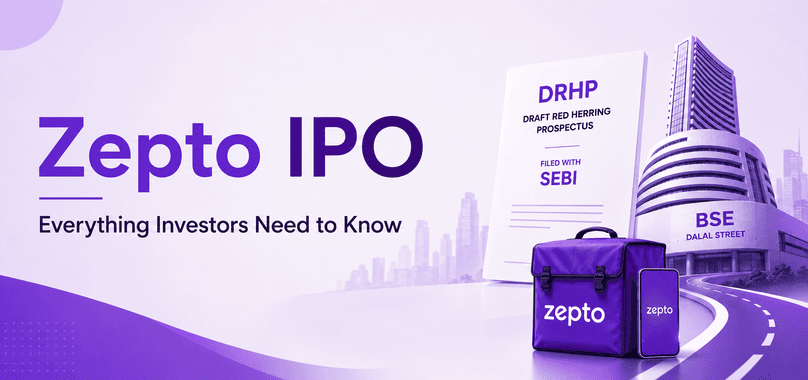
Zepto's profitability push is particularly important because the company has been preparing for an IPO.
Its updated DRHP showed ₹7,498 crore of revenue in Q4 FY26, up 75% year-on-year, while the quarterly net loss narrowed to around ₹1,539 crore.
However, the company still reported an adjusted EBITDA loss of approximately ₹1,247 crore for the quarter.
This creates an interesting IPO story.
Zepto has already demonstrated demand, scale and rapid revenue growth. The next stage is about proving that this scale can translate into better monetisation and sustainable cash generation.
That is likely to make AOV, contribution margins, loss per order and cash flows important metrics for investors to track.
What Does This Mean for Investors?
Zepto's strategic shift is an important development for investors following India's unlisted and pre-IPO market.
The company has moved from a "growth first" narrative toward a "growth plus profitability" narrative. That could strengthen its IPO story if Zepto manages to increase AOV while retaining customers and maintaining order growth.
However, the transition also carries risks.
Higher prices or fewer aggressive discounts could affect customer frequency, while increasing basket sizes may take time. At the same time, competition remains intense, with established players continuing to expand and new entrants investing in quick commerce.
Therefore, investors should look beyond headline revenue growth and track unit economics, AOV, order growth, customer retention, dark-store productivity and the path toward profitability.
The Bigger Picture for India's Quick-Commerce Industry
Zepto's move highlights a broader evolution in Indian quick commerce.
The industry has already proven that consumers are willing to pay for convenience and ultra-fast delivery. The next challenge is proving that this convenience can become a profitable and scalable business model.
If Zepto can successfully increase its average order value while keeping customers engaged, improving per-order economics and controlling expansion costs, the strategy could strengthen its long-term business profile.
For investors tracking Zepto ahead of its potential IPO, the next phase may be less about how many orders Zepto can generate and more about how much value it can create from every order.
To compare companies, documents, and availability explore unlisted companies on Precize. For ongoing IPO and private-market updates, browse the Precize blog. Stay updated with unlisted companies through our Precize Community. If this article was useful, you can share it with other investors through the Precize Referral Program.
Frequently Asked Questions
1. Why is Zepto focusing on average order value?
Zepto is focusing on higher AOV to improve monetisation and unit economics instead of relying primarily on increasing order volumes.
2. What is Zepto's average order value?
Jefferies estimated Zepto's AOV at around ₹357, below the estimated AOV of Blinkit and Instamart.
3. Is Zepto profitable?
No. Zepto remained loss-making in FY26, although its loss per order improved compared with the previous year.
4. Is Zepto planning an IPO?
Zepto has filed an updated DRHP for a proposed IPO, making its profitability and monetisation strategy particularly important for prospective public-market investors.
5. What should investors track in Zepto going forward?
Key metrics include average order value, order growth, revenue, loss per order, dark-store productivity, customer growth, contribution margins and the company's path toward profitability.
Disclaimer: This article is for informational purposes only and should not be considered as investment advice. Investing in unlisted shares carries risks including illiquidity and potential loss of capital. Please consult with a qualified financial advisor before making investment decisions. Precize is not a stock exchange and is not authorized by any capital markets regulator.