
Reaching a 5 trillion economy is more than just a headline figure; it’s a vision that directly connects to jobs, industries, infrastructure, and the standard of living in India. As someone following the country’s financial progress, you know this goal has been at the center of policy debates, business discussions, and public aspirations.
In this blog, you will understand what a $5 trillion economy really means, where India’s economy stands today, and the major forces driving this journey. You will also explore the hurdles that need to be addressed and the government’s strategic roadmaps.
Scroll down to explore!
At a Glance
India plans to achieve a $5 trillion economy by expanding its services, manufacturing, export sectors, and digital economy.
Key growth drivers include services sector expansion, manufacturing with PLI support, infrastructure development, exports, digital transformation, and a young workforce.
Challenges on the way include global economic uncertainty, job and skill gaps, infrastructure bottlenecks, financial sector issues, and inclusive growth.
Strategic government initiatives like Make in India, PLI schemes, Digital India, Skill India, and renewable energy programs are driving sustainable growth.
What Does a $5 Trillion Economy Mean?
The goal of a $5 trillion economy for India represents the total value of all goods and services produced in the country, measured as GDP. This milestone is not just about a bigger number; it reflects the scale of economic activity, higher productivity, and stronger global presence.
With the meaning of a $5 trillion economy clear, it’s important to examine India’s present economic position to see the progress made so far.
Snapshot of India’s 5 Trillion Economy in 2025
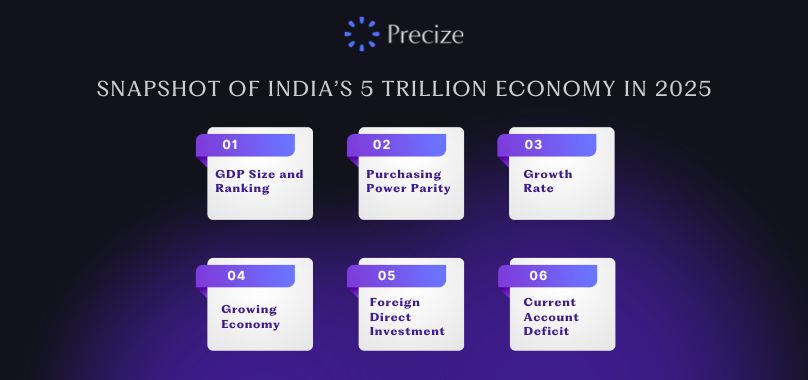
This snapshot highlights India’s current position on its path to becoming a $5 trillion economy:
1. GDP Size and Ranking
India’s nominal GDP in 2024 was around $3.91 trillion with a growth rate of 6.5%. In 2025, the International Monetary Fund (IMF) estimates GDP at $4.19 trillion, making India the fourth-largest economy in the world.
2. Purchasing Power Parity (PPP)
On a PPP basis, India’s GDP is projected to reach nearly $20.7 trillion by 2030, highlighting its larger economic weight compared to nominal values.
3. Growth Rate
In the April–June quarter of 2025, the economy grew by 7.8% year-on-year, beating forecasts. The services sector posted its fastest growth in 15 years, while the composite PMI climbed to a 17-year high of 63.2.
4. Fastest-Growing Major Economy
India continues to hold the position of the world’s fastest-growing major economy in 2025, with an estimated GDP growth rate of about 6.2% for the year.
5. Foreign Direct Investment (FDI)
FDI inflows reached nearly $81.04 billion in FY 2025, showing steady global confidence in India’s economic potential.
6.Current Account Deficit (CAD)
India’s CAD improved to 0.6% of GDP in FY 2024–25, though projections suggest it may rise to 1.2% of GDP in FY26 due to external pressures.
With the current numbers in mind, it’s time to identify the sectors and initiatives fueling India’s progress toward $5 trillion.
Key Drivers for India’s $5 Trillion Economy
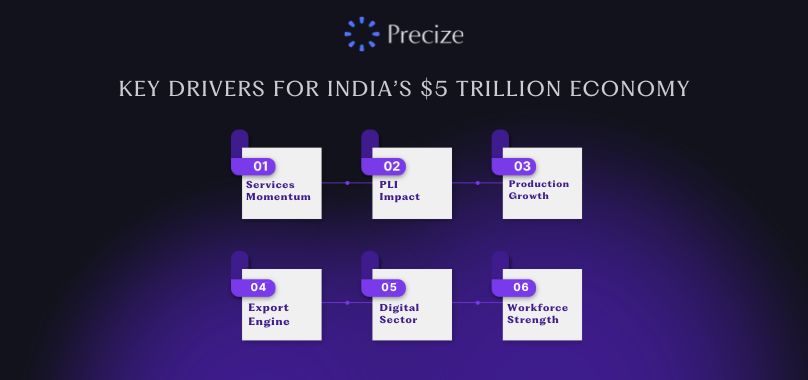
Achieving a $5 trillion economy relies on multiple key sectors driving growth together. Below is a closer look at the main drivers, along with the numbers that show their impact:
1. Services Sector Momentum
The services sector continues to drive India’s economy. It contributed nearly 55.3% of Gross Value Added (GVA) in FY 2024–25, compared to 50.6% in FY 2013–14. Between FY 2022 and FY 2025, this sector grew at an average of 8.3% annually, showing its steady strength.
2. Manufacturing and PLI Impact
The Production-Linked Incentive (PLI) scheme has given a major push to industries, especially electronics. Production in this sector grew by 146%, rising from ₹2.13 lakh crore in FY 2020–21 to ₹5.25 lakh crore in FY 2024–25. Overall, PLI attracted ₹1.76 lakh crore in investments, added ₹16.5 lakh crore in output, and created around 1.2 million jobs by March 2025.
3. Manufacturing Growth
India’s manufacturing sector is gaining momentum. In August 2025, the Purchasing Managers’ Index (PMI) touched 59.3, the highest since 2008. Industrial output also recorded a 7.7% year-on-year increase, reflecting strong activity in this segment.
4. Exports as a Growth Engine
Exports remain a key contributor to economic growth. In FY 2025, India’s exports touched $437 billion, led by engineering goods, petroleum products, and electronic items. This diversity highlights the growing strength of India’s global trade basket.
5. Digital and IT Sector
The IT and Business Process Management (BPM) sector is a key part of India’s economy, making up roughly 7.4% of GDP in FY 2022. In FY 2024, the sector earned $253.9 billion in revenue.
6. Demographic and Workforce Strength
India’s young and expanding workforce remains one of its biggest advantages. With the second-largest labor force in the world, the country is well-positioned to maintain economic growth over the long term.
These drivers are the backbone of India’s economic expansion, yet several obstacles remain that could impact progress.
Challenges on the Road to $5 Trillion Economy in India
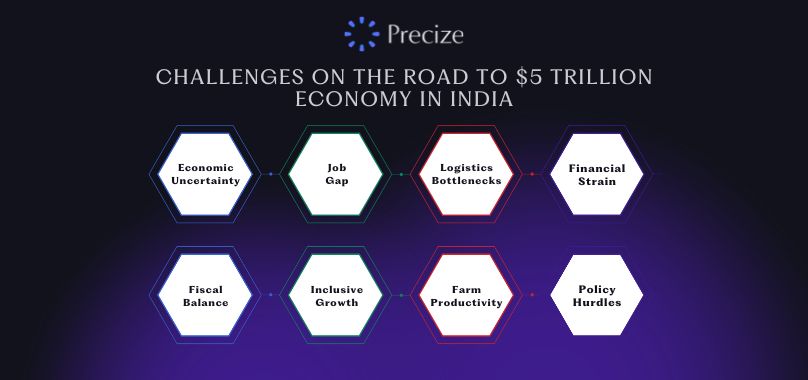
The journey to a 5 trillion economy is ambitious, but it comes with challenges that need to be addressed carefully. These factors directly influence how fast and how steadily India can grow:
1. Global Economic Uncertainty
The world economy is facing headwinds from geopolitical conflicts, inflation, and slowdowns in major markets. These issues affect India’s trade, export demand, and overall stability.
2. Job Creation and Skills Gap
While millions of young people are entering the workforce each year, many lack the skills required by industries. Expanding vocational training and skill development programs is essential to close this gap.
3. Infrastructure and Logistics Bottlenecks
Roads, ports, and urban systems are still under pressure. Delays in projects and high logistics costs reduce competitiveness. Faster execution of large infrastructure plans is necessary.
4. Financial Sector Strain
Small and medium businesses often struggle to access affordable credit. Banking sector challenges, including stressed assets, make it harder for businesses to expand and innovate.
5. Fiscal Balance
Managing government spending while keeping the fiscal deficit under control remains a delicate task. Striking the right balance is important for sustainable growth.
6. Inclusive Growth
Rural–urban gaps in income and opportunities remain a concern. Ensuring that growth benefits reach all sections of society is key to long-term progress.
7. Agricultural Productivity
With a large share of the workforce depending on farming, agriculture reforms are critical. Improving productivity, modernizing practices, and providing better market access will help strengthen this sector.
8. Regulatory and Policy Hurdles
Complex regulations and delays in approvals often slow down business activity. Making processes simpler and improving the ease of doing business are ongoing priorities.
Overcoming these challenges is possible with well-planned policies and strategic initiatives that guide the economy forward.
Strategic Plans and Government Initiatives
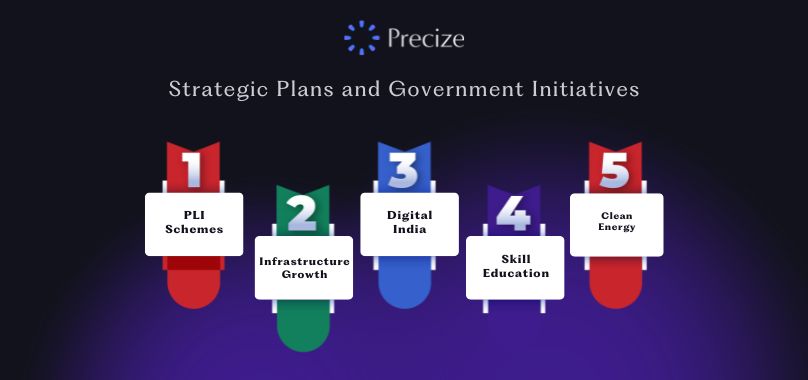
As you move toward the goal of a 5 trillion economy, the government has been rolling out several policies and programs to speed up growth. These efforts cover everything from infrastructure and manufacturing to digital services and workforce development, creating a stronger base for the future.
1. Make in India and PLI Schemes
With Make in India and Production-Linked Incentive (PLI) schemes, the focus is on building a strong manufacturing sector.
These programs encourage growth in electronics, automobiles, and pharmaceuticals, while also reducing heavy reliance on imports.
2. Infrastructure Development
Large-scale projects under the National Infrastructure Pipeline (NIP) and PM Gati Shakti are aimed at building better roads, railways, ports, and energy networks.
Stronger infrastructure helps lower logistics costs and supports faster trade and industrial growth.
3. Digital India
The Digital India program is making government services, financial tools, and e-commerce more accessible online.
This push toward digitization is improving transparency, efficiency, and financial inclusion across the country.
4. Skill Development and Education
Through initiatives like Skill India and the New Education Policy (NEP), the government is preparing the workforce for future opportunities.
These efforts focus on skilling, digital training, and vocational education to close the gap between industry needs and available talent.
5. Clean Energy and Sustainability
Programs such as the National Solar Mission are moving India toward renewable energy.
India aims to achieve 500 GW of renewable energy capacity by 2030, reflecting its focus on sustainable and clean growth.