Financial Planning for Smarter Investments: Steps, Benefits, & Common Mistakes to Avoid

Build your financial plan: assess assets, set SMART goals, create a budget, reduce debt, and prioritize savings. Start planning now!
7 min read
financial planning

In India, financial planning is becoming more common than ever. According to a recent study that surveyed over 4,000 people across 12 cities, nearly 94% of respondents said they either have a detailed financial plan or have done some form of planning. 

This shows that most people today understand the importance of having a clear plan for managing their money, but not everyone knows where to begin or how to make it truly effective. 

That’s where this blog can help. Here, you’ll understand what a financial plan actually is and why it matters. We’ll walk you through the key benefits of financial planning, explain 8 practical steps to help you create your own plan, and highlight common mistakes you should watch out for.  

Whether you're managing a salary, running a household, or saving for goals, this blog offers a simple way to get started with your financial planning.

Let’s start with the basics!

Key Takeaways:

  • A financial plan is a clear roadmap that outlines your income, expenses, assets, debts, and financial goals.

  • Key benefits include better control over your money, reduced stress, and improved decision-making.

  • Effective planning steps include assessing your finances, setting goals, budgeting, building an emergency fund, managing debt, and reviewing regularly.

  • Common mistakes to avoid are skipping budgeting, ignoring emergency funds, overspending, and delaying planning.

What Is a Financial Plan?

A financial plan is a written document that outlines your current financial situation, your future financial goals, and the steps you need to take to achieve those goals. It includes key details like your income, expenses, savings, debts, and assets. A good financial plan clearly shows how your money flows in and out, and helps you map out a strategy for handling your finances over time.

Understanding the definition is just the first step; what truly makes a financial plan useful is the benefits it brings.

Key Benefit of a Financial Plan
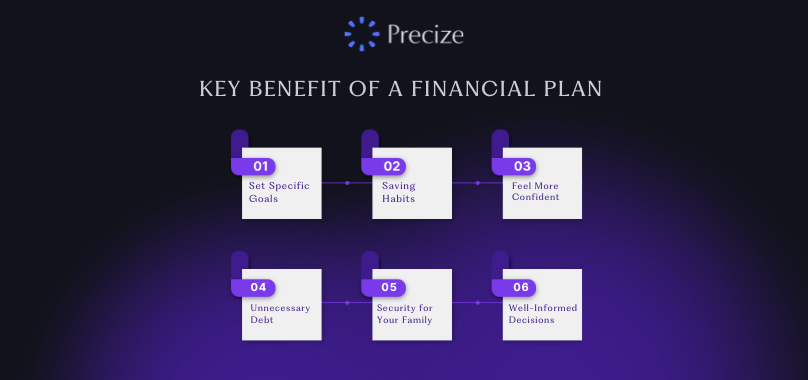
A financial plan gives you a complete view of your money, how much you earn, how you spend it, what you save, and what you owe. The biggest advantage is that it puts you in control of your finances, helping you stay prepared for both everyday expenses and unexpected situations. The following are some of the key benefits of a financial plan:

  1. Set Specific Goals

Whether it’s saving for your child’s education, buying a home, or planning a vacation, a plan helps you define and work towards your personal goals.

  1. Monitor Your Spending and Saving Habits

It shows where your money goes each month, making it easier to cut down on waste and improve your savings.

  1. Feel More Confident and Less Stressed

Knowing you have a plan in place reduces the worry that comes with surprise expenses or financial emergencies.

  1. Stay Away from Unnecessary Debt

With proper planning, you can manage loans and credit smartly, avoiding situations where debt becomes unmanageable.

  1. Create Long-Term Security for Your Family

A solid financial plan ensures that you’re better prepared for the future, making life more stable for your loved ones.

  1. Make Well-Informed Decisions

Having a plan allows you to weigh your options carefully and make choices that are right for your financial situation, whether it’s about spending, saving, or budgeting.

Knowing the ‘why’ is important, now let’s move on to the ‘how’ of building your personal financial roadmap.

Effective 8 Steps to Create a Financial Plan
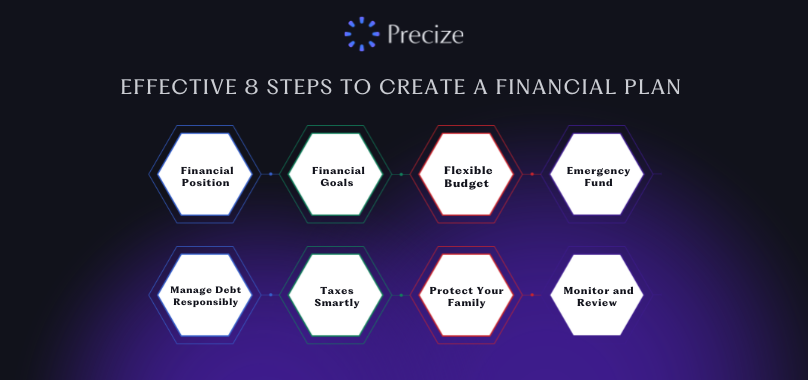
 

Taking charge of your finances doesn't require expert knowledge; it just needs a structured approach and regular attention. A financial plan acts like a roadmap that guides your money decisions, helps you prepare for uncertainties, and supports your long-term goals. Here’s how you can build your own financial plan in a simple yet effective way, keeping Indian financial realities in mind:

Step 1: Assess Your Current Financial Position

Start by understanding where you stand financially.

  • List all sources of income, your salary, freelance work, business income, rent, interest from savings, etc.

  • Write down your regular expenses. These include fixed costs like rent, school fees, EMIs, and variable ones like groceries, electricity, travel, and eating out.

  • Calculate your total assets, such as savings in the bank, fixed deposits, mutual funds, real estate, gold, or any other valuables.

  • Identify your liabilities, home loans, personal loans, credit card dues, or any money borrowed.

Step 2: Set Clear and Measurable Financial Goals

Without goals, your plan has no direction. Define what you want your money to achieve.

  • Break your goals into short-term (0–3 years), mid-term (3–5 years), and long-term (5+ years).

  • Examples include building a ₹1 lakh emergency fund, saving ₹10 lakhs for a down payment, or planning ₹25 lakhs for your child’s education.

  • Be specific: set a clear amount and timeline for each goal.

Step 3: Create a Realistic and Flexible Budget

Your budget decides how well you stick to your plan.

  • Start by tracking every rupee spent over a month. Use apps, notebooks, or spreadsheets, whatever works for you.

  • Divide your income into three buckets: needs (essentials like rent, groceries, transport), wants (dining, shopping, entertainment), and savings.

  • Adjust the balance if you’re overspending or saving too little.

Step 4: Build an Emergency Fund

Life is unpredictable, and emergencies come without warning.

  • Aim to save at least 3 to 6 months’ worth of essential living expenses. This includes rent, bills, groceries, school fees, etc.

  • Keep this fund in a separate savings account or liquid instrument that’s easy to access in urgent situations.

Step 5: Reduce and Manage Debt Responsibly

Debt isn’t always bad, but unmanaged debt can damage your financial health.

  • Make a list of all your loans, their EMIs, and interest rates.

  • Focus on clearing high-interest debt first, especially credit cards and personal loans.

  • Avoid unnecessary borrowing. If you must take a loan, ensure it fits your repayment capacity and doesn't strain your budget.

Step 6: Plan Your Taxes Smartly

Understanding tax laws helps you keep more of what you earn.

  • Identify all your taxable income sources, salary, rent, capital gains, etc.

  • Learn about deductions under sections like 80C, 80D, and HRA exemptions.

  • Maintain proper documentation of investments and expenses to claim benefits when filing your return.

Step 7: Protect Your Family with the Right Insurance

Unexpected events can create major financial stress if you're not prepared.

  • Ensure you have adequate health insurance for yourself and your family.

  • If others depend on your income, consider term life insurance.

  • Check if your vehicle and property are properly insured against risks.

Step 8: Monitor and Review Your Plan Regularly

Your financial plan should evolve with your life.

  • Set a reminder to review your plan every 6 to 12 months.

  • Update your goals and budget if there’s a major life change, like marriage, a job switch, a newborn, or buying a house.

  • Keep track of your progress and adjust your strategies as needed.

Before you put your plan into action, take a moment to learn about the usual missteps. Avoiding them can save you time, money, and effort.


Common Mistakes to Avoid in Financial Planning

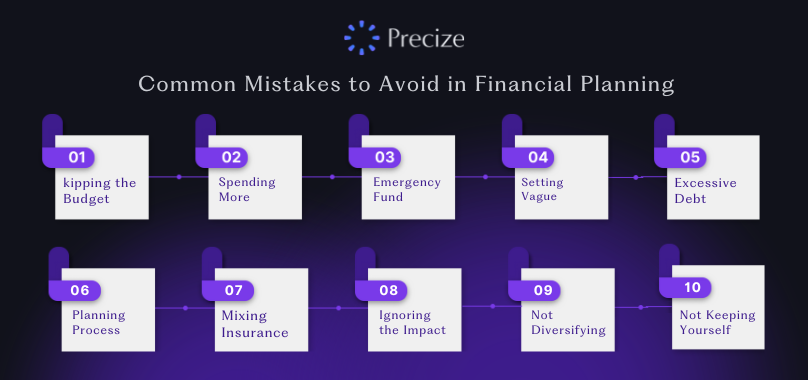
While creating your own step-by-step financial plan is a smart move, it’s just as important to be aware of the mistakes that can weaken it. By knowing these common mistakes, you can avoid them and build a more reliable and effective financial plan for the long run.

  1. Skipping the Budget or Not Sticking to One

One of the biggest mistakes is not having a proper budget. 

  • Without tracking your income and expenses, it becomes difficult to manage your money or spot where it's leaking. 

  • Even if you have a budget, not following it consistently can lead to overspending and financial imbalance.

  1. Spending More Than You Earn

Many people fall into the trap of spending based on lifestyle expectations rather than actual income. 

  • Living beyond your means, especially with the easy availability of credit, can lead to debt and ongoing financial stress.

  • It’s important to align your spending with your income, not with what others are doing or what you wish you could afford.

  1. Ignoring the Need for an Emergency Fund

Unexpected events like a medical emergency, job loss, or home repairs can throw your finances off track. 

  • Not having a separate fund for such situations forces you to borrow or dip into your savings. 

  • A dedicated emergency fund adds a safety cushion and keeps your financial plan intact during tough times.

  1. Setting Vague or No Financial Goals

Planning without specific, measurable goals is like travelling without a destination. If you don’t clearly define what you want, like how much to save for your child’s education or when you want to buy a home, it’s hard to plan or track your progress effectively.

  1. Taking Unnecessary Loans or Accumulating Excessive Debt

Using loans or credit cards to fund non-essential purchases can lead to a debt trap.

  • High-interest debt, in particular, eats into your income and limits your ability to save.

  • Borrow only when absolutely necessary, and always have a repayment plan in place.

  1. Delaying the Planning Process

Many people wait for the “right time” to start planning, which often leads to missed opportunities or being unprepared during emergencies. 

  • Financial planning should begin early, whether you’re starting your career, getting married, or starting a family. 

  • The sooner you start, the more control you’ll have.

  1. Mixing Insurance with Investments

A common mistake is buying insurance plans that are bundled with investment products. 

  • These often offer poor returns and insufficient coverage. 

  • It’s more effective to keep your life and health insurance separate from your investment strategies so that each serves its true purpose.

  1. Ignoring the Impact of Taxes and Inflation

Taxes and inflation directly affect your financial growth. 

  • If you don’t factor in how much tax you’ll pay or how prices may rise over time, your savings may fall short in the future. 

  • Always include these factors when planning for long-term financial goals.

  1. Not Diversifying Your Savings

Putting all your money in one type of account or instrument increases risk. 

  • For example, keeping everything in a savings account may keep your funds safe, but doesn’t help them grow.

  • Diversifying across different options, like FDs, Public Provident Fund (PPFs), or other safe instruments, can improve returns and reduce risk.

  1.  Not Keeping Yourself Informed

Financial rules, products, and tools are constantly changing. 

  • If you don’t take the time to learn or update your knowledge, you may make decisions based on outdated information. 

  • Being financially aware helps you make better, more suitable choices for your situation.

Conclusion 

By now, you’ve learned everything you need to know to start building your own step-by-step financial plan, from assessing your current financial situation and setting clear goals to creating a realistic budget, managing debt, and reviewing your plan regularly. You’ve also seen the common mistakes to avoid and the importance of staying informed and prepared for life’s uncertainties. 

To complement your financial planning journey, Precize provides access to exclusive private market opportunities. It enables you to invest in leading private growth companies by buying and selling unlisted and pre-IPO shares. You also get access to unique global trade finance deals that allow you to diversify your portfolio through alternative fixed-income opportunities.

Reserve your access today and discover a diversified portfolio tailored to help you grow smarter and plan better!

Frequently Asked Questions (FAQs)

1. How do I set financial goals?

Start by identifying what you want to achieve with your money. Set goals that are specific, realistic, and time-bound. These can include short-term goals (like building an emergency fund), medium-term goals (like buying a car), and long-term goals (like retirement or a child’s education).

2. Why is budgeting important in financial planning?

Budgeting helps you track income, control spending, and plan savings. It ensures you don’t overspend and allows you to manage your money better. A common approach is the 50/30/20 rule: 50% for needs, 30% for wants, and 20% for savings.

3. What is an emergency fund, and how much should I keep?

An emergency fund is money kept aside for sudden expenses like medical emergencies or job loss. It’s recommended to save enough to cover 3 to 6 months of basic living costs.

4. How do I assess my risk profile?

Your risk profile depends on factors like your age, income, dependents, and how comfortable you are with financial uncertainty. Knowing it helps you make better decisions and avoid stress.

5. How often should I review my financial plan?

Review your plan at least once a year or whenever there’s a major life change, like marriage, a new job, or having children. This keeps your plan relevant and effective.

6. What should I do if my expenses are more than my income?

Start by tracking your spending. Cut down on non-essential expenses and look for ways to increase your income if possible. Stick to a budget to regain control.

7. Is debt management part of financial planning?

Yes. Managing and reducing debt is essential. List all your debts, focus on high-interest ones first, and avoid taking new loans unless necessary.

8. Do I need professional help to create a financial plan?

You can create a basic plan on your own. But if your finances are complex or you feel unsure, consulting a financial advisor can be helpful.

Disclaimer

This content is for informational purposes only and does not constitute financial advice. Always consult a qualified financial advisor before making any financial decisions. The information shared here is based on general practices and may not apply to every individual’s financial situation.


Precize
Precize
Content Strategy and Research Analyst

Stay in the Loop

Join our newsletter for exclusive access to thoughtfully curated content and we promise, no spam

The next generation of asset classes in India

Resources

Our Office

Office No. 1219, The Summit Business Park, Andheri Kurla Road, Andheri East, Mumbai, Maharashtra - 400093

Find us on Google

support@precize.in

+91 7738336457

All trademarks and logos or registered trademarks and logos found on this Site or mentioned herein belong to their respective owners and are solely used for informational and educational purposes.

The material presented in this advertisement is for informational purposes only and should not be construed as investment advice or investment availability. It is not a recommendation of, or an offer to sell or solicitation of an offer to buy, any particular unlisted share, security, strategy, or investment product. Investing in the private market and securities involves risks, including the potential loss of money, and past performance does not guarantee future results. Market trends, data interpretations, graph projections are provided for informational and illustrative purposes and may not reflect actual future performance. Nothing on this website should be construed as personalized investment advice or should not be treated as legal, financial, or any other form of advice. Precize is not liable for financial or any other form of loss incurred by the user or any affiliated party based on information provided herein.

Precize is neither a stock exchange nor does it intend to get recognized as a stock exchange under the Securities Contracts Regulation Act, 1956. Precize is not authorized by the capital markets regulator to solicit investments. The securities traded on these platforms are not traded on any regulated exchange.

The website will be updated regularly.

Copyright © 2026 - Precize - All Rights Reserved

Financial Planning for Smarter Investments: Steps, Benefits, & Common Mistakes to Avoid