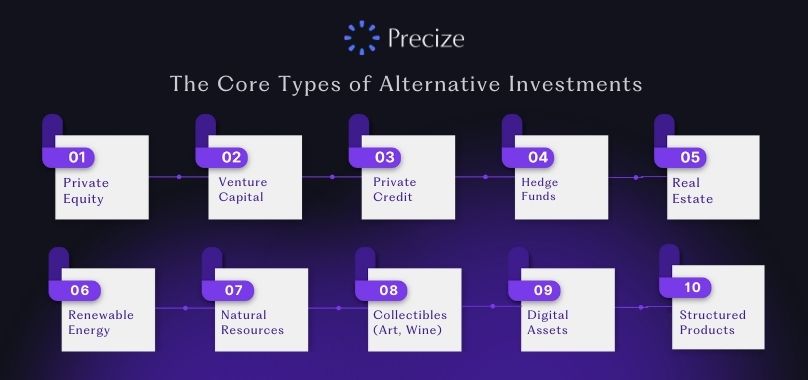
2. Venture Capital
Venture capital is investing in early-stage companies. The reward is potentially massive returns if a startup succeeds, but the risk is equally high since many companies fail. Returns often follow a “power law,” where only a few investments drive most of the gains.
One challenge for early investors is the reduction in ownership stake when new funding rounds bring in additional investors. Liquidity is also limited, with exits such as IPOs or acquisitions typically taking 7 to 12 years.
Venture capital represents the risk-taking edge of alternatives. But if you prefer income-oriented strategies, private credit might be more appealing.
3. Private Credit
Private credit, also known as private debt, involves lending directly to companies outside of traditional banking systems. Strategies include direct lending, mezzanine financing, and special situations.
This market has grown rapidly. According to PwC, by September 2024 private debt unrealised value and dry powder reached 1.05 trillion US dollars, nearly doubling since 2019. The appeal lies in steady income, often from floating-rate loans, but liquidity is limited and downturns in the credit cycle can create losses.
Private credit is often seen as the income-generating heart of alternatives. For investors who want flexible strategies, hedge funds offer a very different approach.
Tap into stable, income-focused investments with Precize private credit.
4. Hedge Funds
Hedge funds use diverse strategies such as long/short equity, global macro, and event-driven investing. They aim to deliver returns that are not tightly correlated to the stock market.
By Q3 2024, hedge fund assets under management reached 4.9 trillion US dollars, with average returns around 10 percent that year. However, the SEC has cautioned that hedge funds with illiquid holdings can sometimes report artificially smooth returns. Fees are also high, often “two and twenty,” though investor.gov notes that mutual fund variants may provide lower-cost access.
Hedge funds bring flexibility but also complexity. Real estate, on the other hand, is more familiar to most investors.
5. Real Estate (Private & Listed)
Real estate can provide rental income and potential appreciation. Strategies include direct property ownership, private funds, or listed REITs. Risks include vacancies, refinancing pressures, and sensitivity to interest rates.
During market stress, some open-ended property funds have restricted redemptions, a reminder that real estate is not always as liquid as investors expect.
Real estate anchors portfolios with tangible assets. Infrastructure, another real asset, offers even more predictable cash flows.
6. Infrastructure and Renewable Energy
Infrastructure assets such as toll roads, airports, and renewable energy projects generate regulated or contracted cash flows. Many are linked to inflation, which makes them attractive during rising price environments.
The key risk is policy or regulatory change, especially for renewable energy projects.
Infrastructure provides stability, while commodities bring exposure to global supply and demand cycles.
7. Commodities and Natural Resources
Commodities such as oil, gold, and agricultural products can act as inflation hedges. Investors often use futures contracts, but these come with roll yield risks and volatility. Geopolitical events also play a major role in commodity price swings.
Commodities can hedge inflation but are volatile. If you want something more personal, collectibles may appeal.
8. Collectibles (Art, Wine, Cars)
Collectibles are passion-driven investments. Some rare items appreciate dramatically, but they are illiquid, costly to insure, and subjective in valuation.
Collectibles highlight the emotional side of investing. Digital assets, in contrast, are driven by technology and regulation.
9. Digital Assets and Tokenised Real-World Assets
Digital assets include cryptocurrencies and tokenised versions of traditional assets. Tokenisation aims to make investing more efficient by allowing fractional ownership and faster settlement.
However, regulation is tightening. The FCA classifies crypto promotions in the UK as “Restricted Mass Market Investments,” requiring risk warnings, appropriateness tests, and cooling-off periods. Reports from the Bank for International Settlements and Financial Stability Board warn that tokenisation creates both opportunities and new risks.
Digital assets are innovative but uncertain. For investors wanting structured exposure, semi-liquid funds are another option.
10. Structured Products and Semi-Liquid Funds
Structured products combine derivatives with traditional securities to offer tailored payoffs. Semi-liquid funds like interval or tender-offer funds allow periodic liquidity but come with layered fees. They are often designed for mass-affluent investors who want access to alternatives without full lock-ups.
Now that we have seen the wide landscape of alternatives, let us look at why investors actually consider them and what risks they need to prepare for.
Also Read: Understanding Basics Of Financial Business: Types And Importance
Benefits: Why Consider the Types of Alternative Investments?

Alternative investments offer several compelling benefits:
Diversification: Alternatives can reduce dependence on traditional equity and bond returns. For example, infrastructure and commodities may behave differently during inflationary periods, offering a cushion against downturns.
Potential return premium: You may earn higher returns for taking on illiquidity, complexity, or sourcing advantages. Private equity historically has delivered higher average returns than public equities, though results vary by manager.
Inflation protection: Real assets like real estate, commodities, and infrastructure often provide natural inflation hedges. Contracts linked to consumer price indices or commodity prices adjust with inflation, preserving value.
Income generation: Private credit, real estate debt, and infrastructure projects generate steady cash flows, making them attractive for income-focused investors.
These benefits are attractive, but they are never free. Each advantage comes with risks, which are equally important to understand before committing capital.
Risks & Drawbacks You Shouldn’t Ignore
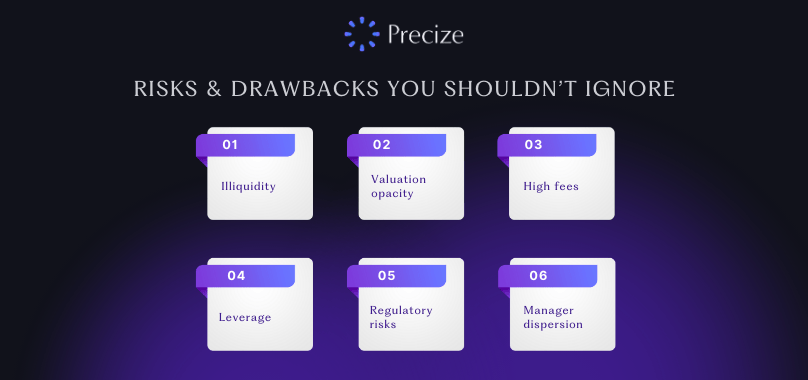
While alternatives offer opportunities, they carry significant challenges:
Illiquidity: Most private funds require investors to lock money for years. Redemption gates and side pockets may restrict access during stress.
Valuation opacity: Illiquid assets are often valued infrequently. This can smooth out reported returns, masking the true volatility of the portfolio.
High fees: Many hedge funds charge management and performance fees. According to Investor.gov, “two and twenty” remains common, making costs a serious drag on net returns.
Leverage: Some strategies rely heavily on debt or derivatives. While this can amplify returns, it also magnifies losses, especially during market shocks.
Regulatory risks: Alternatives like crypto are subject to rapidly changing rules. The FCA’s restrictions on crypto marketing in the UK are an example of how fast compliance burdens can shift.
Manager dispersion: Unlike public equity indices, performance in alternatives can vary widely between managers. Choosing the wrong manager can mean underperformance even when the asset class performs well.
With benefits and risks laid out, the final step is deciding whether alternatives belong in your portfolio and how much weight they should carry.
Final Thoughts
Alternative investments can diversify your portfolio, provide income, and offer protection against inflation. At the same time, they require patience, careful due diligence, and an understanding of risks like liquidity limits, valuation opacity, and high fees. By exploring the different types of alternative investments, you can decide which strategies fit your goals and risk tolerance.
At Precize, we make alternative investments accessible, from unlisted pre-IPO shares to private credit opportunities. Our platform is built to help you diversify, generate income, and invest with confidence.
Ready to explore unlisted shares or private credit deals? Start investing with Precize today.
Frequently Asked Questions (FAQs)
What percentage of a portfolio should be in the types of alternative investments?
Advisers usually suggest 10 to 25 percent of a portfolio. The exact amount depends on how much risk you are comfortable with and how easily you may need access to your money.
Are semi-liquid funds safer than traditional hedge funds?
Semi-liquid funds let you take out money more often than hedge funds, but they still carry risks like market swings, valuation issues, and limits on withdrawals.
How do gates and lock-ups actually work?
A lock-up means you cannot take out your money for a set time. A gate means only part of your money can be withdrawn during certain periods. These rules protect the fund but can limit your flexibility.
What is tokenisation and does it reduce risk?
Tokenisation breaks assets, like real estate, into digital tokens so they can be traded more easily. It can improve access and efficiency, but the risks of the asset remain, and new technology and regulatory risks are added.
Can I access alternatives without being accredited?
Yes, through products like interval funds, ETFs, or UCITS funds. These allow regular investors to get exposure, though usually with lower return potential and different fees compared to private funds.
Disclaimer
The content in this blog is for informational purposes only and does not constitute financial advice. Alternative investments come with inherent risks, and investors are advised to consult a financial expert before making any decisions.