
Every time you deposit money in a bank, buy a corporate bond, or hear that the government borrowed at a certain interest rate, there’s an invisible stamp of trust deciding how costly, or how easy, that borrowing will be. That stamp is the credit rating, meaning investors and lenders watch so closely.
A credit rating sums up, in a single grade, how likely the borrower is to pay back on time, and it quietly affects everything from the interest you earn on fixed‑income funds to the price of essential infrastructure projects.
In this blog, you’ll discover what credit ratings are, their users, why they matter, and their influencing factors. You’ll learn which major credit rating agencies dominate the field, the step‑by‑step process to evaluate, and the types of ratings used in India and worldwide. We’ll also explain how a credit rating differs from the more familiar credit score you see on your personal loan app.
So, keep scrolling!
What Are Credit Ratings?
Credit ratings are simple tools that help you understand how likely a borrower is to repay their debts on time. These ratings are given by agencies after they review various factors like past payment history, current financial condition, and the overall economic environment.
The rating usually comes as a letter grade, such as AAA, BBB, or D, which shows the level of risk involved. A higher rating means lower risk and better chances of getting loans at favorable terms, while a lower rating indicates higher risk. In India, both individuals and businesses use credit ratings to make informed decisions about lending and borrowing.
You’ve learned the credit rating meaning. Next, find out who depends on these ratings and why they should matter to you.
Key Users of Credit Ratings
Credit ratings are important for many people and organizations in India. Here is who relies on them and why:
Banks and Financial Institutions: You use credit ratings to assess the risk before giving loans or credit cards. They help you decide whether a borrower is likely to repay on time.
Investors: If you invest in bonds or debentures, credit ratings guide you in choosing safer options. Higher ratings mean a lower chance of default.
Companies and Businesses: As a business, you depend on credit ratings when raising money from the market. A good rating allows you to borrow at lower interest rates.
Government and Regulators: Government bodies and regulators use credit ratings to keep track of the financial market’s health and to make informed policy decisions.
Suppliers and Trade Partners: If you are a supplier, you might check a company’s credit rating before entering into long-term agreements. This helps you avoid losses caused by non-payment.
Insurance Companies: Insurance firms rely on credit ratings to evaluate the risk of investing in corporate bonds and other financial products.
Mutual Funds and Asset Managers: When managing funds, you consider credit ratings to select safe assets for your portfolio.
Individual Borrowers: Your personal credit rating (or credit score) affects your chances of getting loans, credit cards, or even renting a house.
Since you’ve seen who depends on credit ratings, it’s time to explore why they play such a crucial role.
Importance of Credit Ratings

Understanding the importance of credit ratings helps you see how they affect lending, borrowing, and the overall economy, especially in India. Below is what you need to know:
Helps You Access Loans Easily
A good credit rating shows lenders that you are reliable and likely to repay your loans on time. This makes it easier for you to get loans, often at better interest rates.
Protects Lenders and Reduces Risk
Credit ratings help banks and financial institutions decide who is trustworthy. This lowers their risk of lending money to someone who might not repay, keeping the financial system safer for everyone.
Encourages Responsible Borrowing
When you borrow within your credit limits and maintain a good rating, you contribute to a stable flow of money in the economy. This helps control inflation by preventing excessive borrowing.
Influences on Interest Rates
Your credit rating affects the interest rates you receive. Higher ratings usually mean lower rates, which can save you money and discourage risky borrowing that could increase inflation.
Supports Economic Stability
Good credit ratings for companies and governments attract investments and keep the economy steady. A stable economy helps keep inflation under control, benefiting you and the wider community.
To see how your credit rating is determined, it helps to know what influences it the most.
Factors that Influence Credit Ratings
When you want to understand your credit rating, it’s important to know that several key factors affect it. These are especially important for individuals and businesses in India. The following are the factors you should consider:
Financial Health
Your overall financial condition plays a big role. Lenders look at your income, profitability, and how well you manage your money. Having a steady income and controlling your expenses can improve your rating.
Amount of Debt
The total debt you owe compared to your income or assets matters a lot. If you have a high level of debt, it can hurt your credit rating because it increases the chance you might not repay on time.
Payment History
Whether you pay your loans and credit card bills on time is crucial. Late or missed payments can quickly lower your credit rating.
Cash Flow Stability
For businesses, having a steady and predictable cash flow is important. It shows you can meet your financial commitments regularly.
Economic Conditions
Wider economic factors like GDP growth, industrial production, exchange rates, crude oil prices, and inflation also influence credit ratings. In India, GDP, industrial growth, and exchange rates usually have a direct effect, while crude oil prices and inflation can impact ratings in less predictable ways.
Industry Risk
The industry you belong to can affect your credit rating. Some sectors are seen as riskier than others, which influences how rating agencies assess your profile.
Government Policies
Changes in rules, regulations, and the overall business environment can impact credit ratings, especially for companies.
Company Size and Profitability
Bigger and more profitable companies usually have stronger credit ratings because they are seen as more stable and less likely to default.
Use of Borrowed Money (Leverage)
This shows how much you depend on borrowed funds. Higher borrowing increases risk, which can lower your credit rating if not managed well.
After learning what affects credit ratings, it’s important to know which agencies are responsible for evaluating and issuing these ratings.
Major Credit Rating Agencies
If you want to understand credit ratings in India, it is important to know about the main agencies that provide these ratings. Below are the key credit rating agencies you should be aware of:
CRISIL
CRISIL (Credit Rating Information Services of India Limited) is the largest and most well-known credit rating agency in India, with a market share of over 60%.
It rates companies, banks, and government bodies on their ability to repay loans.
The agency is headquartered in Mumbai and is partly owned by Standard & Poor’s, a global rating agency.
ICRA Limited
ICRA (Investment Information and Credit Rating Agency) is another leading credit rating agency, established in 1991 and headquartered in Gurgaon.
It was started as a joint venture with Moody’s, a major international rating agency, which now holds a significant stake in ICRA.
The agency provides ratings for a wide range of sectors, including MSMEs (Micro, Small, and Medium Enterprises).
CARE Ratings (Credit Analysis and Research Limited)
CARE Ratings, set up in 1993 and based in Mumbai, is India’s second-largest rating agency. It reviews the financial health of businesses, banks, and government projects.
India Ratings & Research (Ind-Ra)
India Ratings & Research is part of the global Fitch Group and is headquartered in Mumbai. It offers detailed credit assessments for corporates, financial institutions, and infrastructure projects.
Acuite Ratings & Research
Formerly known as SMERA, Acuité specialises in rating Small and Medium Enterprises (SMEs) as well as large corporations. It is recognised by both SEBI and the Reserve Bank of India (RBI).
ONICRA Credit Rating Agency
ONICRA focuses on rating SMEs and individuals, providing services related to finance and analytics. The agency is based in Gurgaon and has rated thousands of SMEs across India.
Brickwork Ratings
Brickwork Ratings is recognized by SEBI and provides ratings for banks, non-banking financial companies, and other organizations in India.
After learning about the agencies, let’s explore the process they follow to assess your credit rating.
Step-By-Step Process to Evaluate Credit Rating
When you want to understand how a credit rating is evaluated, it helps to know the step-by-step process that agencies and lenders follow to assess the creditworthiness of an individual, company, or
government. Here is how the process generally works in India:
Step 1: Gathering Information
The first step is collecting all the relevant financial data.
This includes income statements, balance sheets, outstanding debts, repayment history, and other important financial documents.
For individuals, this means your loan records, credit card usage, and payment history.
For companies or governments, it involves reviewing detailed financial reports, assets, liabilities, and the overall economic environment.
Step 2: Analysing Financial Health
Next, the collected information is carefully examined. Agencies look at your income compared to your expenses and debts.
They check how regularly you have paid your dues in the past.
For businesses, they study profitability, cash flow, and the ability to meet both short-term and long-term financial obligations.
Step 3: Reviewing Credit History
Your past borrowing and repayment behaviour plays a key role.
Making timely and consistent payments can improve your credit rating, while defaults or late payments can lower it.
The length of your credit history and the different types of credit you have used are also taken into account.
Step 4: Considering Current Economic Conditions
The current economic situation is also important.
For companies and governments, agencies assess the sector’s performance, market risks, and overall economic outlook.
For individuals, factors like job stability and the health of the industry they work in may be considered.
Step 5: Applying Rating Methodology
Credit rating agencies use their own standard methods and formulas to calculate the rating. They combine all the information and factors gathered to produce a score or grade that reflects creditworthiness.
Step 6: Assigning the Credit Rating
Based on the analysis, a credit rating is given.
This rating can range from high (showing strong creditworthiness) to low (indicating higher risk).
It is usually shown as a letter grade, such as AAA, AA, A, BBB, and so on.
Step 7: Regular Monitoring and Review
Credit ratings are not fixed forever.
They are reviewed regularly to reflect any changes in your financial situation, repayment behaviour, or economic conditions.
If your financial health improves or worsens, your credit rating may be upgraded or downgraded accordingly.
With the evaluation process clear, it’s time to look at the various credit ratings you should know about.
Types of Credit Ratings
Credit ratings help you understand the creditworthiness of individuals, companies, or even governments. In India, different types of credit ratings are used for various borrowers and financial products. Here are the main types you should be aware of:
Corporate Credit Ratings
These ratings are given to private companies that raise money through instruments like bonds or commercial papers. They indicate how likely the company is to repay its debt on time.
Sovereign Credit Ratings
These ratings apply to the Central Government of India when it borrows funds for projects or development. Sovereign ratings show the government’s ability to meet its debt obligations.
Municipal Bond Ratings
Local government bodies or municipalities also borrow money in India. Municipal bond ratings reflect the ability of these bodies to repay their debts.
Structured Finance Ratings
Banks often bundle loans, such as home or auto loans, and issue securities backed by them. Structured finance ratings assess the risk of default on these securities, like mortgage-backed or asset-backed securities.
Bank Loan Ratings
When a bank gives a loan to a company or individual, it evaluates the risk of repayment. Bank loan ratings help banks understand how likely it is that the borrower will repay the loan.
Short-Term and Long-Term Credit Ratings
Credit ratings are also classified based on the duration of the financial product. Short-term ratings apply to instruments maturing within one year, while long-term ratings are for those with longer maturity periods.
Credit Scores for Individuals
Credit bureaus such as CIBIL, Equifax, CRIF HighMark, and Experian assign credit scores to individuals. These scores usually range from 300 to 900 and reflect your repayment history and credit behaviour. A higher score means better creditworthiness.
Investment Grade and Speculative Grade
Credit ratings are grouped into investment grade (lower risk, from AAA to BBB) and speculative grade (higher risk, from BB to D). Investment grade means the borrower is more likely to repay, while speculative grade indicates higher risk.
Now that you’ve seen the main credit rating types, let’s explore the key differences between credit ratings and credit scores.
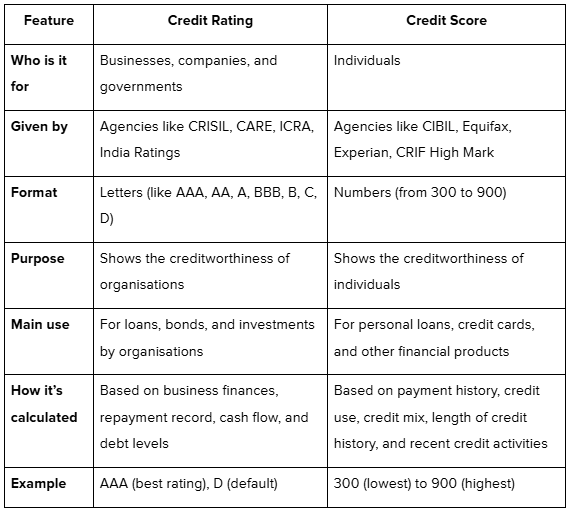
Difference Between Credit Rating vs. Credit Score
Knowing the difference between a credit rating and a credit score can help you better understand how borrowing works and how financial trust is measured in India.
Conclusion
Now that you understand the measures and strategies for controlling inflation, it’s clear how important credit ratings are in supporting financial stability and economic growth. Knowing the credit rating meaning helps you see how these ratings affect borrowing costs, investor confidence, and the overall health of India’s financial markets.
Platforms like Precize facilitate investments in leading private growth companies, giving you the chance to buy and sell unlisted shares and pre-IPO shares. Also, Precize offers private credit investments that provide unique global trade finance opportunities, helping you diversify your portfolio with alternative fixed-income options.
To explore how you can broaden your investment horizons, consider reserving access to diversified portfolio opportunities today!
Disclaimer
This information is provided for educational purposes only and should not be taken as financial advice or a recommendation to invest. It’s always best to talk to a qualified financial advisor before making any investment decisions. Investments carry risks, and past performance is not indicative of future results.