Understanding the Currency Trading Time in India

Learn the best time to trade currency in India, key differences between INR and cross-currency pairs, and how to align with global forex sessions.
7 min read
currency trading time in india

More and more people like you in India are starting to explore currency trading as a way to take part in the global market. With trading apps and online platforms making things easier, it’s no surprise that interest is growing. 

In fact, India’s trade growth is currently at 5.78%, which is slightly higher than the global average of 5.34%, showing how active and involved Indian traders have become. That’s why understanding the currency trading time in India is so important. The right timing can make a big difference in how effective your trades are. 

In this blog, you’ll learn why timing matters in currency trading, what the official trading hours are in India, and how global forex market sessions match with Indian Standard Time (IST). 

You’ll also find out the best times to trade based on overlapping sessions that bring higher liquidity. Plus, you’ll see the difference between trading INR pairs and cross-currency pairs, and get simple tips to align your strategy with the right time for better decision-making.

Keep scrolling to learn!

Here’s the Short Version:

  • INR currency pairs can be traded in India from 9:00 AM to 5:00 PM IST, Monday to Friday.

  • Cross-currency pairs like EUR/USD or GBP/USD are available for longer hours, from 9:00 AM to 7:30 PM IST.

  • Forex trading isn’t available in India on weekends or public holidays.

  • India’s currency trading hours are set by SEBI and RBI for regulation and liquidity control.

  • While global forex markets run 24 hours a day, Indian exchanges have fixed hours due to local policies.

Why Timing Matters in Currency Trading?

When you trade currency in India, the timing of your trades can directly impact how smoothly the trade goes and how much the prices shift. Since the global forex market runs in different time zones, knowing the right currency trading time in India helps you take advantage of the most active trading hours, where prices are more responsive and the market is more liquid.

Here’s why timing matters:

  • Better Liquidity: When the Indian trading session overlaps with major markets like Europe, more buyers and sellers are active. This makes it easier to buy or sell without major price changes.

  • Increased Volatility: Overlapping sessions often bring faster price movements. This is especially true for currency pairs like GBP-INR or EUR-INR, which are more active during the London session.

  • Cross-Currency Trading Windows: For pairs like EUR-USD or GBP-USD, Indian exchanges allow longer trading hours to match the timing of the UK and US markets. These extended hours offer more trading opportunities.

  • More Opportunities: The most favorable trading windows often occur during market overlaps, where price action is stronger, giving you better chances to make the most of your trades.

Once you understand why timing matters, the next step is knowing the hours during which trading is allowed in India.

Official Currency Trading Hours in India

Currency trading in India follows fixed hours as per the guidelines of SEBI and RBI. These hours differ depending on whether you're trading INR-based pairs or cross-currency pairs. Knowing the correct timings helps you stay within the legal window and take advantage of active market periods. Here is what to keep in mind:

  • Trading Hours for INR Pairs: Currency pairs that include the Indian Rupee (like USD/INR, EUR/INR, GBP/INR, JPY/INR) are available for trading from 9:00 AM to 5:00 PM IST, Monday to Friday.

  • Trading Hours for Cross-Currency Pairs: For pairs that don’t involve INR (such as EUR/USD, USD/JPY), trading is open from 9:00 AM to 7:30 PM IST.

  • No Weekend or Holiday Trading: Markets remain closed on Saturdays, Sundays, and official public holidays.

  • Regulatory Framework: Currency trading in India is not 24/7 and is allowed only within the specified hours on regulated exchanges like NSE and BSE. Only approved currency pairs are permitted for trading.

To make the most of your trades, it helps to see how India’s market timings fit into the larger global forex calendar.

Global Forex Market Sessions (Converted to IST)

The global forex market runs 24 hours a day, five days a week, with trading activity moving through major financial hubs across the world. While trading in India is limited to official hours, knowing when global sessions open and close in Indian Standard Time (IST) can help you understand when the market is most active. 

This is especially useful when global sessions overlap and bring in higher liquidity and stronger price movements. Here is how the major forex sessions translate into IST, along with what to expect from each:

  1. Sydney Session

🕒 3:30 AM to 12:30 PM IST

This session kicks off the global trading day. It’s usually calm with lower volatility and is more suitable for trading AUD and NZD currency pairs.

  1. Tokyo Session

🕔 5:30 AM to 2:30 PM IST

The Tokyo session brings moderate activity and is important for JPY-based pairs. It overlaps slightly with the Sydney session, creating decent trading opportunities in the morning hours.

  1. London Session

🕐 1:30 PM to 10:30 PM IST

One of the most active sessions globally. 

  • The London market opens in the Indian afternoon and sees strong price movements, especially for EUR, GBP, and USD pairs. 

  • Liquidity rises even more when it overlaps with the New York session.

  1. New York Session

🕕 6:30 PM to 3:30 AM IST 

This session starts in the evening in India and remains active until early morning. 

  • It’s highly liquid and volatile, especially during the overlap with London. 

  • USD-related pairs often experience significant movements during this time.

With the global sessions in mind, let’s take a closer look at how trading times differ when dealing with INR pairs versus cross-currency pairs.


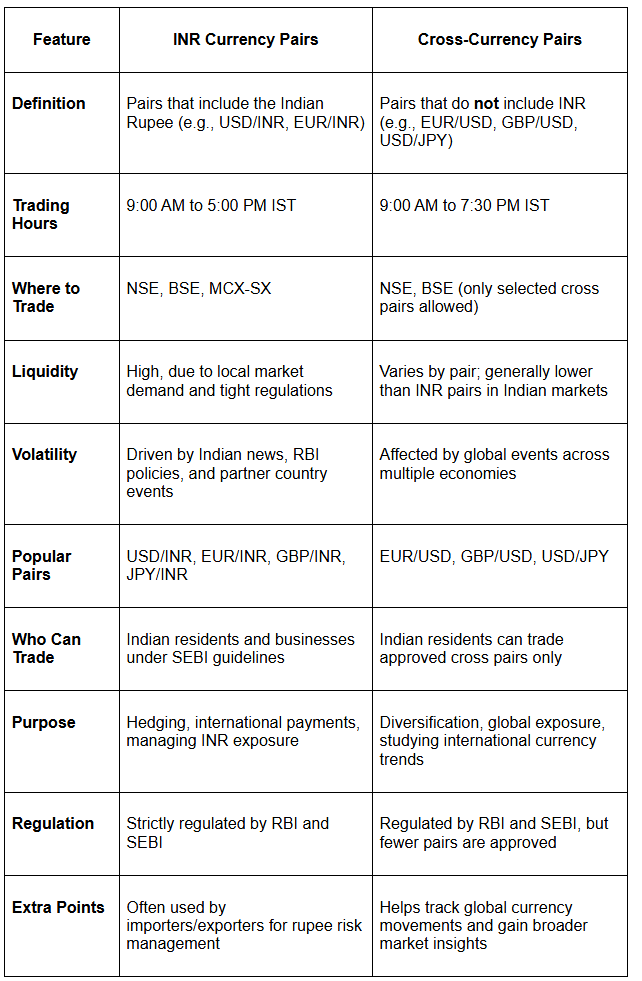
Difference Between Trading INR vs. Cross-Currency Pairs

When trading in the Indian forex market, it's important to know the difference between INR currency pairs and cross-currency pairs. Both have unique features, timings, and regulations. Below is the table to help you choose the right pairs based on your trading goals and market access.

Once you’ve grasped the trading patterns of INR and cross-currency pairs, it’s time to explore how to pick the best trading windows.

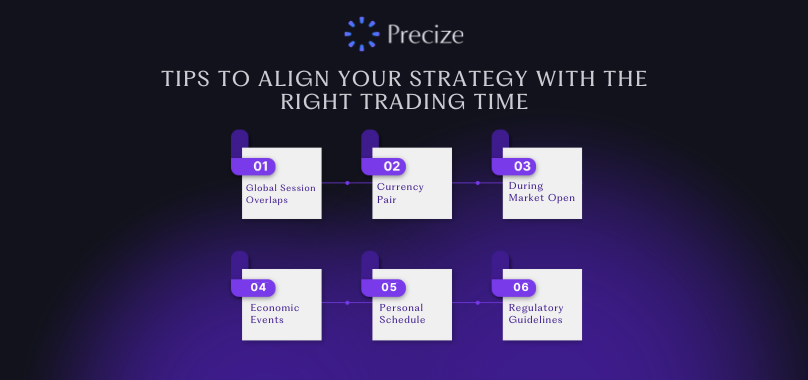
Tips to Align Your Strategy with the Right Trading Time

Knowing the best time to trade can improve your overall currency trading experience in India. Since price movements and liquidity vary throughout the day, aligning your strategy with the most active hours can help you make more informed decisions. Here are some simple and practical tips to help you trade at the right time:

  • Watch for Global Session Overlaps: The London–New York overlap (between 5:30 PM to 8:30 PM IST) is one of the most active periods. It offers better liquidity and higher price movements, especially useful for trading popular cross pairs.

  • Choose Trading Hours Based on Your Currency Pair: Trade INR pairs during the official Indian market hours. If you're focusing on cross-currency pairs, use the extended window till 7:30 PM IST to catch global activity.

  • Stay Aware During Market Open and Close: Around 9:00 AM and just before 5:00 PM, there is often a surge in volume and volatility. This could bring quick trading opportunities, but also requires caution.

  • Keep an Eye on Economic Events: Global or domestic news, policy announcements, and economic data releases can affect currency prices. Use a reliable economic calendar to stay updated during active sessions.

  • Consider Your Personal Schedule: Only trade during hours when you can stay focused. Overlapping sessions may offer the best conditions, but they also require your full attention.

  • Know the Regulatory Guidelines: Make sure you trade only through SEBI-registered brokers and stick to RBI-approved currency pairs within permitted hours to stay compliant.

Conclusion 

As covered throughout this blog, knowing the currency trading time in India is essential for making the most of your trading hours. From understanding official trading windows for INR and cross-currency pairs to learning how global forex sessions align with Indian timings, every detail helps you navigate the market more confidently. 

You've also seen how timing impacts liquidity, volatility, and overall trading experience, whether you're focused on INR pairs during the day or cross-currency opportunities in the extended window.

Beyond currency trading, today’s market also opens doors to private investment options. You can now gain access to leading private companies, buying and selling unlisted shares and pre-IPO shares through trusted platforms like Precize

There's also growing interest in private credit investments, which offer global trade finance opportunities and help diversify portfolios with alternative fixed-income options.

Reserve your access today and explore a more diversified portfolio beyond public markets!

Frequently Asked Questions

1. Why do cross-currency pairs have longer trading hours than INR pairs?

Cross-currency pairs like EUR/USD or GBP/USD are linked to international markets, especially the UK and US. Their trading hours are extended in India to match the active times of these global sessions. That’s why you can trade them until 7:30 PM IST, giving more time for better liquidity and market activity.

2. Can you trade Indian currency pairs 24 hours a day in India?

No, you can’t. Indian currency pairs are only available for trading during official exchange hours, which are 9:00 AM to 5:00 PM IST, Monday to Friday. After this, trading isn’t allowed on Indian exchanges, even though international platforms may offer 24/5 forex trading globally.

3. Have there been any recent changes to market timings in India?

Yes, there have been some updates. Starting July 1, 2025, the Reserve Bank of India extended the trading hours for the call money market to 9:00 AM to 7:00 PM. Also, from August 1, 2025, market repo and Tri-Party Repo timings now run from 9:00 AM to 4:00 PM. However, the trading hours for the forex market in India remain unchanged.

4. Why is the forex market open 24 hours globally but not in India?

Globally, the forex market runs 24 hours a day because trading moves through different time zones, like Sydney, Tokyo, London, and New York. In India, though, currency trading follows strict exchange regulations. These rules limit trading to specific hours to ensure better oversight and controlled liquidity.

5. Are forex markets open on weekends in India?

No, forex trading is closed on weekends in India. The market operates from Monday to Friday, and there’s no trading on Saturdays, Sundays, or public holidays.

Disclaimer

This blog is for informational purposes only and does not constitute financial, investment, or trading advice. Currency trading in India is subject to regulations set by SEBI and RBI, and all trades must be conducted through registered platforms within approved timeframes. Readers are advised to consult with certified financial professionals or authorized brokers before making any trading or investment decisions. The mention of unlisted shares, pre-IPO shares, or private credit investments is purely educational and not a recommendation to buy or sell any financial instruments.


Precize
Precize
Content Strategy and Research Analyst

Stay in the Loop

Join our newsletter for exclusive access to thoughtfully curated content and we promise, no spam

The next generation of asset classes in India

Resources

Our Office

Office No. 1219, The Summit Business Park, Andheri Kurla Road, Andheri East, Mumbai, Maharashtra - 400093

Find us on Google

support@precize.in

+91 7738336457

All trademarks and logos or registered trademarks and logos found on this Site or mentioned herein belong to their respective owners and are solely used for informational and educational purposes.

The material presented in this advertisement is for informational purposes only and should not be construed as investment advice or investment availability. It is not a recommendation of, or an offer to sell or solicitation of an offer to buy, any particular unlisted share, security, strategy, or investment product. Investing in the private market and securities involves risks, including the potential loss of money, and past performance does not guarantee future results. Market trends, data interpretations, graph projections are provided for informational and illustrative purposes and may not reflect actual future performance. Nothing on this website should be construed as personalized investment advice or should not be treated as legal, financial, or any other form of advice. Precize is not liable for financial or any other form of loss incurred by the user or any affiliated party based on information provided herein.

Precize is neither a stock exchange nor does it intend to get recognized as a stock exchange under the Securities Contracts Regulation Act, 1956. Precize is not authorized by the capital markets regulator to solicit investments. The securities traded on these platforms are not traded on any regulated exchange.

The website will be updated regularly.

Copyright © 2026 - Precize - All Rights Reserved