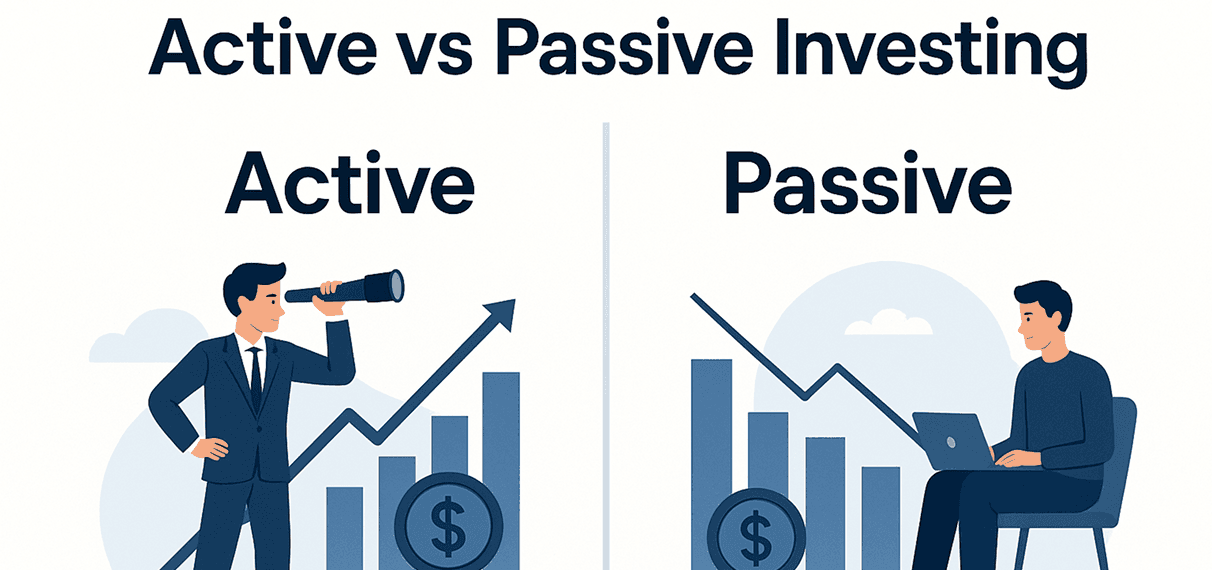
When it comes to growing your wealth through investments, there are two popular strategies: active investing and passive investing.
While both aim to help you earn returns, the methods and mindsets behind them are very different. Choosing the right one depends on your financial goals, risk appetite, time commitment, and investment style.
In this blog, we’ll break down the key differences between active and passive investing, their advantages and disadvantages, and help you decide which strategy suits you better.
What is Active Investing?
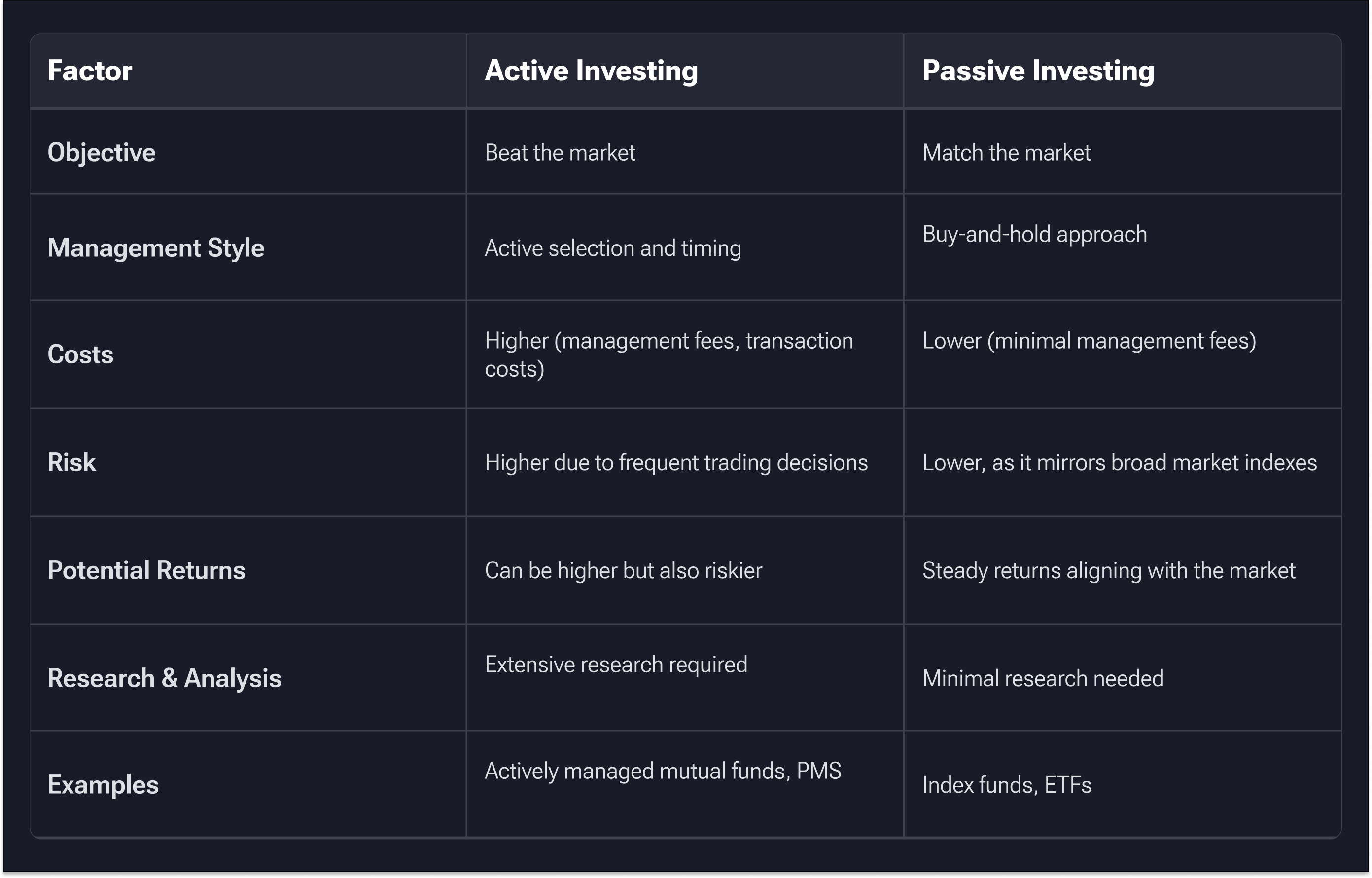
Active investing involves a hands-on approach where fund managers or individual investors actively buy and sell securities to outperform the market.
The goal is to beat a benchmark index (like Nifty 50, Sensex, or S&P 500) by using research, analysis, market timing, and stock picking strategies.
Examples of active investment options include:
Actively managed mutual funds
Portfolio management services (PMS)
Individual stock picking by investors
Fund managers of active funds continuously monitor market movements, company performance, economic trends, and other factors to make buy/sell decisions.
What is Passive Investing?
Passive investing follows a buy-and-hold strategy where the goal is to match the performance of a market index, not beat it.
Investors typically invest in index funds or Exchange Traded Funds (ETFs) that mirror the performance of indices like Nifty 50, Sensex, or Nasdaq 100.
In passive investing:
There's minimal buying and selling.
Costs are lower because there’s less active management.
The strategy believes in the long-term growth of markets.
Passive investors assume that over time, markets tend to rise, and trying to beat the market consistently is difficult and expensive.
Key Differences Between Active and Passive Investing
Advantages of Active Investing
Opportunity to Outperform: Skilled fund managers can deliver higher-than-market returns, especially in volatile markets.
Flexibility: Managers can quickly shift strategies based on market conditions.
Tailored Portfolios: Active funds can focus on specific sectors, themes, or strategies.
Disadvantages of Active Investing
Higher Costs: Management fees and frequent transactions can eat into returns.
Higher Risk: If decisions go wrong, losses can be significant.
Inconsistency: Few active managers consistently outperform the market over the long term.
Advantages of Passive Investing
Lower Costs: Expense ratios for index funds and ETFs are much lower.
Simplicity: No need to constantly track market movements.
Consistent Performance: Passive funds generally deliver returns similar to the market index.
Transparency: It's easier to understand where your money is invested.
Disadvantages of Passive Investing
No Outperformance: Passive investors settle for market returns even during strong bullish phases.
Market Risk: Passive funds cannot avoid market downturns; they fall along with the market.
Limited Flexibility: Passive funds cannot change their portfolio even if certain sectors perform poorly.
Which Strategy Should You Choose?
The choice between active and passive investing depends on various factors:
Risk Tolerance: If you can handle higher risk for the chance of higher returns, active investing might suit you. If you prefer steady growth with lower costs, passive investing is better.
Investment Horizon: Passive investing is ideal for long-term investors who believe in the market's long-term growth.
Cost Sensitivity: If minimizing fees is important, passive investing wins.
Market Knowledge and Time: Active investing requires significant research, time, and expertise.
In many cases, a combination of both, a hybrid approach, works well. For example, investors can have core investments in passive index funds for stability and satellite investments in active funds for potential alpha (extra returns).
Conclusion
Both active and passive investing strategies have their strengths and weaknesses.
There is no one-size-fits-all answer. It largely depends on your investment goals, risk appetite, and time commitment.
If you are just starting or prefer a hands-off approach, passive investing through index funds or ETFs may be ideal.
If you have market knowledge, a higher risk appetite, and aim to outperform the market, active investing might be worth exploring. Ultimately, the best investment strategy is the one that you can stick to for the long term, with confidence and consistency.
If you're interested in exploring alternative investment opportunities, Precize offers a platform that provides access to pre-IPO shares and global trade finance opportunities. With a minimum investment of ₹10,000, these investment options become accessible to a wide range of investors. Precize emphasises security and provides research-driven insights to help you make informed investment decisions.
So, take the first step in diversifying your portfolio by reserving your access on Precize.
(Disclaimer: The information provided in this blog is for educational and informational purposes only. It should not be considered as investment advice or financial recommendation. Investing in financial markets involves risk, including the risk of loss. Readers are advised to conduct their own research or consult with a qualified financial advisor before making any investment decisions.)