When you’re navigating the complexities of trade finance, you may come across two terms that often create confusion: factoring and forfaiting. Both are financial solutions that can help you manage cash flow and mitigate risk, but they serve different purposes and work in distinct ways.
In this blog, we’ll explain the differences between factoring and forfaiting to help you make the right decision for your business. We’ll begin by discussing what factoring is in trade finance, along with its advantages and disadvantages.
Then, we’ll look at forfaiting, its main benefits, and its potential downsides. Finally, we’ll compare the two to show you how they differ. By the end, you’ll have a much better understanding of factoring and forfaiting, and how they can shape your financial decisions.
Keep reading to learn more!
What is Factoring in Trade Finance?
Factoring in trade finance is when you sell your unpaid invoices to a third party, called a factor, to get quick cash. Instead of waiting for your customers to pay, the factor gives you most of the money upfront and then collects the payment from your customers. It’s a way to free up cash that’s stuck in your pending payments.
Now that you have a clearer understanding of factoring, let’s explore the advantages it can bring to your business.
Key Advantages of Factoring
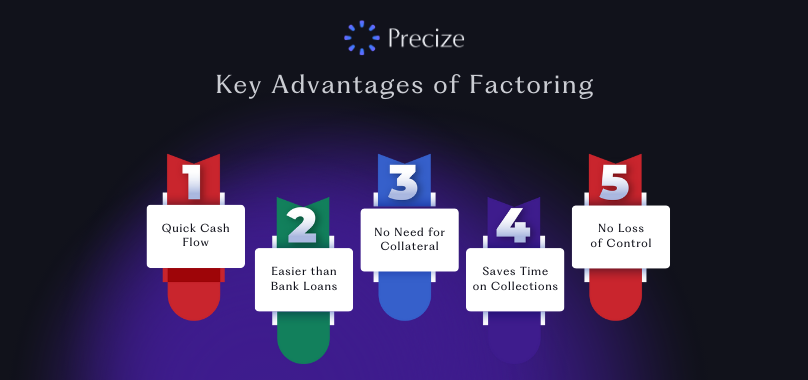
Factoring offers several advantages that can help you manage your business finances more effectively. Here are some key advantages:
Quick Cash Flow
Factoring helps you get money fast by selling your invoices, so you don’t have to wait for customers to pay. This can be useful for managing daily expenses and keeping operations smooth.
Easier than Bank Loans
Getting approved for factoring is usually simpler than applying for a loan, especially if your business is new or doesn’t have a strong credit history.
No Need for Collateral
You don’t have to offer any business assets as security, which is often required in traditional loans.
Saves Time on Collections
The factoring company handles the task of collecting payments, so you can focus more on your business activities.
No Loss of Control
Since you’re not giving away any ownership, you keep full control of your business.
With the benefits in mind, let’s explore some of the disadvantages you might face when using factoring.
Common Disadvantages of Factoring
While factoring can be helpful for improving cash flow, it also comes with certain drawbacks that you should consider before choosing this option. Here are some common disadvantages:
Costly Service
Factoring can be expensive. Fees usually range between 1% to 5% of the invoice amount, and there might be extra charges too.
Customer involvement
Since the factoring company deals directly with your customers, it could affect your relationship with them or make some customers uneasy.
Not Ideal for All Types of Businesses
Factoring mainly works for businesses that sell to other businesses (B2B). It may not suit you if you have a small number of clients or mostly sell to individuals.
Depends on Customer Credit
The factor looks at your customers' creditworthiness, not just yours. If your customers have poor payment records, it may be hard to qualify.
Binding Contracts
Some factoring companies require you to sign long-term agreements or factor all your invoices, which can limit your flexibility.
Complex Terms
Factoring contracts can be hard to understand, with different fees and conditions. It's important to read everything carefully before agreeing.
Now that you’ve understood the disadvantages of factoring, let’s move on to understanding forfaiting and how it could be another solution for your business.
What is Forfaiting in Trade Finance?
Forfaiting in trade finance is when you sell your medium to long-term receivables, usually from international trade, to a forfaiter (a financial institution). This allows you to receive immediate cash while transferring the risk of payment to the forfaiter, who then takes over the responsibility of collecting payment from your customer.
With forfaiting defined, let’s see the key advantages it offers for businesses like yours.
Key Advantages of Forfaiting
Forfaiting offers several advantages that can help your business manage international transactions more efficiently and securely. Below are the key advantages of forfaiting:
Immediate Cash Flow
With forfaiting, you get immediate payment for your export bills, helping you manage your working capital and keep your business running smoothly, rather than waiting for your importer to pay.
Risk Elimination
Forfaiting removes several types of risk, including credit risk, political risk, and currency risk. The forfaiter takes on these risks, so you don’t have to worry about defaults or currency fluctuations.
No Debt on Balance Sheet
Since you’re selling your receivables, forfaiting doesn’t add any debt to your company’s balance sheet. This can improve your financial ratios and present a healthier financial profile.
Simplified Collections
You don’t need to handle the task of chasing payments or managing collections. The forfaiter takes care of all the paperwork and collection efforts, saving you valuable time and resources.
Flexible and Customizable
Forfaiting can be adjusted to fit your business needs and is especially useful for large, long-term international transactions.
Competitive Advantage
By offering longer payment terms to your foreign buyers, you can make your exports more attractive, giving you a competitive edge in the global market.
Although forfaiting has its upsides, it’s crucial to consider the potential downsides as well.
Common Disadvantages of Forfaiting
Despite its advantages, forfaiting also comes with a few disadvantages that you should consider before choosing this financing option.
Higher Costs
Forfaiting tends to be more expensive than traditional bank loans or other trade finance options. The forfaiter charges a fee (discount rate), which can raise your overall export costs.
Limited to Larger Transactions
Forfaiting is generally only available for large export deals with medium to long-term payment terms. Small businesses or those with smaller transactions might find it unsuitable or may not qualify.
Strict Documentation
The process requires detailed legal documents, such as promissory notes or bills of exchange, which can add complexity and additional paperwork.
Limited Currency Options
Not all currencies are accepted in forfaiting. Typically, only major international currencies are considered, which may not be suitable for every exporter.
Dependency Risk
Relying heavily on forfaiting can make your business too dependent on one type of financing, which may not be ideal for long-term financial stability.
With the benefits of forfaiting in mind, let’s move on to explore the key differences between forfaiting and factoring.
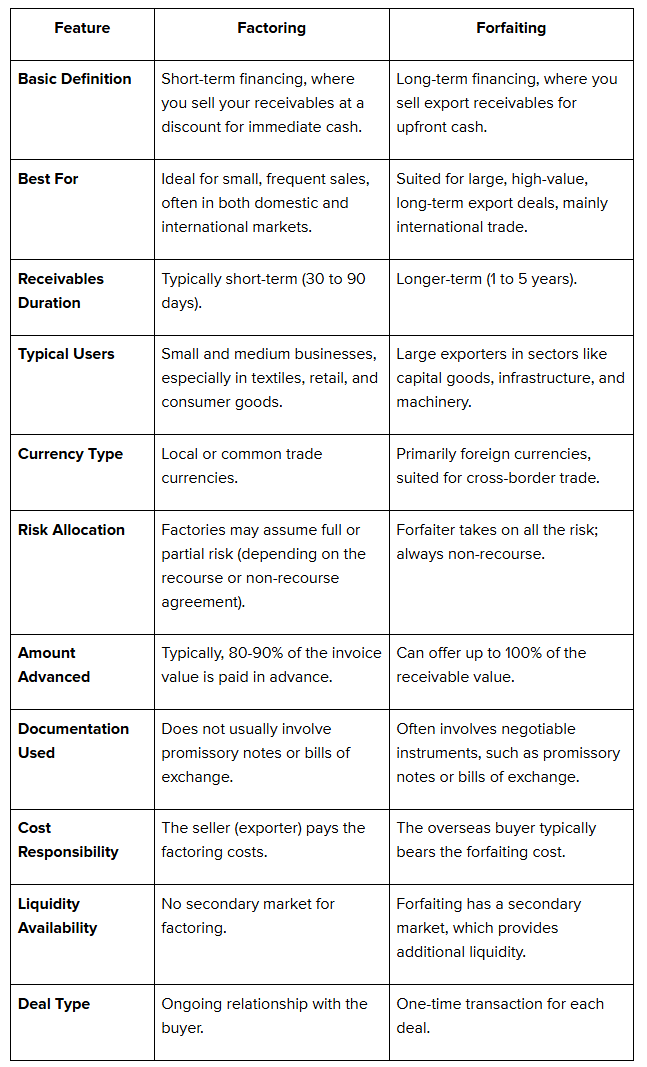
Key Differences Between Factoring and Forfaiting
To help you better understand how factoring and forfaiting differ in trade finance, here’s a quick comparison of their key features. This will allow you to make a more informed decision based on your business needs and the nature of your transactions.
Conclusion
By now, you’ve learned the key differences between factoring and forfaiting in trade finance. Recognizing how each option works and the specific benefits they offer will help you make more informed decisions when selecting the right financing strategy for your business. Whether you’re focused on short-term cash flow management or handling long-term export deals, understanding your financial objectives, risk tolerance, and timelines is essential to selecting the most suitable choice.
As you optimize your export financing strategy, consider exploring unique global trade finance opportunities with Precize. This platform allows you to diversify your portfolio through alternative fixed-income investments, as well as offering opportunities to explore in leading private companies, buy, and sell unlisted shares and pre-IPO shares.
Reserve your access today and start exploring these investment opportunities!
Disclaimer
The information provided in this blog is for general informational purposes only. It is not intended as financial advice and should not be relied upon as such. While we strive to ensure accuracy and relevance, we encourage readers to consult with a financial expert or advisor before making any financial decisions. All financial activities and investments carry inherent risks, and you should carefully consider these risks before proceeding.