In boardrooms and AI labs alike, one question is now unavoidable: what price will the market assign to India’s leading analytics-and-AI firm? Fractal Analytics has moved decisively toward a public listing, having filed its DRHP in August 2025 and secured approval from SEBI for a ₹4,900 crore IPO, combining fresh equity and a substantial Offer-for-Sale.
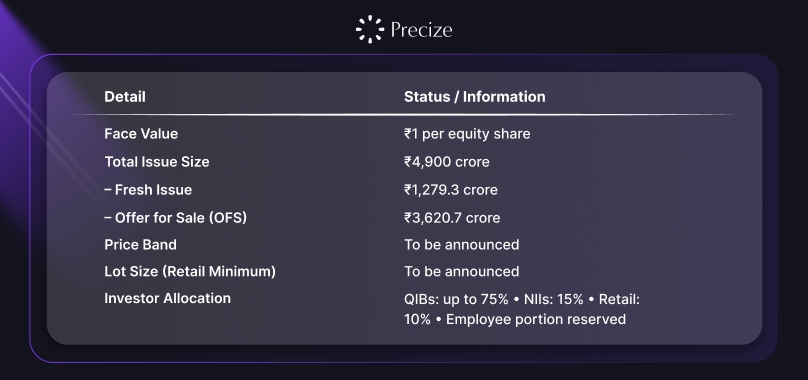
The IPO structure envisages a fresh issue worth ₹1,279.3 crore and an OFS amounting to ₹3,620.7 crore; a move designed to offer liquidity to existing investors while fuelling Fractal’s global expansion plans.
As of now, the company has not disclosed the per-share price band or lot size, leaving actual valuations and minimum investment thresholds to be determined closer to the final offering.
In this blog, we collect all verified facts and explain how the IPO size and share-offer structure reflect Fractal’s scale and liquidity strategy. You will also learn about the operational and market signals to watch as the issue progresses.
At a Glance
What Is Fractal Analytics? Key Facts and Growth
Fractal Analytics is a global provider of artificial intelligence and advanced analytics solutions to Fortune 500 companies, with the stated mission of powering every human decision in the enterprise through AI, engineering, and design.
Their business units include Asper.ai (revenue-growth management), Flyfish (generative-AI for search and product discovery), and they incubated Qure.ai (a healthcare-AI leader for TB and lung-cancer diagnosis).
Fractal operates from more than 16 global offices and has over 4,500 employees across the United States, the United Kingdom, Ukraine, India, Singapore, and Australia.
With its planned IPO marking a major milestone, it’s important to understand the company’s core capabilities, global reach, and growth drivers.
Key Facts & Growth Highlights:
Global Presence & Client Base: Fractal serves large enterprises worldwide and claims leadership in “decision-intelligence” solutions across geography and industry.
Innovation-First Platform: It develops proprietary AI frameworks (e.g., for consumer insights, risk analytics, and conversational AI) that underpin its value proposition.
Revenue Momentum: According to its 2025 DRHP, Fractal reported revenue from operations of ₹2,765.4 crore. This is up about 26% from ₹2,196.3 crore in FY24, signalling strong scaling in its analytics and AI services business.
Unicorn and Valuation Signals: Earlier private-market rounds valued Fractal at US$2.44 billion following a large secondary transaction in 2025.
Sector Tailwinds: Fractal operates at the intersection of rising enterprise demand for AI/analytics and India’s outsourcing & tech services growth; a background that shapes its growth outlook.
With a clear understanding of who Fractal is and how it has evolved, the next step is to comprehend the structure of its IPO.
Fractal Analytics IPO Overview and Structure
Fractal’s public offer is being run as a book-built mainboard issue designed to broaden shareholder liquidity and formalise governance for a large, global AI-services business. The filing and merchant-banker lineup point to a conventional, and tightly managed, offer structure aimed at institutional demand and an orderly market debut.
Here’s how the IPO is structured and what matters for investors and market participants:
Book-building route: The offer is being conducted through the book-building process under SEBI rules, with pricing to be set via investor bids during the book-build window.
Investor allocation mix: The DRHP allocates the net offer primarily to institutions; up to 75% for Qualified Institutional Buyers (QIBs), 15% for Non-Institutional Investors (NIIs), and 10% for Retail Individual Investors (RIIs), reflecting a QIB-heavy placement strategy.
Employee reservation: The offer includes a dedicated employee reservation portion (not exceeding 5% of post-offer paid-up equity), allowing ESOP holders and eligible staff to participate.
Book-runners and advisers: A high-profile syndicate is managing the issue: Kotak Mahindra Capital, Morgan Stanley India, Axis Capital, and Goldman Sachs (India) are the book-running lead managers, supported by legal and underwriting advisers.
Registrar and listing: MUFG Intime India Private Limited is the registrar for the offer; the equity shares are proposed to be listed on both the NSE and BSE.
Allocation mechanics & anchor book: The DRHP contemplates an anchor investor book and standard ASBA/UPI application routes for the public offering; the merchant bankers may close the QIB book earlier if demand dictates.
Lock-in / share disposal mechanics: The DRHP and related filings set out customary lock-in provisions and seller-specific conditions for the OFS portion; consult the final red-herring prospectus for exact timelines once published.
After outlining how the IPO is structured, the schedule ahead offers a clearer picture of what happens next.
Important IPO Dates and Timeline
From regulatory filings to subscription windows, the timing around Fractal’s IPO is now taking final shape. A clear view of the schedule helps you monitor when key milestones will hit and how the process will unfold.
Here’s the current timeline of major events driving the IPO journey:
12 August 2025: Fractal filed its Draft Red Herring Prospectus (DRHP) with the Securities and Exchange Board of India (SEBI).
18 November 2025: SEBI granted its observation letter, approving Fractal Analytics’ IPO and allowing the company to move forward toward listing.
To Be Announced: The official subscription open and close dates will be revealed once the price band is finalised.
Expected Listing: While the exact date isn’t published, market commentary suggests the listing could occur once allotments settle post-subscription.
(Sources: BSE, SEBI & Other Financial Articles)
As the timeline takes shape, the structure of how the offer can be accessed becomes the next meaningful detail.
Fractal Analytics IPO Lot Size and Guide
One of the most practical components of any IPO is its lot size; the minimum number of shares you must apply for in a single bid. Lot size, together with the final price band, will determine the starting ticket size for retail investors.
As of December 2025, Fractal’s offer structure is clear, but the exact lot size and per-share pricing are not yet announced.
Here’s what we know so far:
Why this matters:
Your effective entry ticket into the IPO will depend on (final price × lot size). Since neither is declared yet, treat any specific “minimum amount” you see elsewhere as speculative; always confirm with the final RHP/exchange notice/broker app before placing your bid.
Suggested Read: IPO Investment Strategies- Maximizing Returns with Informed Decisions
With the entry framework outlined, it’s useful to look at how the company aims to channel the funds toward its next phase of growth.
IPO Use of Funds and Expansion Plans
Fractal Analytics has outlined how it plans to deploy the fresh issue proceeds from its IPO, focusing on enhancing infrastructure, fuelling innovation, and supporting strategic growth initiatives. Below are the key uses and growth-oriented allocations.
Debt prepayment & subsidiary funding: ₹264.9 crore of the proceeds is earmarked for the pre-payment or repayment of borrowings of its U.S. subsidiary.
Technology infrastructure and work-environment build-out: ₹57.1 crore is set aside for the procurement of laptops and ₹121.1 crore for new Indian office premises.
R&D, marketing and innovation under ‘Fractal Alpha’: ₹355.1 crore has been allocated to bolster research & development, sales and marketing efforts.
Inorganic growth and strategic initiatives: The remainder of the fresh issue proceeds is reserved for acquisitions, strategic investments, and general corporate purposes, each capped under the DRHP framework.