Fractional Ownership: The Future of Real Estate in India

Discover how fractional ownership makes high-value real estate in India accessible with lower capital. See how it provides opportunities for passive income.
11 min read
fractional ownership

Investing in real estate in India has traditionally been out of reach for many due to high capital requirements, long-term commitment, and complex legal processes. For most, owning property was either a distant dream or reserved for the affluent. But this is changing. 

Fractional ownership is making real estate accessible to a broader pool of investors by allowing them to buy a share of high-value properties at a fraction of the cost. A market analysis estimates the current Indian fractional‑ownership market at around ₹3,700 crore, with projections exceeding ₹37,000 crore by 2030.

This blog will walk you through how fractional ownership works, why it's gaining popularity, and how it’s helping Indian investors overcome traditional barriers to real estate investment.

Key Takeaways

  • Fractional ownership allows investors to own a share in real estate, starting with as little as ₹10,000.

  • It provides access to premium properties that would otherwise be out of reach for most investors.

  • Investors can earn passive income from rental yields without managing the property themselves.

  • While market risks, legal concerns, and liquidity issues exist, they can be mitigated by choosing reliable platforms.

  • As regulatory frameworks like SEBI’s SM‑REIT guidelines evolve, fractional ownership is becoming a more mainstream investment option.

What is Fractional Ownership and How Does It Work?

Fractional ownership allows multiple investors to collectively own a portion of a high-value asset, such as real estate, by pooling their resources. Instead of one individual or entity owning an entire property, fractional ownership divides the asset into shares, enabling investors to own a percentage of it. 

This model is particularly attractive in real estate, where properties often have prohibitively high entry costs for individual investors.

How It Works

Fractional ownership works by allowing a group of investors to pool their funds to purchase a share in a property. The process usually involves the following steps:

  1. Pooling of Funds: A platform facilitates capital pooling from multiple investors, with each contributing based on the share they wish to own.

  2. Ownership Allocation: After the capital is raised, investors receive proportional ownership stakes. For example, 10 investors contributing ₹10 lakh each for a ₹1 crore property own 10% each.

  3. Legal Framework: A legal agreement outlines investor rights, property management, revenue distribution (e.g., rent), and future sales or liquidation terms.

  4. Property Management: The property is either managed by a third-party firm or the investors themselves, ensuring maintenance and fair income distribution.

  5. Revenue Sharing: Rental income and potential profits from a property sale are shared in accordance with ownership percentages.

  6. Exit Strategy: Investors can sell their shares to another investor or back to the platform, providing liquidity in an otherwise illiquid market.

Examples of Fractional Ownership in Indian Real Estate

Let’s look at a few examples of how fractional ownership works in the Indian real estate market:

Example 1: Residential Property Investment

An apartment in a high-demand city like Bangalore is worth ₹1.5 crore. Through a fractional ownership model, 15 investors contribute ₹10 lakh each. 

These investors now collectively own the property, with rental income generated and shared in proportion to their ownership percentages. This allows them to invest in a property they would not otherwise be able to afford individually.

Example 2: Commercial Real Estate

A commercial office space in Mumbai is valued at ₹5 crore. A group of 20 investors each invests ₹25 lakh, securing ownership in a property located in a prime business district. 

The property generates steady rental income from corporate tenants, which is divided among investors. Additionally, if the property appreciates and is sold, the profits are shared according to ownership percentages.

Example 3: Vacation Property

Consider a luxury vacation villa in Goa. The property is priced at ₹3 crore, and a company divides it into 30 equal shares, each worth ₹10 lakh. The property generates income through short-term vacation rentals. 

Investors benefit from both rental income and potential capital appreciation when the property is sold. 

The model allows people to own a share in a luxury vacation home without the full financial burden.

Also Read: Personal Finance Guide: Importance, Core Areas & Essential Services

Now, let’s explore the reasons behind the rapid rise of fractional ownership in India’s real estate market.

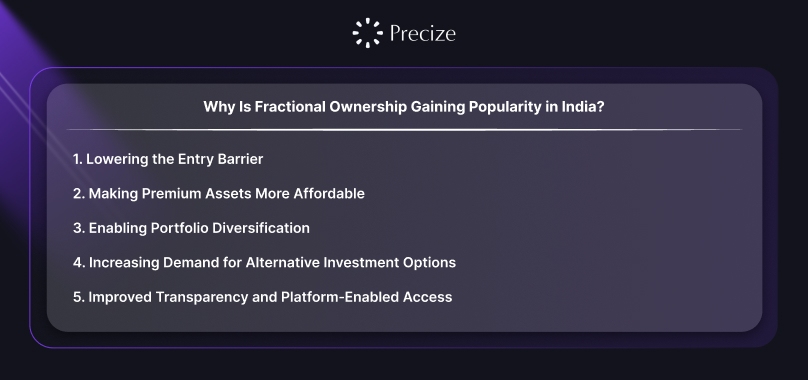
Why Is Fractional Ownership Gaining Popularity in India?

The rise of fractional ownership in Indian real estate is rooted in apparent shifts across investor behaviour, market structure, and regulation. These changes are opening access to high-value assets that were once out of reach for many. 

Below are the key drivers behind this trend:
1. Lowering the Entry Barrier

  • High‑ticket property investments traditionally required crores of rupees and a long‑term hold. 

  • With fractional ownership, investors can begin with much smaller sums—sometimes as little as a few lakhs—making premium real estate accessible to a broader audience.

2. Making Premium Assets More Affordable

  • Instead of buying an entire high‑value property, investors buy a share. This spreads both cost and risk.

  • This model allows access to Grade‑A office assets, luxury holiday properties, or well‑located commercial real estate without needing full ownership capital.

  • As a Colliers report shows, in the top six Indian cities, 28% of Grade‑A office stock is already part of strata‑sale/fractional models, with a projected market value of about ₹4,500 billion by 2026.

3. Enabling Portfolio Diversification

  • Investors who might otherwise tie up large capital in a single property now have the option to spread their investment across multiple shares, locations, or asset types.

  • This means, for instance, that instead of one large residential flat, an investor could own fractional interests in a commercial asset, a vacation home, and a logistics warehouse.

  • Diversification helps manage risk and enhances exposure.

4. Increasing Demand for Alternative Investment Options

  • As incomes rise and financial literacy grows in India, more people are looking beyond traditional savings and stock markets to build wealth.

  • The structural real estate market in India offers yield and appreciation, but was often inaccessible. Fractional ownership fills that gap.

  • Moreover, regulatory developments such as the framework for Securities and Exchange Board of India (SEBI)‑approved Small & Medium Real Estate Investment Trusts (SM‑REITs) are building trust and standardisation in the sector.

5. Improved Transparency and Platform‑Enabled Access

  • Prop‑tech platforms and regulated structures are offering clear legal frameworks, documented ownership rights, and easier online access.

  • This transparency lowers investor hesitation and increases participation from newer investor segments.

Also Read: What are (REIT) Real Estate Investment Trust?

Next, we will break down how fractional ownership specifically benefits Indian investors.

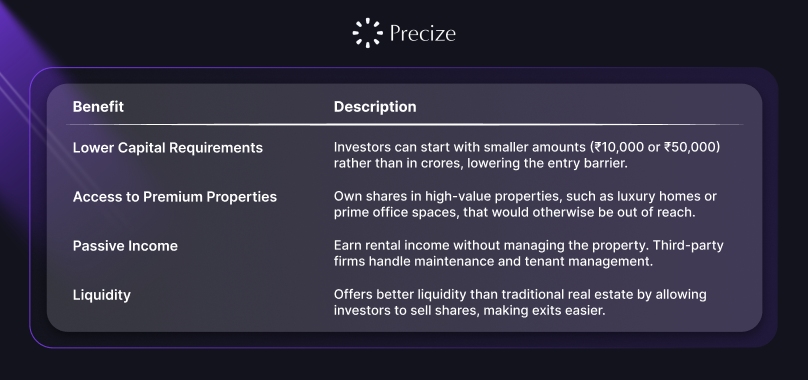
The Benefits of Fractional Ownership for Indian Investors

Fractional ownership is an appealing investment model, particularly for retail investors looking to participate in real estate without the significant capital traditionally required. 

By enabling investors to invest in high-value properties with smaller financial commitments, fractional ownership allows them to access the benefits of property ownership while avoiding the full costs and responsibilities. 

Here's how fractional ownership is proving beneficial for Indian investors:

Are you ready to explore private market investment opportunities with just ₹10,000? At Precize, you can access curated unlisted and pre‑IPO shares backed by detailed analyst research, designed to put high‑growth companies within reach of retail investors. 

Also Read: Understanding Tax Benefits and Income from Let Out Property

However, fractional ownership comes with risks. Let’s discuss what those are and how you can mitigate them.

What Are the Risks of Fractional Ownership in Real Estate?

While fractional ownership offers many advantages, it's important to understand the potential risks before you invest. Here are some key risks to be aware of:

1. Market Risk

Real estate values can fluctuate due to factors such as economic conditions, interest rate changes, and shifts in local market demand. 

For fractional owners, this means the property value could decrease, affecting both capital appreciation and rental income. In cities like Mumbai and Delhi, property values can swing significantly with market conditions. 

Keep in mind that fractional ownership ties you to the property’s performance, which is subject to market trends.

2. Legal and Regulatory Concerns

India’s real estate market is still adapting to fractional ownership, and there are a few legal uncertainties:

  • Ownership Issues: As multiple investors share ownership, the legal framework governing ownership rights can be unclear, leading to disputes.

  • Regulation Gaps: While fractional ownership platforms are becoming more common, the regulations governing them are still evolving. In the absence of clear guidelines, some platforms may lack adequate investor protection.

  • Exit Challenges: The legal process for selling fractional shares might not be as straightforward as selling traditional real estate, leading to potential delays or complications.

3. Exit Strategy

One of the biggest challenges with fractional ownership is the lack of liquidity. In traditional real estate, selling a property can take time. Similarly, fractional shares aren’t as easy to sell as stocks, and you may face delays or difficulty finding buyers when you want to exit.

Some platforms allow you to sell shares back to the platform or to other investors, but this process may not always be quick or easy. It’s important to confirm the platform offers a clear, structured exit strategy before you invest.

4. Property Management

Property management can differ based on the fractional ownership model. In some cases, the platform handles everything—tenant management, property maintenance, and rental collection. 

However, in other models, you might be expected to take part in managing the property or making maintenance decisions. 

Also Read: Understanding the Basics of Cash Management 

Understanding how property management works is essential, as poor management can affect rental yields and the property's overall condition. 

How Can You Get Started with Fractional Ownership in India?

Getting started with fractional ownership requires a well-informed approach. It’s essential to select the right platform, understand the types of properties available for investment, and follow a straightforward investment process.

1. Choosing a Platform

First, you need to select a reliable platform that offers fractional ownership opportunities. Here’s what to look for:

  • Transparency – Look for clear disclosures on the platform’s fees, asset ownership structure, and process for buying or exiting shares.

  • Regulatory Alignment – Ensure the platform either operates under or is preparing to follow frameworks proposed by the Securities and Exchange Board of India (SEBI), such as the “MSM REIT” rules.

  • Track Record – Verify past deals, property quality, investor feedback, and management’s capability to handle shared ownership models.

2. Types of Properties to Invest In

Fractional ownership is available in a variety of property types. Some popular options include:

  • Residential Properties: Located in prime areas, these offer rental income and potential capital appreciation.

  • Commercial Properties: Office spaces and retail properties tend to offer more stable returns, especially in urban centres.

  • Vacation Properties: High-end vacation homes or resorts, which can be rented out for short-term stays.

  • Mixed-Use Properties: These offer diversified income streams from both residential and commercial spaces.

Each property type carries different risks and potential returns, so consider your investment goals before choosing.

3. Investment Process

The process of investing in fractional ownership is simple but varies by platform. Here’s a general step-by-step guide:

  • Research: Explore different platforms and properties available for fractional investment. Make sure the platform provides all the necessary legal details.

  • Select a Property: Choose a property based on your investment goals, whether you're focused on rental income or long-term appreciation.

  • Sign Legal Agreements: Once you’ve selected a property, you’ll need to sign agreements that outline your share of the property and responsibilities.

  • Invest: Transfer the required amount to purchase your share in the property.

  • Receive Income: Depending on the property’s rental performance, you’ll start receiving rental income, usually distributed quarterly.

4. Regulatory Considerations

Fractional ownership in India is still new, and regulations are developing. 

  • SEBI has proposed regulating Fractional Ownership Platforms (FOPs) under the MSM REIT regime. 

  • Real estate laws, such as the Real Estate (Regulation and Development) Act, 2016 (RERA), apply to properties in registered projects, thereby adding transparency. 

  • Confirm that the platform provides details on stamp duty, registration charges, and transfer rights of your fractional share.

Also Read: Basics and Objectives of Tax Planning in India 

Conclusion

The entry of fractional ownership into India’s real estate market signals a practical shift for investors who have high thresholds. With younger investors prioritising steady rental yields over single‑asset ownership—57% of surveyed individuals cite income stability as their key motivator—fractional ownership becomes a credible option.

The future of fractional ownership hinges on clearer regulations, effective exit mechanisms, and platform transparency. As frameworks such as the SEBI SM‑REIT guidelines take shape, fractional ownership is poised to transition from a niche model to a mainstream investment option.

Ready to start investing in high-value assets?

With Precize, you can begin investing in pre-IPO shares, unlisted assets, and fractional ownership opportunities from as little as ₹10,000. Our platform provides you with detailed research, a seamless process, and secure transactions, making it easier than ever to diversify your investment portfolio.

Reserve your access to exclusive investment opportunities today.

FAQs

Q: How do fractional ownership platforms handle property management?
A: Property management is usually handled by third-party firms, which take care of tenant management, maintenance, and rent collection. This allows investors to earn passive income without the hassle of daily management. Some platforms may offer different management models, so it’s essential to check the terms before investing.

Q: What happens if the property value decreases?
A: If the property value declines, fractional owners share the loss proportionally. This is a market risk to consider, but the diversified nature of fractional ownership helps spread such risks across multiple properties, reducing the impact of a downturn in one asset.

Q: Are fractional ownership investments taxed differently than other real estate investments?
A: Yes, fractional ownership may have specific tax implications, such as capital gains tax on property sales or rental income tax. It's essential to consult with a tax advisor to understand how these investments are taxed and to ensure compliance with Indian tax laws.

Q: Can fractional ownership shares be resold easily?
A: The ease of reselling fractional shares depends on the platform. Some platforms provide a secondary market or buyback options, but liquidity can vary. Always verify the platform’s exit strategy and resale process before investing.

Q: How do I choose the right fractional ownership platform?
A: When selecting a platform, look for one with a transparent legal framework, strong property selection, and a proven track record. Ensure that the platform is regulated and offers a clear exit strategy, and check if they provide detailed reports and due diligence on their listed properties.

Precize
Precize
Content Strategy and Research Analyst

Stay in the Loop

Join our newsletter for exclusive access to thoughtfully curated content and we promise, no spam

The next generation of asset classes in India

Resources

Our Office

Office No. 1219, The Summit Business Park, Andheri Kurla Road, Andheri East, Mumbai, Maharashtra - 400093

Find us on Google

support@precize.in

+91 7738336457

All trademarks and logos or registered trademarks and logos found on this Site or mentioned herein belong to their respective owners and are solely used for informational and educational purposes.

The material presented in this advertisement is for informational purposes only and should not be construed as investment advice or investment availability. It is not a recommendation of, or an offer to sell or solicitation of an offer to buy, any particular unlisted share, security, strategy, or investment product. Investing in the private market and securities involves risks, including the potential loss of money, and past performance does not guarantee future results. Market trends, data interpretations, graph projections are provided for informational and illustrative purposes and may not reflect actual future performance. Nothing on this website should be construed as personalized investment advice or should not be treated as legal, financial, or any other form of advice. Precize is not liable for financial or any other form of loss incurred by the user or any affiliated party based on information provided herein.

Precize is neither a stock exchange nor does it intend to get recognized as a stock exchange under the Securities Contracts Regulation Act, 1956. Precize is not authorized by the capital markets regulator to solicit investments. The securities traded on these platforms are not traded on any regulated exchange.

The website will be updated regularly.

Copyright © 2026 - Precize - All Rights Reserved