
TL;DR Section
Mezzanine financing is a hybrid of debt and equity, offering flexible capital for business growth, expansion, or acquisitions.
It comes with higher interest rates but usually requires little to no collateral and delays equity dilution unless there's a default.
You get customised repayment terms, often interest-only until maturity, with the possibility of equity conversion if repayment fails.
While it supports mid-stage business needs, it carries risks like complex terms, loss of control, and higher borrowing costs.
Compared to bank loans and equity funding, it offers a middle path, balancing access to funds with partial ownership protection.
When your business is growing fast but traditional loans aren’t enough, and giving away too much equity doesn’t feel right, you’re likely stuck in the middle, searching for a smarter funding route. That’s where mezzanine financing often fits in. It’s designed for situations just like this, when you need a boost in capital to take the next big step, without immediately giving up control.
In this blog, you’ll explore what mezzanine financing really means, how it works in real business scenarios, and why many companies consider it during expansion or acquisitions. We’ll walk you through its core components, benefits like flexible repayment, and potential risks such as higher costs.
You’ll also see how it stacks up against other funding options, so you get a clear, balanced view before exploring it further.
Let’s start with the basics!
What Is Mezzanine Financing?
Mezzanine financing is a type of funding that combines elements of both debt and equity. It usually comes into play when a business has already used up traditional loan options but still needs more capital to grow, expand, or acquire another company. This form of financing is typically unsecured, meaning it doesn’t require physical collateral, but lenders may ask for a small ownership stake or the option to convert the loan into equity if the repayment doesn’t happen on time.
Example of Mezzanine Financing
A fast-growing logistics startup based in Bengaluru has secured a bank loan but still needs additional funds to acquire a smaller regional player. Instead of giving up more equity to investors, the founders go for mezzanine financing. The lender provides the extra capital with an agreement that if the startup fails to repay on time, part of the loan can be converted into shares. This way, the company gets the funding it needs for expansion without immediately giving up more control to outside investors.
Now that you know what mezzanine financing means, let’s explore the key components that make it different from traditional funding options.
Core Components of Mezzanine Financing
When you explore mezzanine financing, you’ll notice it works differently from regular loans or equity funding. It has a few key parts that make it unique. Here’s a simple breakdown of the main components:
Hybrid Structure (Mix of Debt and Equity)
Mezzanine financing gives you a loan but with a twist. If your company can’t repay as agreed, the lender may have the right to convert part of the loan into shares. This mix of loan and equity is what makes it a hybrid; it sits between senior debt (like a bank loan) and equity (ownership) on your company’s balance sheet.
Subordination (Lower Priority Than Senior Loans)
This type of loan is considered lower in priority than traditional bank loans. If your company ever faces financial trouble, senior lenders are paid first, and mezzanine lenders are next, before equity holders. That’s why mezzanine lenders usually expect higher returns, as they take on more risk.
Flexible Repayment Options
Usually, you’re required to pay just the interest during the loan period. The full loan amount (principal) is paid back at the end. And if you miss an interest payment, some agreements allow you to defer it by adding it to the total loan balance, giving you more breathing room.
Unsecured or Lightly Secured
Most mezzanine loans don’t need you to offer specific assets as security. Instead, the lender looks at how much cash your business generates and your ability to repay over time.
Equity Participation (Warrants or Conversion Rights)
In many cases, lenders get the option to buy shares at a fixed price (called warrants) or convert the loan into equity if there’s a default. If your company grows, the lender benefits from that success, too.
Payment Priority
If your company is ever liquidated, mezzanine lenders get paid after banks but before shareholders. So, they’re in the middle when it comes to repayment priority.
Arrangement Fees
You might have to pay a one-time fee to the lender for arranging the loan. This is usually paid upfront and is part of the cost of the deal.
No Monthly EMI for the Principal
Unlike regular loans, you don’t pay back the main loan amount in monthly installments. The full principal is due at the end of the loan term, which can help ease your cash flow during the growth phase.
With the main features covered, the next step is to explore how mezzanine financing operates.
How Mezzanine Financing Works?
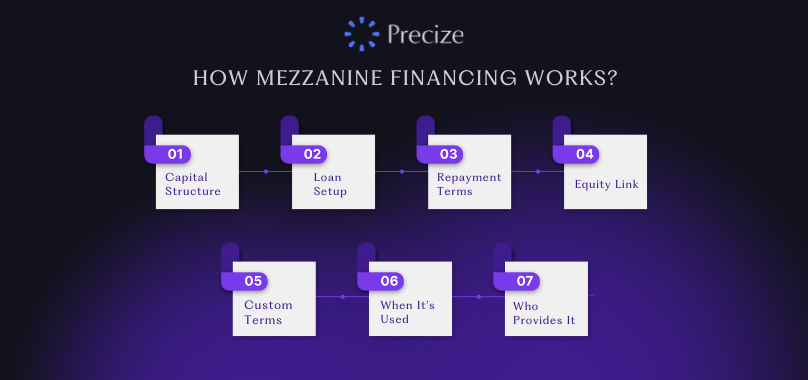
Mezzanine financing is a hybrid funding method that combines parts of both loans and equity. Here is a simple look at how it usually works for businesses in India in 2025:
Position in Capital Structure
This type of funding sits between senior debt (like bank loans) and equity (ownership shares). If your company faces financial trouble, bank lenders are paid first, mezzanine lenders next, and then the equity holders. That’s why it’s called a middle-layer financing option.
Loan Setup
You receive the money either as a loan or through financial tools like bonds or debentures. Since this funding is riskier for the lender and often unsecured, the interest rates are higher, usually between 12% and 20%.
Repayment Terms
With mezzanine loans, you generally pay only the interest during the loan period. The actual loan amount (principal) is paid back at the end of the term. This setup helps you manage your business cash flow better during the growth phase.
Equity Link
If your company can’t repay the loan, the lender may have the option to convert the loan into shares of your business. This is usually done through tools like warrants or conversion rights, giving them a possible stake in your company.
Custom Terms
The terms of the loan are usually tailored to fit your business needs. These may include a mix of fixed and variable interest rates, profit-sharing agreements (where lenders get a part of your profits), and arrangement fees.
When It’s Used
In India, mezzanine financing is commonly used when companies are expanding, buying other businesses, or starting large-scale projects. It helps fill funding gaps when bank loans fall short, and owners don’t want to give away too much equity.
Who Provides It
This type of capital usually comes from private equity firms, specialized investment funds, or long-term investors who understand your business and industry.
Now that you know how mezzanine financing works, let’s look at the types of mezzanine financing.
Types of Mezzanine Financing
Mezzanine financing can be structured in different ways, depending on what suits both the business and the lender. Here are the main types you should know about:
Subordinated Debt (Mezzanine Loans)
This is a loan that ranks below senior debt but above equity in terms of repayment priority.
If your company faces financial trouble, these lenders are paid only after bank loans are cleared, but before any money goes to shareholders.
These loans are usually unsecured, meaning you don’t need to pledge specific assets.
Preferred Equity
In this setup, the lender provides funds in exchange for preferred shares rather than a standard loan.
Preferred shareholders get priority over common shareholders when it comes to earnings and assets, but they usually don’t have voting rights.
Since there are no fixed repayments, it can ease pressure on your company’s cash flow.
Convertible Debt
This type of mezzanine financing starts as a loan, but it can be converted into equity under specific conditions, usually if you fail to repay on time.
It gives lenders a chance to become partial owners if the company does well, offering them potential future gains.
Payable-in-Kind (PIK) Loans
With PIK loans, you don’t pay interest in cash. Instead, the interest is added to the loan amount, and you repay it later. This helps preserve cash in the short term, though the total loan balance increases over time.
Equity Participation or Warrants
Along with the loan, lenders may receive rights, called warrants, that let them buy shares in your company later at a fixed price. If your business grows in value, they benefit by purchasing shares at a lower rate.
Participation Payouts
In some cases, instead of taking equity, lenders agree to earn returns based on your company’s performance.
This could be a share of profits or revenue, often linked to earnings like EBITDA. It ties the lender’s returns directly to how well your business performs.
Now that you know the different ways mezzanine financing can be structured, let’s look at the key benefits it offers to growing businesses.
Benefits of Mezzanine Financing
Mezzanine financing offers several advantages, especially for businesses that are growing but don’t want to give up control or face strict loan conditions. Here is how it can support your business:
Flexible Way to Raise Capital
Since mezzanine financing blends debt and equity, it gives you more flexibility compared to regular loans. You can access funds without dealing with rigid repayment terms or heavy collateral requirements.
Keeps Ownership in Your Hands
One of the biggest benefits is that you don’t have to give up ownership right away. Unless you miss payments or default, the lender doesn’t take a share in your business, unlike with equity funding.
Helps You Grow
Whether you’re planning to expand operations, enter a new market, or acquire another company, mezzanine financing can help you bridge the funding gap when bank loans fall short. It's especially useful for large-scale projects.
Possible Tax Advantages
The interest you pay on mezzanine loans is usually tax-deductible. This can help lower your company’s taxable income and reduce the total cost of borrowing.
Improves Your Financial Image
Having mezzanine capital on your books can strengthen your company’s financial position. This often makes it easier to raise more funds later, as banks or investors may see your business as more stable.
Repayment on Your Terms
The repayment plan can be designed to suit your cash flow. You may also have the option to roll unpaid interest into the loan amount, which gives you more breathing space when things are tight.
Easier to Attract Risk-Taking Investors
Even though this mostly benefits the lender, the chance to earn high returns makes it easier for you to bring in investors who are open to taking on more risk.
No Immediate Share Dilution
You can raise the money you need without instantly reducing your ownership in the company. This is useful if you want to keep full control over key decisions.
Higher Claim Than Equity Holders
If your business runs into trouble, mezzanine lenders have a better chance of being repaid than equity investors. This structured priority can help with smoother negotiations during financing discussions.
Along with its benefits, mezzanine financing carries a few risks that businesses need to be aware of.
Potential Risks of Mezzanine Financing
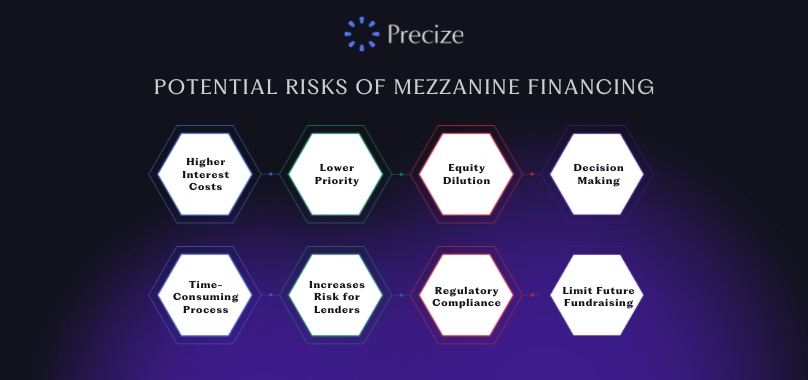
While mezzanine financing offers flexibility, it also comes with certain risks you should be aware of before considering it for your business:
Higher Interest Costs
Mezzanine loans usually come with higher interest rates than regular bank loans. This makes them a more expensive option, adding to your total borrowing cost over time.
Lower Priority in Repayment
Since mezzanine debt is subordinate to senior loans, lenders are only repaid after banks and other senior creditors if your business runs into financial trouble. If your assets aren’t enough to cover all debts, mezzanine lenders may not get fully paid.
Chance of Equity Dilution
If you default on the loan, the lender may have the right to convert the debt into equity. This could lead to a reduction in your ownership and control, especially if your business is struggling financially.
Loss of Control in Decision-Making
Some lenders might ask for a seat on your board or set strict rules in the agreement. This can limit your freedom to make business decisions, raise more funds, or distribute profits as you wish.
Time-Consuming Process
Setting up mezzanine financing can take time. From negotiations to legal paperwork, the whole process is often complex and may stretch over several months.
Unsecured Nature Increases Risk for Lenders
Since these loans are usually unsecured or backed by limited collateral, lenders take on more risk. To cover this, they often demand higher interest rates or add more conditions to the deal.
Legal and Regulatory Compliance
Even though there aren’t any specific rules in India just for mezzanine financing, you’ll still need to follow general financial regulations set by authorities like SEBI. This adds an extra-legal layer to manage.
Can Limit Future Fundraising
Some mezzanine agreements may include conditions that restrict your ability to raise more capital or restructure existing loans. This could affect your future growth or expansion plans.
To understand where mezzanine financing truly fits, it helps to compare it with other popular funding choices available to Indian businesses.
Mezzanine Financing vs Other Funding Options
When exploring funding options, it’s important to compare mezzanine financing with other common choices available to Indian businesses. Each has its own structure, cost, and impact on your company.
Here is a simple side-by-side comparison to help you understand where mezzanine financing stands:

Conclusion
As seen throughout this blog, mezzanine financing stands out as a flexible funding route that bridges the gap between traditional debt and equity. It offers mid-sized businesses in India the chance to access growth capital without immediately giving up ownership or pledging heavy collateral.
With features like customized repayment terms, equity conversion options, and minimal asset requirements, it supports expansion plans while still carrying risks like higher interest rates and potential dilution.
For those looking to explore more private market opportunities, Precize is an alternative investment platform in India that gives access to curated private equity and private credit deals. Precize helps you explore diversified fixed-income and growth-focused alternatives, all in one place.
Request early access to explore exclusive investment opportunities with Precize!
Frequently Asked Questions (FAQs)
1. Where does mezzanine financing stand in the repayment order?
Mezzanine financing comes after senior debt (like bank loans) but before equity (shares held by owners). If your company runs into financial trouble, the bank or senior lenders get paid first, mezzanine lenders next, and shareholders are the last to receive anything.
2. Who usually uses mezzanine financing?
This type of funding is mostly used by established businesses, such as SMEs, infrastructure companies, and real estate firms, especially when they’re planning to expand or acquire another business and need extra capital beyond what banks can offer.
3. Is collateral needed for mezzanine loans?
In most cases, mezzanine financing doesn’t require you to provide any specific collateral. Since it’s usually unsecured, it's easier for companies to access, but also riskier for lenders, which is why the interest rate is higher.
4. How is interest paid on mezzanine loans?
The interest can be paid in regular cash installments. In some cases, it may be “payable in kind” (PIK), which means the interest is added to the loan amount and paid along with the principal at the end of the loan term.
5. Will it affect ownership of the business?
At first, it won’t affect your ownership. But if your business can’t repay the loan as agreed, the lender might have the option to convert the debt into shares, reducing your ownership in the company.
Disclaimer
The information provided in this blog is for general knowledge and educational purposes only. It does not constitute financial, investment, or legal advice. Readers are advised to consult with a qualified financial advisor or legal expert before making any funding or investment decisions. Examples mentioned, including references to companies like IL&FS and DHFL, are for illustrative purposes only and do not imply any judgment or recommendation.