
The gap between these numbers raises an important question: how did Mohan Meakin maintain its profitability despite such a steep fall in revenue?
The answer lies in the changing composition of its expenses, particularly purchases of stock-in-trade, along with lower operating costs and higher other income. However, the decline in EBITDA and operating cash flow suggests that the results need a closer look.
Mohan Meakin Q2 FY27 Results: Key Financial Highlights
Mohan Meakin Limited, best known for its Old Monk brand, reported the following standalone, unaudited financial performance for the quarter ended September 2026.
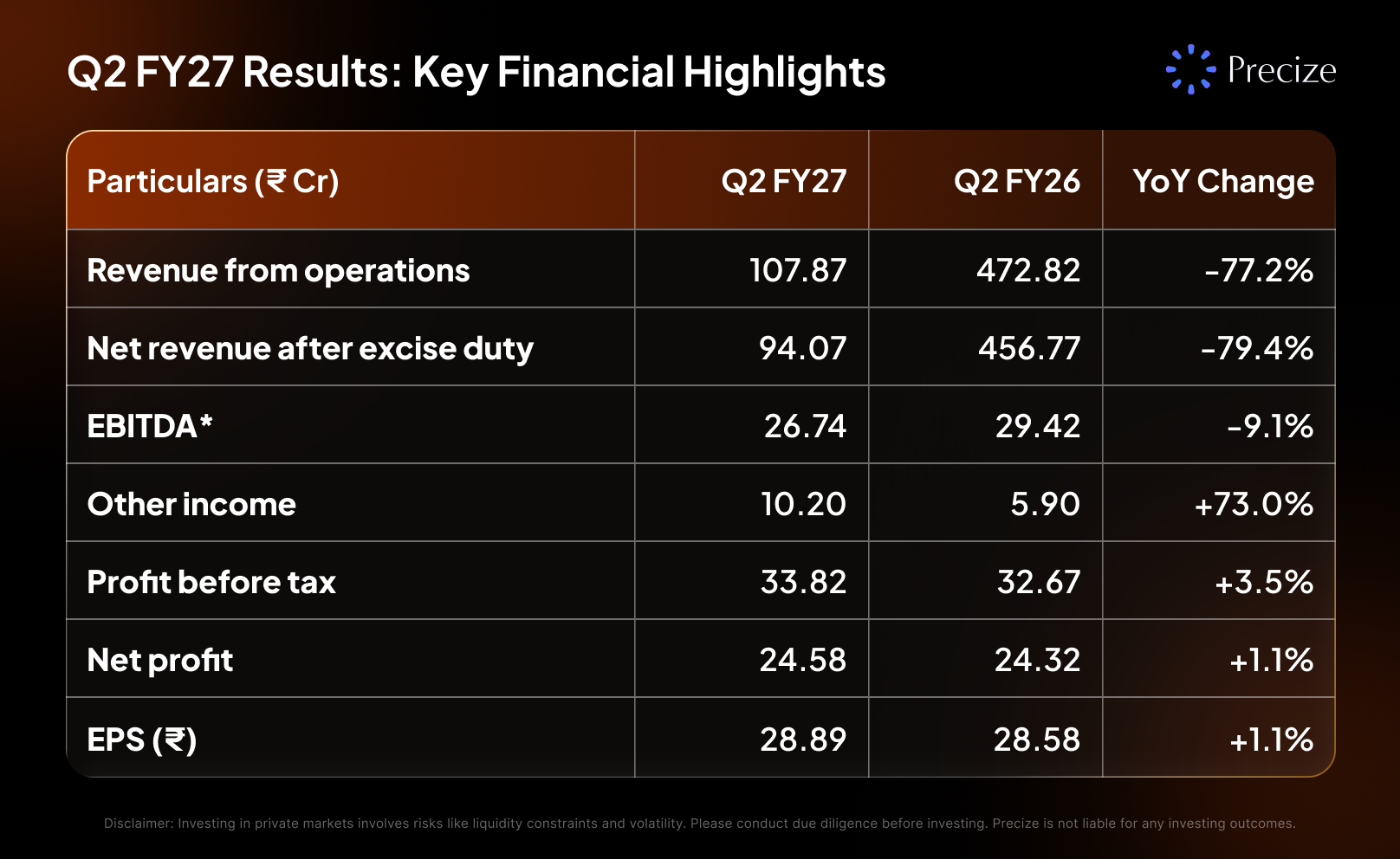
EBITDA is presented excluding other income, as reported in the secondary results coverage.
The numbers reveal a clear difference between the company's revenue performance and its bottom line. While revenue contracted sharply, net profit remained almost unchanged.
For investors tracking Mohan Meakin unlisted shares, this distinction matters because revenue growth alone does not explain how a business is performing. The cost structure and quality of earnings are equally important.
Why Did Mohan Meakin's Revenue Fall 77% in Q2 FY27?
The biggest movement in the results came from purchases of stock-in-trade. Stock-in-trade refers to finished goods purchased by a company for resale rather than manufactured by the company itself. A change in this activity can affect both reported revenue and the associated purchase costs.
Mohan Meakin's purchases of stock-in-trade changed significantly during the quarter:
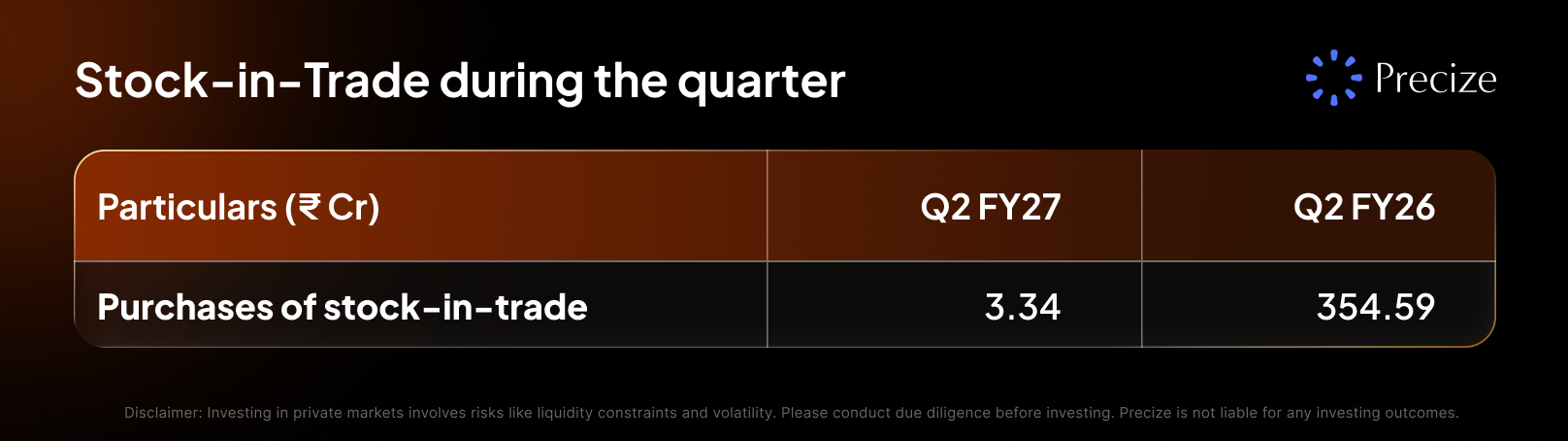
The sharp reduction in these purchases provides important context for the fall in revenue. When a company buys and resells fewer finished goods, the revenue generated from those transactions can also decline. At the same time, the associated purchase expenses reduce. This means the decline in revenue should not automatically be interpreted as an equivalent decline in the company's underlying manufacturing activity or profitability.
However, it also does not mean the revenue contraction is insignificant. Investors need to understand which business activities slowed, whether the change is temporary, and how much of the company's future revenue depends on these activities. This is where a closer look at financial performance becomes important.
How Did Mohan Meakin Maintain Its Profit Despite Lower Revenue?
Three movements help explain why the decline in revenue did not translate into a similar fall in net profit.
1. Lower stock-in-trade purchases
Purchases of stock-in-trade fell from ₹354.59 crore in Q2 FY26 to ₹3.34 crore in Q2 FY27. This significantly reduced a major expense associated with the company's trading activity.
2. Operating expenses remained relatively controlled
Some of the company's other expenses also remained lower or increased only moderately.
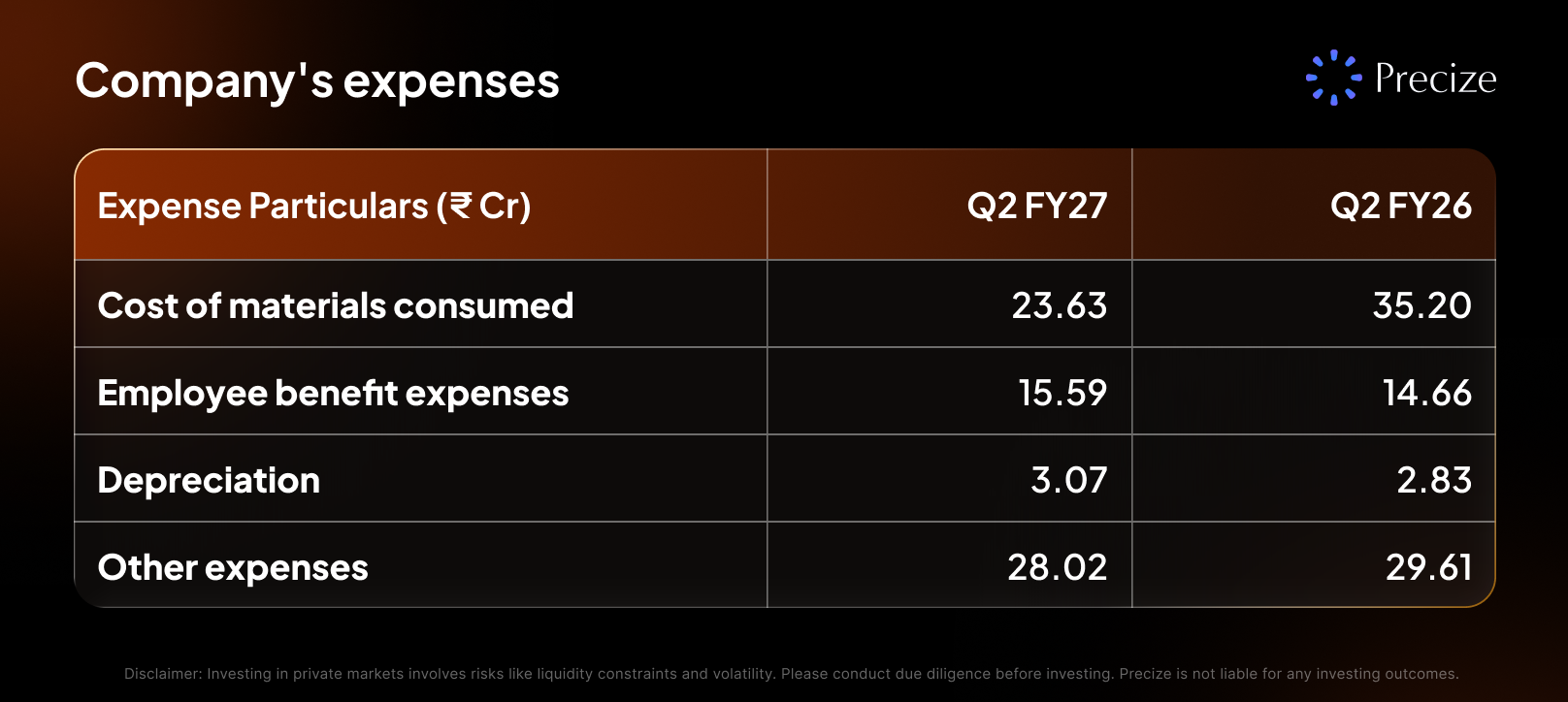
Lower material consumption costs and other expenses helped moderate the impact of lower revenue. Employee expenses and depreciation, meanwhile, moved upwards.
3. Higher other Income Expense Particulars (₹ Cr)
Other income increased to ₹10.20 crore from ₹5.90 crore, a rise of 73%. This contributed to the company's profit before tax. However, other income is different from income generated through regular business operations. Investors should therefore assess it separately when evaluating the sustainability of earnings.
What Does EBITDA Reveal About Mohan Meakin's Operating Performance?
Net profit is only one part of a company's financial performance. EBITDA helps investors understand operating profitability before interest, taxes, depreciation and amortization.
Mohan Meakin 's EBITDA, excluding other income, declined by 9.1% to ₹26.74 crore in Q2 FY27 from ₹29.42 crore in the corresponding quarter last year.
Although net profit increased by 1.1%, operating earnings were lower. The increase in other income helped support the bottom line, but it did not fully offset the decline in operating profitability.
For a clearer understanding of these metrics, investors can learn how to read financial statements rather than relying on net profit alone. Looking at revenue, margins, expenses and cash generation together provides a more complete picture of a company's earnings quality.
Mohan Meakin H1 FY27 Results: April to September 2026
The first-half performance provides a wider view of the company's financial position. Between April and September 2026, Mohan Meakin recorded a significant decline in revenue, while its net profit remained relatively stable.
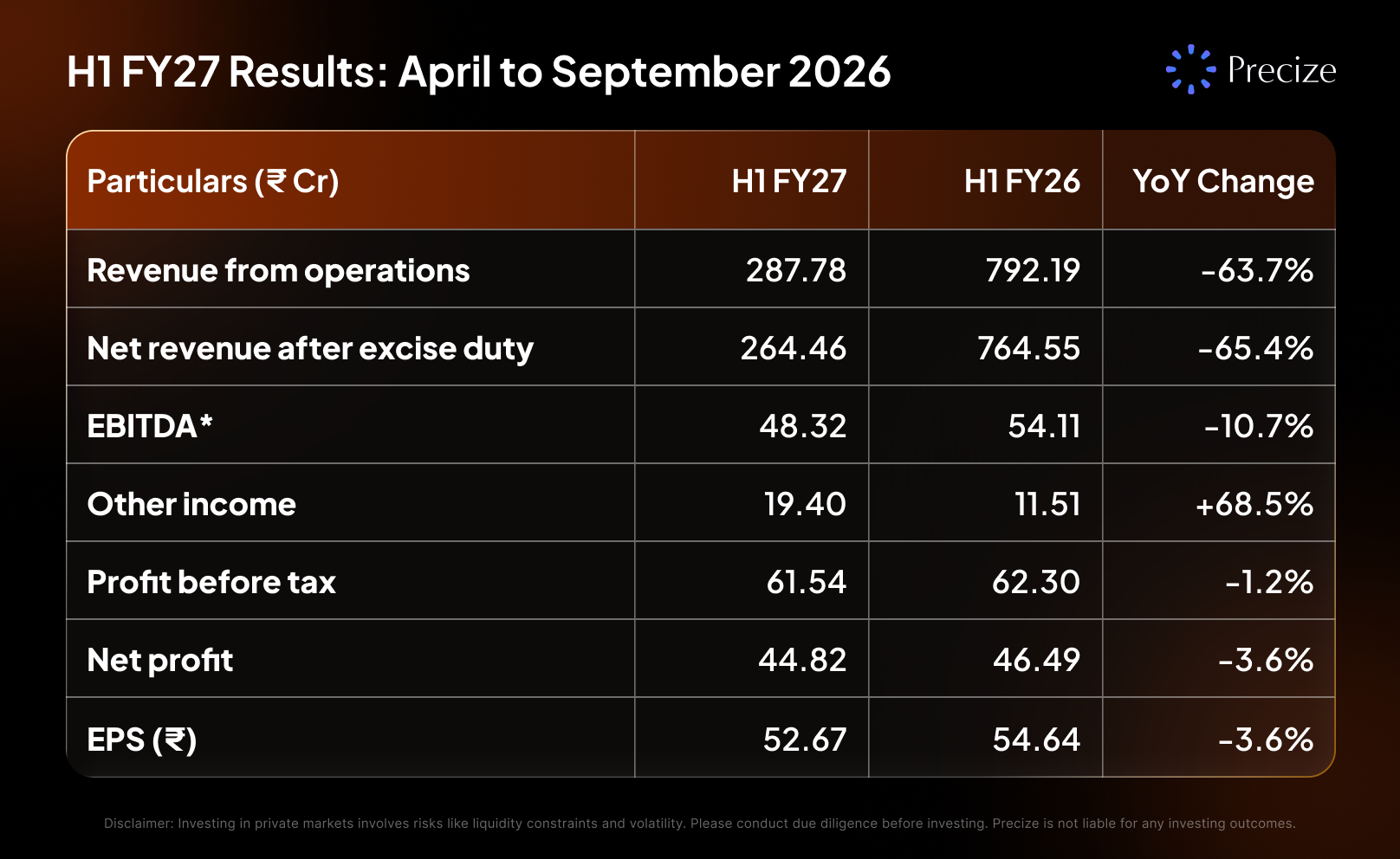
EBITDA excludes other income, as reported in the secondary results coverage.
The half-year figures reinforce the trend seen in Q2. Revenue declined considerably, but profit before tax remained nearly unchanged. However, EBITDA fell by 10.7%, indicating that operating earnings were under pressure even as the bottom line remained relatively resilient.
Operating Cash Flow: Another Number Investors Should Watch
According to the figures reported in the available results coverage, Mohan Meakin's operating cash flow stood at ₹17.89 crore in H1 FY27, compared with ₹54.40 crore in H1 FY26.This represents a decline of approximately 67.1%, profitability does not always translate into cash generated by a company's regular operations.
The movement deserves attention because operating cash flow reflects how effectively a business converts its operations into cash. A company may report accounting profits while generating less cash during the same period.
Investors should therefore examine cash flow analysis alongside revenue, EBITDA and net profit. A closer look at the cash flow statement can help explain why reported earnings and actual cash generation may move differently.
What Should Investors Watch After Mohan Meakin's Q2 FY27 Results?
The latest results raise a few important questions about the company's performance over the coming quarters.
How Brand Strength Translates into Business Performance
Beyond the quarterly numbers, Mohan Meakin's performance also highlights the importance of business consistency. A company with an established brand presence may have a strong market identity, but sustaining that position requires more than brand recognition. Distribution strength, changing consumer preferences, product availability and the ability to adapt to market conditions all influence long-term performance. For investors, the bigger question is whether the company can translate its established presence into consistent business growth and stronger operating performance over time.
1. Revenue recovery: Investors will want to understand whether the sharp decline in revenue is temporary or reflects a more sustained change in the business mix.
2. Stock-in-trade activity: The significant reduction in purchases of stock-in-trade makes this an important metric to monitor in subsequent results.
3. Core operating profitability: EBITDA declined in both Q2 and H1 FY27. A recovery in operating earnings would offer a clearer indication of improving business performance.
4. Other income contribution: Higher other income supported reported profit. Investors should assess whether the company can strengthen earnings through its core operations rather than relying on non-operating income.
5. Cash generation: The decline in operating cash flow makes future cash conversion an important area to monitor.
There has also been secondary-market reporting linking the revenue decline to restrictions affecting certain Old Monk variants manufactured at the company's Maharashtra facility. However, this explanation should not be treated as an independently confirmed company statement without the relevant official disclosure.
For investors evaluating the company's valuation, these operating trends matter alongside its historical financial performance. Its position in the unlisted market also means that price discovery and exit opportunities may differ from those of exchange-listed companies.


Conclusion
Mohan Meakin's Q2 FY27 results show why looking at revenue in isolation can give an incomplete picture of a company's financial performance.
A 77.2% decline in quarterly revenue alongside a 1.1% rise in net profit is an unusual combination. Lower stock-in-trade purchases, controlled expenses and higher other income help explain the difference. Yet the fall in EBITDA and operating cash flow suggests that the business still has areas that require attention.
The next few reporting periods will be important in understanding whether the company can restore revenue momentum while strengthening operating profitability and cash generation.
For investors following Mohan Meakin , the key question is no longer just how much revenue the company generates, but how consistently it can convert that revenue into sustainable earnings and cash flow.
FAQs
Mohan Meakin reported revenue from operations of ₹107.87 crore in Q2 FY27, down 77.2% year-on-year.
The company reported a net profit of ₹24.58 crore, compared with ₹24.32 crore in Q2 FY26.
The sharp reduction in purchases of stock-in-trade provides important context for the revenue decline. Other reported coverage has also discussed restrictions affecting certain Old Monk variants, but the cause requires confirmation from an official company disclosure.
Mohan Meakin reported a net profit of ₹44.82 crore for H1 FY27, compared with ₹46.49 crore in H1 FY26.
Investors should track revenue recovery, stock-in-trade purchases, EBITDA, operating cash flow and the contribution of other income to overall profitability. They should also consider the risks of unlisted share investments.
Disclaimer: This article is for informational purposes only and should not be considered as investment advice. Investing in unlisted shares carries risks including illiquidity and potential loss of capital. Please consult with a qualified financial advisor before making investment decisions. Precize is not a stock exchange and is not authorized by any capital markets regulator.