
That distinction matters. NSE's listing has been discussed since 2016, delayed by regulatory, governance, technology, and legal questions, and watched closely by investors in both the listed and unlisted markets. If you hold NSE unlisted shares or plan to follow the IPO, the next meaningful signals are not social media price targets. They are formal documents, especially the Draft Red Herring Prospectus (DRHP), SEBI observations, and the final offer structure.
What Is a SEBI NOC for the NSE IPO?
A No Objection Certificate (NOC) is SEBI's regulatory comfort that NSE can proceed with IPO-related preparation and filings. In plain English, it means the regulator does not object to the exchange moving forward to the next stage.
For a normal company IPO, SEBI mainly reviews disclosures, risk factors, financial statements, promoter information, litigation, and issue structure. For a stock exchange, the bar is higher because the exchange itself is part of the market's core infrastructure.
SEBI has to consider whether NSE's systems and governance are strong enough for public-market scrutiny. That includes:
Governance and board oversight.
Conflict-of-interest safeguards.
Fair and equal market access.
Technology resilience and trading-system controls.
Clearing corporation ownership and risk management.
Pending litigation, settlements, and regulatory actions.
Disclosure quality for public investors.
That is why the NOC matters. It signals that the most material regulatory constraints have been addressed enough for the IPO process to restart.
However, investors should not confuse this with final IPO clearance.
What the SEBI NOC Does Not Mean
A SEBI NOC does not mean the NSE IPO date is fixed. It also does not confirm the issue size, price band, valuation, retail quota, or listing date.
Here is the clean way to read it:
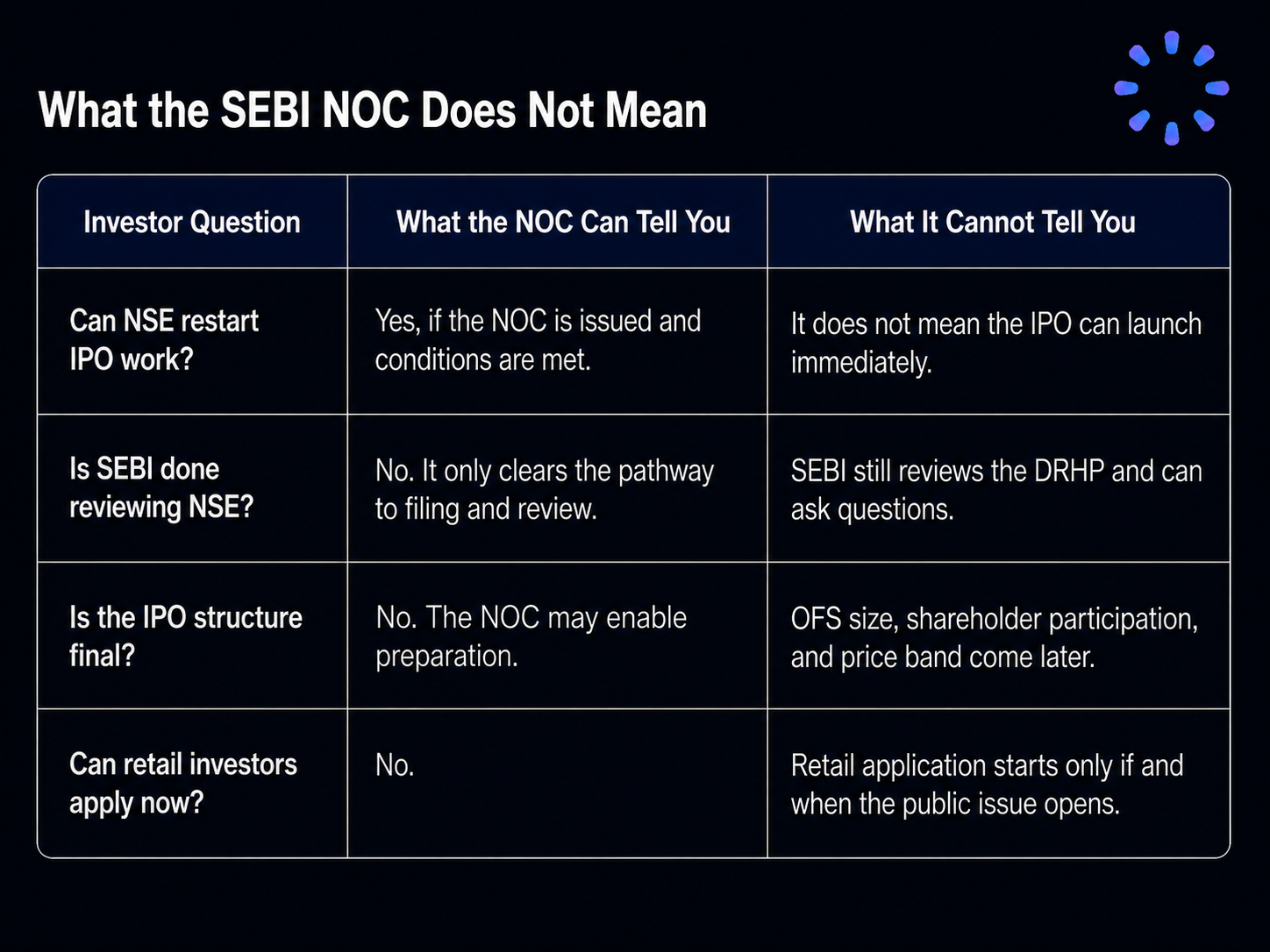
The NOC is important because it moves NSE from "waiting for regulatory clearance" to "working through the IPO pipeline." But the binding details come only from SEBI-reviewed offer documents.
For primary regulatory context, investors should follow updates from SEBI and NSE's official disclosures on NSE India.
Why NSE's IPO Was Delayed Since 2016
NSE first filed draft IPO papers in December 2016, setting up what many expected to be one of India's most important market infrastructure listings. The process then slowed materially.
The delay was not because investors lacked interest. NSE is a large, profitable, systemically important exchange. The delay was mainly about regulatory comfort, governance history, technology-related questions, and legal matters connected to fair access and exchange systems.
2016: NSE Files IPO Papers
NSE's December 2016 filing positioned the exchange for a landmark public listing. A listed NSE would have created a public market benchmark for India's largest exchange operator and given existing shareholders a formal liquidity route.
2019 Onward: Regulatory Action and Litigation
The IPO process lost momentum after regulatory action and litigation connected to equitable access and related governance and technology issues. For an exchange, these concerns are especially sensitive because the company is not just another issuer. It is an institution that hosts trading activity for the wider market.
August 2024: NSE Reapplies for an NOC
NSE's fresh NOC application in August 2024 was a key restart signal. It showed that the exchange wanted to reopen the listing track after years of delay and regulatory back-and-forth.
October 2024: TAP Architecture Settlement
A major milestone was the reported settlement of a SEBI matter linked to trading access point (TAP) architecture and network connectivity, with reports citing a settlement amount of ₹643 crore. Settlements do not erase the past, but they can reduce uncertainty around legacy proceedings.
January 2026: SEBI Signals NOC Progress
In January 2026, SEBI's leadership publicly indicated that the NOC process was in an advanced stage. That statement mattered because it shifted the conversation from whether NSE could restart the IPO path to what steps would come next.
By May 2026, investor attention had moved toward board-level listing steps, potential OFS structure, shareholder processes, and the expected DRHP stage. For a deeper look at the OFS angle, read Precize's explainer on the NSE IPO OFS and India's most awaited listing.
What Happens After SEBI Issues the NOC?
Once the NOC is in place, the IPO becomes easier to track because the process moves into document-led milestones.
1. Offer Document Preparation
NSE and its advisors prepare the offer document. This includes business information, financial statements, governance details, risk factors, litigation history, technology controls, shareholder information, and offer structure.
For NSE, the risk-factor section will be especially important. Investors should expect detailed discussion of regulatory history, technology systems, clearing arrangements, pending matters, and market structure risk.
2. DRHP Filing or Re-Filing
The NSE DRHP is the first major public document investors can study. It is where market chatter becomes checkable disclosure.
Once filed, SEBI reviews the document and can ask questions or request more information. This is normal. For a company as important as NSE, that review may be detailed.
3. SEBI Observations
After reviewing the DRHP, SEBI issues observations. The company and advisors then respond, clarify, revise, or disclose more detail as needed.
For NSE, likely focus areas include governance, technology controls, settlement and clearing risk, litigation, and the way exchange ownership is structured.
4. Final RHP and Launch Window
After SEBI's review is complete and market conditions are suitable, NSE can move toward the Red Herring Prospectus (RHP) and public issue launch.
That launch window will depend on investor demand, market volatility, institutional appetite, and whether the final structure is primarily an OFS, a fresh issue, or a mix of both.
NSE IPO 2026 Timeline: Key Milestones to Track
Use this NSE IPO timeline as a practical watchlist:
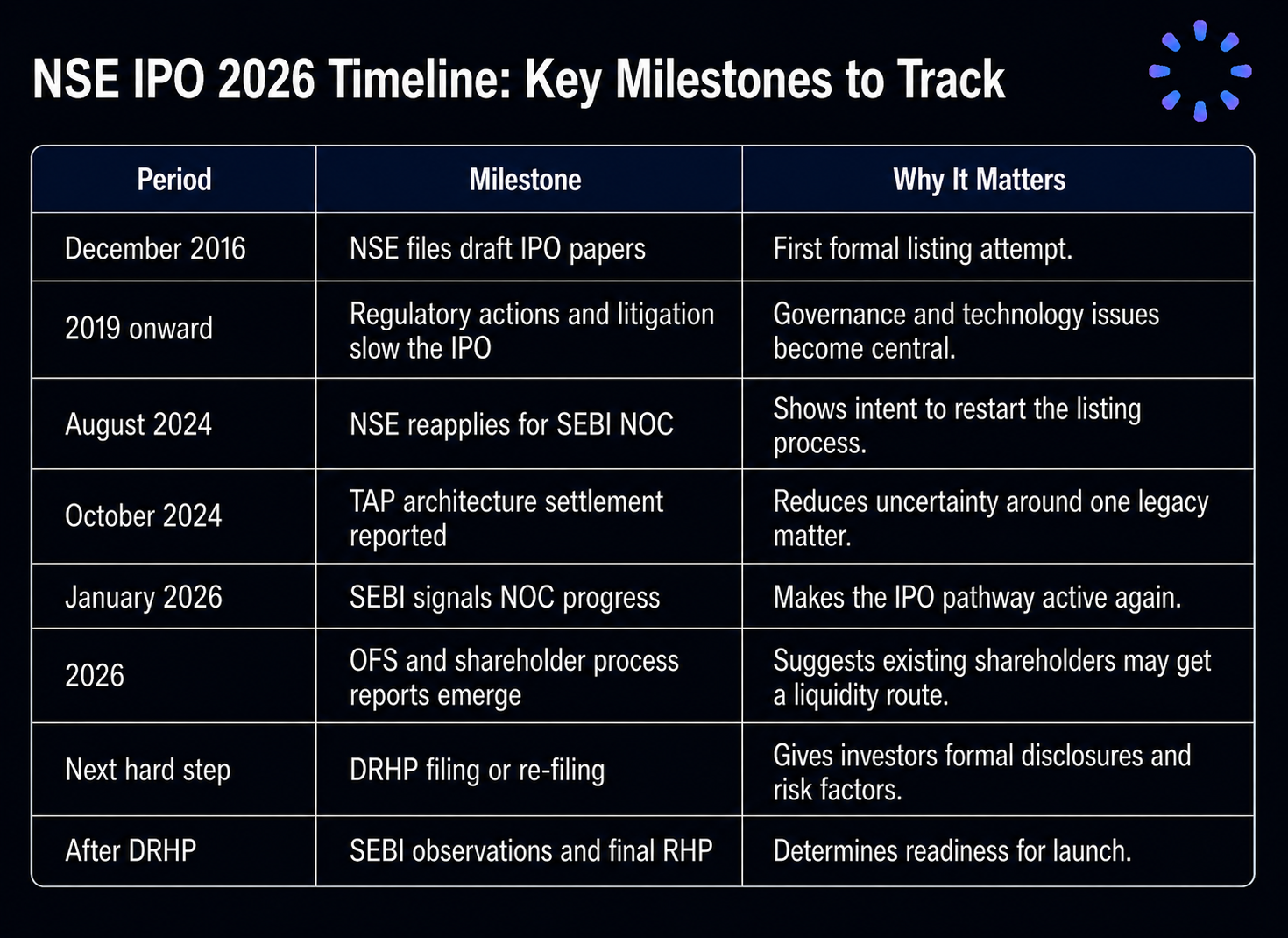
The most important takeaway is that DRHP filing is the next truly useful public milestone. Until then, issue size, valuation, timing, and category details remain provisional.
Why the NSE IPO Draws So Much Investor Attention
NSE matters because it sits at the centre of India's capital markets. Its role spans cash equities, derivatives, listings, market data, indices, and clearing-linked market infrastructure.
Investors track NSE for three broad reasons.
First, scale. NSE is one of India's most important financial market institutions, with deep participation across equities and derivatives.
Second, profitability. Public reporting on NSE's FY25 performance cites revenue of around ₹19,176.83 crore and profit after tax of around ₹12,187.69 crore. Those numbers show why public-market investors are interested, but they still need to be verified against official offer documents and the latest exchange disclosures before valuation work. For recent regulatory and earnings context, see Precize's NSE FY26 results and regulatory headwinds analysis.
Third, ecosystem strength. NSE's platform benefits from market activity, listings, investor participation, and institutional flows. Public reporting also notes 242 IPOs listed on NSE in FY25, with total mobilised proceeds of about ₹1.69 lakh crore.
These fundamentals explain the interest. Still, in an exchange IPO, financial strength is only one part of the story. Public investors will also study governance quality, technology resilience, regulatory history, and clearing-risk architecture.
If you are comparing NSE with other private-market names, use the Precize screener to track available opportunities, financial snapshots, and risk context.
What NSE Unlisted Shareholders Should Watch
If you hold NSE in the unlisted market, the IPO pathway can affect sentiment and price discovery. But it can also create confusion, especially if the offer is structured around an Offer for Sale (OFS). If the issue is mainly an NSE OFS, existing shareholders may get liquidity while NSE itself may not raise fresh capital in that tranche.
Track these checkpoints:
NOC confirmation: Has SEBI formally cleared NSE to restart the process?
DRHP filing date: Has NSE filed or re-filed the offer document?
Offer structure: Is the IPO an OFS, fresh issue, or mix of both?
Selling shareholder rules: Who can sell, how much can they sell, and what holding conditions apply?
SEBI observations: Are there material questions on governance, technology, clearing, or litigation?
Final RHP: What are the final issue size, categories, risk factors, and pricing terms?
Launch window: Are market conditions supportive when the issue is ready?
If you recently bought or are planning to buy NSE unlisted shares, do not assume that ownership automatically gives you the right to sell into an OFS. Eligibility depends on the final offer documents and shareholder rules. For process basics, read process of investing in NSE unlisted shares before you size a position.
Risks Investors Should Not Ignore
The NSE IPO story is exciting, but it is not risk-free.
Regulatory risk: SEBI can ask detailed questions during the DRHP review. Any unresolved governance, technology, or legal issue can affect timing.
Valuation risk: Private-market prices may already include IPO optimism. A listing does not guarantee upside from current unlisted levels.
Timeline risk: The IPO has been delayed before. Even after an NOC, DRHP review and market conditions can shift the schedule.
Liquidity risk: Unlisted shares do not trade like listed stocks. Lot size, counterparty availability, documentation, and approvals can affect exit prices.
Offer-structure risk: If the issue is primarily an OFS, the public issue may mainly provide liquidity to eligible existing shareholders rather than fresh capital to NSE.
For common platform and process questions, see the Precize FAQs.
FAQ: NSE IPO 2026 and SEBI NOC
What does SEBI NOC mean for the NSE IPO?
A SEBI NOC means the regulator has no objection to NSE moving forward with IPO-related preparation and filings. It is an important restart signal, but it is not final IPO approval.
What is the next important NSE IPO milestone?
The next important public milestone is the DRHP filing or re-filing. That document will give investors the clearest view of risks, financials, offer structure, and shareholder details.
Why was the NSE IPO delayed for so long?
NSE's IPO was delayed because of regulatory action, litigation, governance questions, and technology-related concerns connected to fair market access. These issues matter more for exchanges because they are core market infrastructure.
Will the NSE IPO be an OFS?
Public reporting and related 2026 discussions have pointed toward an OFS-led route, but investors should wait for the DRHP and final RHP to confirm the actual structure.
Bottom Line
The NSE IPO 2026 update is meaningful because SEBI's NOC process can move NSE out of a long waiting phase and back into a document-led IPO pathway. But the NOC is not the finish line. It is the start of the next round of scrutiny.
For investors, the right way to track NSE is simple: watch for the NOC confirmation, then DRHP filing, SEBI observations, final RHP, offer structure, and launch window. Until those documents arrive, treat valuation chatter and timeline claims as signals, not facts.
If you want to monitor NSE and other pre-IPO opportunities, explore the Precize screener. You can compare private-market opportunities, read research context, and follow IPO milestones in one place.
Disclaimer: This content is for informational purposes only and does not constitute investment advice. Investing in unlisted shares involves risks including illiquidity and potential loss of capital. Consult a qualified financial advisor before making investment decisions. Precize is not a stock exchange and is not regulated by SEBI. This is not a recommendation to buy or sell shares of National Stock Exchange of India.