If you’ve ever explored different ways to invest your money in India, you might have come across the terms PMS vs AIF. At first, both may seem confusing or even similar, but in reality, they follow different approaches and serve different investor needs.
In this blog, you’ll understand what Portfolio Management Services (PMS) are, the types of PMS, and their pros and cons. You’ll also learn what an Alternative Investment Fund (AIF) is, the categories of AIF, and their pros and cons. Finally, we’ll bring it all together by explaining the key differences between PMS and AIF in simple terms.
Scroll down to explore!
PMS vs AIF: Both are professional investment options in India, but PMS focuses on individual portfolios while AIF pools funds from multiple investors.
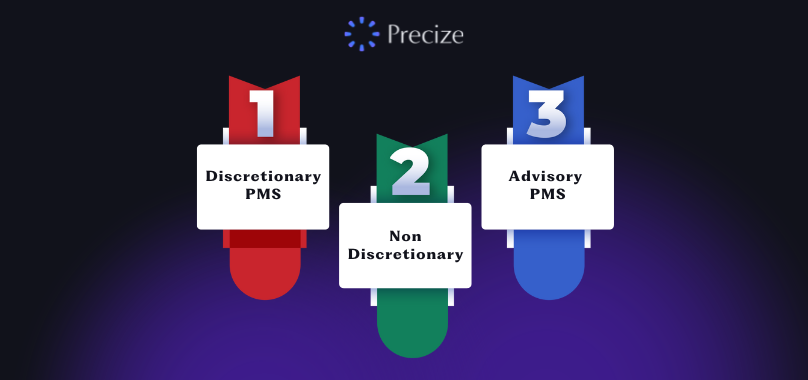
PMS Types: Discretionary (manager decides), Non-Discretionary (you approve), Advisory (manager advises, you act).
AIF Categories: Category I (socially beneficial), Category II (private wealth, alternative strategies), Category III (high-risk, leveraged trading).
Pros & Cons: PMS offers personalization and control but needs high investment and comes with higher fees; AIF provides access to alternative strategies and diversification but may have lock-in periods and regulatory limits.
Key Difference: PMS gives direct ownership and customized management, while AIF pools money to follow broader strategies with professional management.
Portfolio Management Services is a professional service where a qualified portfolio manager manages your investments in equity, debt, or a mix of securities on your behalf. It is regulated by SEBI in India and designed to provide customized investment strategies based on your financial profile and goals.
Knowing what PMS means is useful, but seeing the types will show how your involvement and control can vary.

Portfolio Management Services in India are broadly classified into three types, and each works differently depending on how much decision-making you want to keep with yourself or give to the manager.
In this format, the portfolio manager takes full responsibility for making investment decisions on your behalf.
The manager actively buys and sells securities depending on market conditions, without needing to check with you each time.
In this type, the manager shares ideas and strategies with you, but the final call is always yours.
The manager executes a trade only after you give approval, so you stay in control of every decision while still getting expert input.
This option works more like guidance. The manager suggests possible investment opportunities and market insights, but you handle the transactions on your own.
You benefit from expert advice while keeping full control of your portfolio.
Now that you know the different types of PMS, it’s helpful to look at the advantages each type can offer.

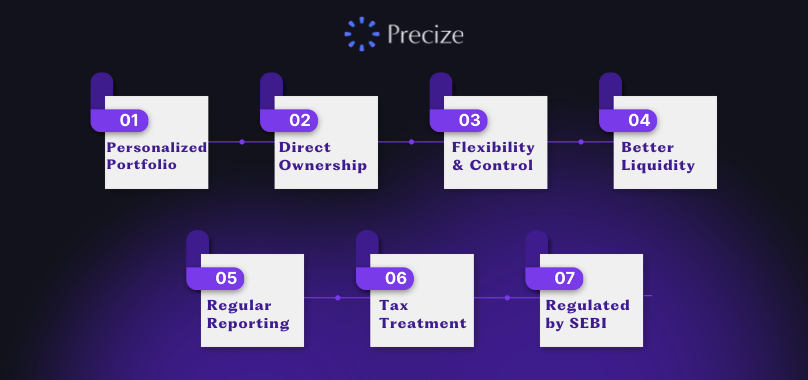
PMS comes with several benefits that make it different from other investment options. Here are the main pros you should know:
Your portfolio is designed to match your specific goals, risk appetite, and preferences. Instead of being part of a common pool, your investments are managed in a way that suits your individual profile.
All securities in your portfolio, like stocks or bonds, are held directly in your name. This gives you clear visibility and complete transparency about where your money is placed.
With PMS, you can choose how involved you want to be. Whether it’s giving full decision-making power to the manager or approving each trade yourself, PMS gives you the flexibility to decide.
PMS usually offers more convenient access to your funds compared to AIFs. Withdrawals are allowed as per agreed terms, and you don’t typically face long lock-in periods.
You receive frequent updates about your portfolio’s performance and transactions. This ensures you always know how your portfolio is being managed.
Since you directly own the securities, gains and tax liabilities are calculated for each transaction separately. This structure can help you manage taxes in a more organized way.
PMS is monitored under SEBI’s Portfolio Managers Regulations. These rules are in place to maintain transparency and safeguard investor interests through proper disclosures and compliance.
It’s helpful to balance the pros with the potential downsides before forming a clear view of PMS.

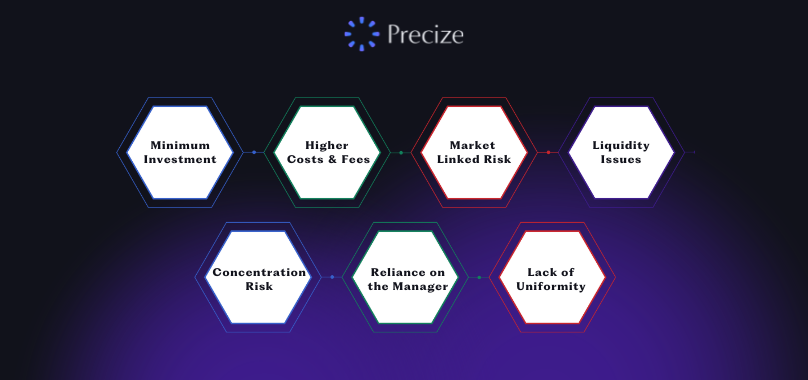
PMS has certain limitations that are important to understand for a balanced view. Here are the main cons:
To start with PMS, you need a minimum of around ₹50 lakh. This high entry point means PMS is usually limited to high-net-worth individuals and not easily accessible for most retail investors.
Compared to mutual funds, PMS often comes with higher charges. These may include management fees, performance-linked fees, brokerage, custody charges, and audit costs, which can affect your overall returns.
Since PMS portfolios are often equity-heavy, they carry the same risks as the stock market. There’s always a chance of underperformance due to unfavorable market movements or wrong investment calls by the manager.
Certain assets in a PMS portfolio may not be easy to sell right away. During volatile market conditions, this can make it harder to quickly access your money at a fair price.
PMS strategies sometimes focus heavily on a limited set of stocks or sectors. While this approach can deliver strong gains, it also increases risk if those chosen areas do not perform well.
The success of your portfolio depends largely on the skill and judgment of the portfolio manager. Poor decisions or delays in adjusting to market changes can directly hurt performance.
Unlike mutual funds, PMS does not have strict standardization. The strategies can vary widely between providers, making it difficult to compare different PMS options on the same scale of risk or performance.
With PMS out of the way, let’s move on to AIFs to see another way investments are structured.

An Alternative Investment Fund is a privately pooled investment vehicle that collects funds from multiple investors and manages them according to a defined investment strategy. In India, AIFs are regulated by SEBI and typically focus on assets beyond traditional options like stocks and bonds, including private equity, venture capital, real estate, or hedge funds.
Next, we’ll explore the main categories of AIF.
AIFs in India are classified into 3 categories by SEBI. Knowing these categories helps you understand how AIFs differ from other options like PMS.
1. Category I AIF
These funds invest in areas considered important for economic or social development, such as startups, small businesses, early-stage ventures, and social enterprises.
They aim for long-term growth and may come with certain tax advantages.
Category I funds are generally seen as lower risk compared to the other categories.
2. Category II AIF
This category includes private equity funds, debt funds, and fund-of-funds that do not fall under Category I or III.
These funds usually avoid borrowing except for short-term operational needs.
Their strategies are more conservative than Category III, focusing on steady growth.
3. Category III AIF
These funds follow more complex and higher-risk strategies. They may use leverage or borrowed funds to try to achieve higher short-term returns.
Hedge funds and funds targeting quick gains in public equities fall under this category.
Due to their aggressive strategies, Category III funds carry the highest level of risk among the three.
Different categories bring different strengths, which is why their benefits vary across funds.

AIFs offer several benefits that make them different from traditional options. Here are the main advantages:
AIFs provide exposure to assets beyond regular stocks and bonds, such as private equity, real estate, venture capital, hedge funds, and commodities. Alternative funds offer access to assets outside regular stocks and bonds, including private equity, real estate, venture capital, hedge funds, and commodities. This allows you to explore niche markets and diversify your portfolio.
AIFs are managed by experienced fund managers who use a variety of strategies, including advanced approaches, to handle the fund effectively. Their expertise helps navigate complex markets.
Since AIFs pool money from multiple participants, they can spread funds across different sectors and asset types. This reduces reliance on any single area and helps balance risk.
Certain AIF categories, such as those focusing on startups, private equity, or hedge funds, can generate significant gains, though these opportunities usually come with higher risk.
AIFs operate under SEBI regulations specific to their category. This ensures transparency, proper compliance, and protection for participants.
AIFs often have lock-in periods of around three years or more. They are suitable for those willing to commit funds for a longer period, which aligns with growth-oriented goals.
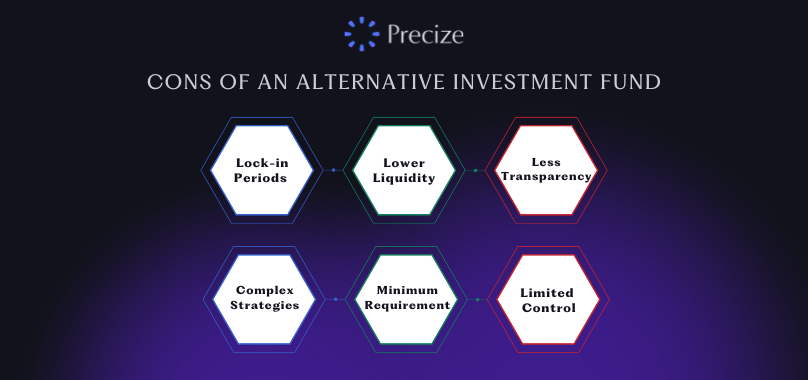
Even with all these benefits, AIFs have certain limitations that you should be aware of.

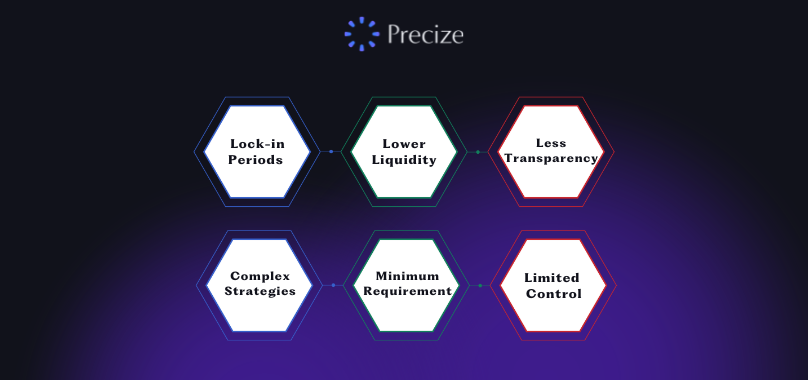
It is essential to consider the potential limitations of AIFs to gain a comprehensive understanding of their structure and functioning.
Long Lock-in Periods
AIFs usually require funds to remain committed for a longer duration, often 3 to 5 years or more, especially in Categories I and II. This reduces flexibility compared to other options.
Lower Liquidity
Unlike PMS, where funds can be accessed more easily, AIFs typically allow withdrawals only at specific times, making quick access difficult.
Less Transparency
Since AIFs pool money from multiple participants and focus on less conventional assets like private equity, real estate, or hedge funds, updates and visibility into specific decisions are less frequent.
Complex Strategies and Higher Risk
Certain AIF categories, particularly Category III, follow more complex approaches, such as leverage. These strategies can increase the volatility and risk of returns.
Higher Minimum Requirement
AIFs often require a higher minimum commitment, usually around ₹1 crore, which limits accessibility for many people.
Limited Control
Because funds are pooled with others, you have less control over individual choices compared to PMS, where assets are held directly in your name.
Once you’ve explored the details of PMS and AIF, the distinctions between them become easier to spot.
PMS and AIF are two distinct structures for managing wealth, each with its own approach and features. Understanding their differences helps you see how control, risk, and flexibility vary between the two. The following key differences are presented for a clear understanding.
_v1762003903400.png)
By now, you have a clear view of how PMS and AIF differ in terms of structure, control, flexibility, and risk. PMS gives you a tailored portfolio with direct ownership and options to stay involved at your preferred level, while AIFs open doors to alternative investment strategies and pooled opportunities under regulatory frameworks.
For those looking to explore private equity and private credit opportunities in India, platforms like Precize make it easier by offering detailed research reports, including income statements, balance sheets, cash flow statements, and industry and peer analyses. These insights can help you stay informed and make more structured decisions.
Reserve access today to explore a diversified portfolio and gain exposure to a range of private investment opportunities with Precize!
1. How does ownership work in PMS compared to AIF?
With PMS, you directly own the stocks or bonds in your portfolio. In AIFs, you hold units of the pooled fund rather than direct ownership of individual securities.
2. Who typically uses PMS and AIF?
Both options mainly cater to High Net Worth Individuals (HNIs), NRIs, and institutional participants. AIFs, in particular, attract those interested in alternative assets and who are comfortable with longer lock-in durations.
3. How do PMS and AIF strategies differ?
PMS usually focuses on listed equities and debt, with portfolios tailored to individual preferences. AIFs concentrate on alternative assets like private equity, venture capital, real estate, and complex strategies, especially in Category III funds.
4. What fees are associated with PMS and AIF?
PMS charges typically include a management fee, performance-linked fees, and other transaction costs. AIFs may have setup fees, management fees, performance fees, and exit loads.
5. How is taxation handled in PMS and AIF?
In PMS, gains are taxed at the individual level, depending on the holding period and type of asset. AIF taxation varies by category; some are pass-through (taxed at the participant level), while others are taxed at the fund level.
6. Can you withdraw your money anytime from PMS or AIF?
PMS generally allows flexible exits, as per the agreement with the manager. AIFs usually have fixed lock-in periods, with exits permitted only after the period or in designated windows.
7. How many participants can PMS and AIF have?
AIFs have a cap on participants, typically up to 1,000 per scheme. PMS does not have a limit on the number of clients.
8. Are PMS portfolios more customizable than AIFs?
Yes, PMS portfolios are designed specifically for individual participants, while AIFs follow a pre-defined strategy set by the fund.
The information provided in this article is for educational and informational purposes only. It does not constitute financial, investment, or professional advice. Readers should conduct their own research or consult a qualified professional before making any financial decisions.

Join our newsletter for exclusive access to thoughtfully curated content and we promise, no spam
Company
Our Office
Office No. 1219, The Summit Business Park, Andheri Kurla Road, Andheri East, Mumbai, Maharashtra - 400093
Find us on Googlesupport@precize.in
+91 7738336457
All trademarks and logos or registered trademarks and logos found on this Site or mentioned herein belong to their respective owners and are solely used for informational and educational purposes.
The material presented in this advertisement is for informational purposes only and should not be construed as investment advice or investment availability. It is not a recommendation of, or an offer to sell or solicitation of an offer to buy, any particular unlisted share, security, strategy, or investment product. Investing in the private market and securities involves risks, including the potential loss of money, and past performance does not guarantee future results. Market trends, data interpretations, graph projections are provided for informational and illustrative purposes and may not reflect actual future performance. Nothing on this website should be construed as personalized investment advice or should not be treated as legal, financial, or any other form of advice. Precize is not liable for financial or any other form of loss incurred by the user or any affiliated party based on information provided herein.
Precize is neither a stock exchange nor does it intend to get recognized as a stock exchange under the Securities Contracts Regulation Act, 1956. Precize is not authorized by the capital markets regulator to solicit investments. The securities traded on these platforms are not traded on any regulated exchange.
The website will be updated regularly.
Copyright © 2026 - Precize - All Rights Reserved