Quoted Shares Demystified: How to Value & Understand Their True Worth in India

Learn what quoted shares are, their differences from unquoted shares, valuation methods, challenges, and how to interpret results in India.
11 min read
quoted shares

Have you ever wondered why the price of some company shares keeps changing every day on the stock market, while others don’t appear on the exchange at all? These publicly listed shares are called quoted shares, and understanding them is key to knowing how companies are valued in the market. 

In this blog, we will explain what quoted shares are, how they differ from unquoted shares, and the legal and regulatory rules that apply. You will also learn why valuing quoted shares matters, the main methods used to determine their worth, common challenges in valuation, and how to interpret the results. By the end, you will have a clear and practical understanding of quoted shares and their valuations.

Let’s get into it!

Quick Overview

  • Quoted shares are company shares listed on stock exchanges with publicly available prices.

  • They differ from unquoted shares, which are privately held and harder to value.

  • Valuation is important for transparency, regulatory compliance, financial reporting, and fair transactions.

  • Common methods include DCF, Market Value, P/E ratio, Book Value, and Comparable Company Analysis.

  • Challenges include price volatility, market sentiment, data accuracy, and choosing the right valuation method.

What Are Quoted Shares?

Shares that are listed on stock exchanges, allowing their prices to be publicly tracked, are known as quoted shares, such as the Bombay Stock Exchange (BSE) or National Stock Exchange (NSE) in India. These shares have a market price that is publicly available and can be easily tracked through stock listings. The term “quoted” indicates that the shares have a transparent price determined by supply and demand in the market.

Understanding quoted shares is just the beginning; it’s equally important to know how they compare with unquoted shares.

Quoted vs. Unquoted Shares

Understanding the difference between quoted and unquoted shares is important when looking at company stocks and their valuations. The table below summarizes the key distinctions:
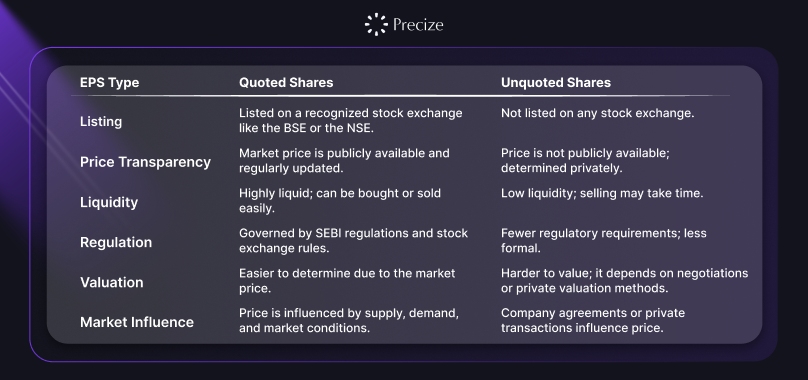
With the distinction clear, the next step is to explore the legal and compliance aspects that protect shareholders and maintain trust in the market.

Legal and Regulatory Aspects of Quoted Shares

When you deal with quoted shares, it’s important to know the rules that govern them. These regulations protect you and ensure that everything is transparent and fair.

  1. SEBI Regulations

SEBI, the Securities and Exchange Board of India, is the main authority for share markets. 

  • If you hold or follow quoted shares, you need to know that companies must follow SEBI rules for listings, disclosures, and reporting. 

  • This keeps the market fair and transparent.

  1. Companies Act, 2013

The Companies Act covers how companies operate, your rights as a shareholder, and procedures for raising public funds. 

  • It also guides how companies should list shares and prevents misleading statements or fraud related to quoted shares.

  1. Disclosure and Transparency Requirements

Companies must make important information public, such as financial details, risks, and management updates. 

  • You can see audited financial statements and announcements about events like dividends, new share issues, or mergers.

  1. Shareholder Rights and Protections

As a shareholder in a quoted company, you have legal rights to access financial statements, annual reports, and dividend information. 

  • The law protects you against fraud, ensures declared dividends are paid on time, and allows you to take action if your rights are ignored.

  1. Listing and Compliance Requirements

Companies must meet certain criteria to stay listed and keep their shares quoted. 

  • This includes rules on minimum promoter holdings, lock-in periods for large shareholders, and clear procedures for issuing new shares or public offers.

  1. Oversight and Enforcement

SEBI and stock exchanges monitor listed companies to spot problems and penalize violations. 

  • If companies fail to follow the rules, they may face fines, suspension, or restrictions on directors and promoters accessing the market.

Having covered the regulations, let’s explore how valuations help make sense of quoted shares.

Why Valuation of Quoted Shares Matters?
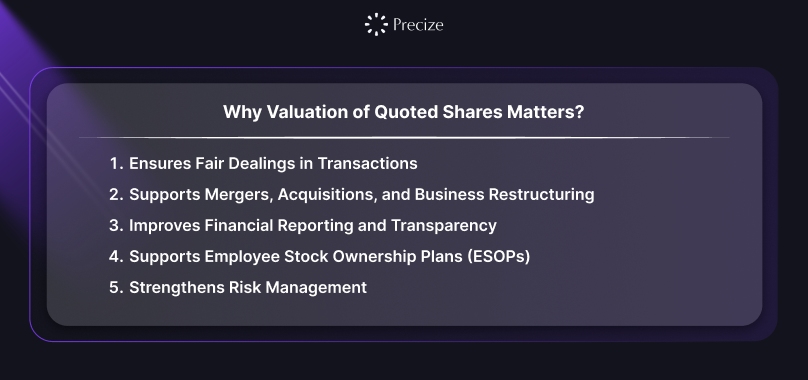
Knowing the true value of quoted shares is essential for making informed decisions and ensuring fairness across all financial and business activities.

  • Ensures Fair Dealings in Transactions: Valuation makes sure shares are priced fairly when you are buying, selling, or transferring them. This keeps transactions transparent and avoids misunderstandings.

  • Supports Mergers, Acquisitions, and Business Restructuring: Accurate share values are essential during mergers or acquisitions. They help set fair terms and protect the interests of all parties involved.

  • Improves Financial Reporting and Transparency: Valuing quoted shares allows companies to prepare clear and accurate financial statements, building trust with shareholders, lenders, and business partners.

  • Supports Employee Stock Ownership Plans (ESOPs): When shares are issued to employees, fair valuation ensures they receive the correct value, maintaining fairness and boosting employee satisfaction.

  • Strengthens Risk Management: Valuation highlights the real worth of assets, helping you identify and manage risks for more reliable decision-making.

With the significance of valuations clear, the next step is to explore the methods that help assign an accurate value to quoted shares


Valuation Methods for Quoted Shares

To determine the real worth of quoted shares, you can use several valuation methods depending on the company, its industry, and the information you have. Here are the main approaches:

  1. Intrinsic Value Method (Discounted Cash Flow – DCF)

This method estimates value based on the company’s future projected cash flows, discounted to their present value using a risk-adjusted rate.

  • Formula: Intrinsic Value = ∑ (Future Cash Flow_t / (1 + r)^t)

  • Where:

    • Future Cash Flow_t = projected cash flow in year t

    • r = discount rate (reflects risk and cost of capital)

    • t = year

Example: A company is expected to generate ₹10 lakh next year and ₹12 lakh the year after. Discount rate = 10%

PV = 10,00,000 / (1+0.10)^1 + 12,00,000 / (1+0.10)^2 = ₹9,09,091 + ₹9,91,736 = ₹19,00,827

This method works best when future cash flows can be predicted accurately.

  1. Market Value Method

This uses the current market price of the shares on a recognized stock exchange. It reflects the value that the buyers and sellers agree on at a particular time.

  • Formula: Market Value = Current Share Price × Number of Shares

Example: Share price = ₹500, Number of shares = 1,00,000

Market Value = 500 × 1,00,000 = ₹5,00,00,000

It’s simple and real-time, but may fluctuate based on market sentiment.

  1. Price-Earnings (P/E) Ratio Method

Compares the share price to its Earnings Per Share (EPS) to understand how the market values earnings.

  • Formula: P/E Ratio = Share Price / EPS

Example: Share Price = ₹400, EPS = ₹20

P/E = 400 / 20 = 20

This indicates you are paying 20 times the earnings per share. Comparing with peers shows relative valuation.

  1. Book Value Method

Calculates value per share by dividing the company’s net assets by the total number of shares.

  • Formula: Book Value per Share = (Total Assets – Total Liabilities) / Number of Shares

Example: Assets = ₹50 crore, Liabilities = ₹20 crore, Shares = 1 crore

Book Value per Share = (50 – 20) / 1 = ₹30

Useful as a baseline, especially for companies with significant tangible assets.

  1. Comparable Company Analysis (Comps)

Compares the company with similar businesses using ratios like P/E, Price-to-Book (P/B), or Price-to-Sales (P/S).

  • Formula (P/B example): P/B = Share Price / Book Value per Share

Example: Book Value per Share = ₹50, Share Price = ₹100

P/B = 100 / 50 = 2

If similar companies trade at P/B = 2.5, the share may be slightly undervalued.

  1. Precedent Transaction Analysis

Look at the valuations of similar companies recently acquired or involved in major transactions.

Example: A similar company was acquired at 15× earnings. If your company’s EPS = ₹10, valuation = 10 × 15 = ₹150 per share.

  1. Asset-Based Valuation

Values the company based on its tangible and intangible assets. Useful for capital-intensive businesses.

  • Formula: Asset-Based Value = Total Assets – Total Liabilities

Example: Assets = ₹100 crore, Liabilities = ₹60 crore

Asset-Based Value = 100 – 60 = ₹40 crore

  1. Dividend Yield and Earnings Yield Methods

The Dividend Yield method uses the expected annual dividend relative to the share price, while the Earnings Yield focuses on anticipated earnings compared to the share’s value.

  • Dividend Yield Formula: Dividend Yield (%) = (Annual Dividend per Share / Share Price) × 100

Example: Annual Dividend = ₹5, Share Price = ₹100

Dividend Yield = (5 / 100) × 100 = 5%

  • Earnings Yield Formula: Earnings Yield (%) = (EPS / Share Price) × 100

Example:  EPS = ₹10, Share Price = ₹200

Earnings Yield = (10 / 200) × 100 = 5%

These methods help you understand potential returns relative to the share price.

While these valuation methods give you a solid estimate of a share’s worth, applying them in the real world can sometimes be tricky.

Common Challenges in Valuing Quoted Shares

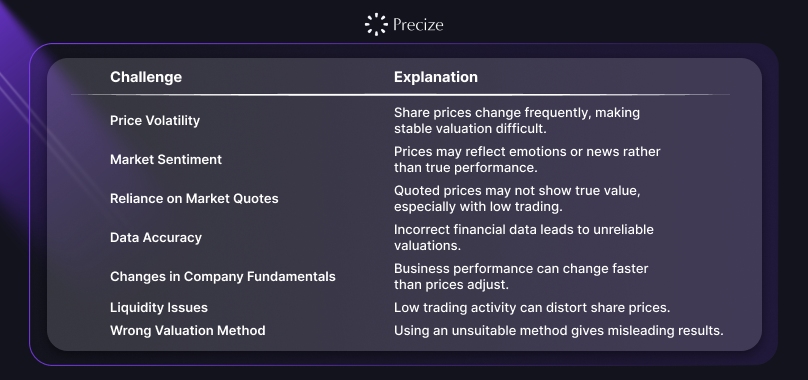
Valuing quoted shares can be tricky due to several factors:

  • Price Volatility: Share prices can change quickly in the market, making it hard for you to determine a stable value, especially during uncertain economic times.

  • Market Sentiment: Prices are sometimes influenced by news, rumors, or overall market mood rather than the company’s actual financial health, which can lead to misleading valuations.

  • Reliance on Market Quotes: The prices shown on the stock exchange reflect recent trades but may not always represent the share’s real worth, particularly if it isn’t traded frequently.

  • Data Accuracy: Valuation depends on reliable information, such as earnings and future cash flows. Inaccurate data can lead to incorrect results.

  • Changes in Company Fundamentals: A company’s performance can shift due to management, market trends, or industry changes, affecting its actual value faster than market prices might indicate.

  • Liquidity Issues: Shares of smaller or less frequently traded companies can be hard to value, as limited trading can create a gap between the quoted price and real value.

  • Wrong Valuation Method: Using a method that doesn’t match the company’s situation, like a dividend model for a firm that rarely pays dividends, can give misleading results.

While challenges exist, interpreting the results effectively helps you connect the numbers with real company performance.

How to Interpret Valuation Results of Quoted Shares

When you look at the value of quoted shares, it’s important to understand what the numbers mean and how to use them effectively.

  1. Understand Market Price vs. Valuation

The market price shows what the shares are currently trading at on the stock exchange, while the valuation reflects the estimated fair value based on financial analysis. Comparing the two helps you see if shares are priced reasonably.

  1. Look at Common Valuation Metrics

  • Price-to-Earnings Ratio: Indicates how much you are paying per unit of earnings.

  • Net Asset Value: Shows the company’s net assets per share.

  • Discounted Cash Flow: Estimates the present value of the company’s expected future cash flows.

  1. Check for Overvaluation or Undervaluation

Shares trading above their fair value are considered overvalued, while those below fair value are undervalued. This comparison helps you understand market expectations compared to the company’s actual fundamentals.

  1. Consider Industry and Market Conditions

Valuations depend on the growth potential of the sector and overall market trends. Comparing metrics with similar companies gives a better context and perspective.

  1. Pay Attention to Historical Valuation Trends

Tracking how valuations change over time can reveal patterns in growth or risk. Sudden shifts may signal new developments or changes in market sentiment.

  1. Assess the Impact of Company Performance

Company earnings, assets, debt, and cash flows directly influence valuations. Strong financial performance usually supports higher valuations.

  1. Use Valuation as a Guide, Not a Guarantee

Valuation models rely on assumptions and estimates. Treat them as helpful tools to guide decisions, rather than exact predictions of what a share is worth.

Conclusion

You now have a clear understanding of quoted shares, from their definition and differences with unquoted shares to valuation methods, challenges, and how to interpret results. This knowledge helps you make sense of market prices and company fundamentals.

To explore broader opportunities beyond listed shares, Precize offers access to private credit opportunities in India. Using Precize, you can diversify your portfolio while keeping track of valuations and market trends.

Reserve your access today and start building a more diversified portfolio with Precize!

Frequently Asked Questions (FAQs)

  1. What factors affect the market price of quoted shares in India?

The price of quoted shares can change based on the company’s performance, industry trends, and the overall economy. News, announcements, or even market sentiment can make a difference, so understanding these helps you see why a share’s price goes up or down.

  1. How often should quoted share valuations be updated?

Valuations should be reviewed whenever there’s important financial or market news, like quarterly results, mergers, or regulatory changes. Keeping them updated ensures you’re looking at a current and accurate view of the company’s value.

  1. Can small shareholders influence the value of quoted shares?

Even if you hold only a small portion, your actions can affect liquidity and market perception. While you may not move the market alone, participating in voting or responding to company news can still play a part in how the shares are valued.

  1. Why are audited financial statements important for valuing quoted shares?

Audited statements provide verified details about a company’s earnings, assets, and liabilities. Using this accurate data makes valuation methods, like DCF or P/E ratios, more reliable and reflective of the true value of the shares.

  1. Are quoted shares easier to value than unquoted shares?

Yes, because quoted shares have public prices that are regularly updated, making them easier to assess. Unquoted shares don’t have market visibility, so their value relies more on assumptions and private negotiations.

Disclaimer 

The information provided in this article is meant to help you understand quoted shares and their valuations. While we have made every effort to ensure the content is accurate and up to date, it is intended for general informational purposes only. Financial markets and company valuations can change rapidly, and the details shared here may not reflect the latest developments. You should not rely solely on this content to make decisions related to shares, business, or finance. It’s always a good idea to verify facts independently and consult with qualified professionals for guidance tailored to your specific situation.

Precize
Precize
Content Strategy and Research Analyst

Stay in the Loop

Join our newsletter for exclusive access to thoughtfully curated content and we promise, no spam

The next generation of asset classes in India

Resources

Our Office

Office No. 1219, The Summit Business Park, Andheri Kurla Road, Andheri East, Mumbai, Maharashtra - 400093

Find us on Google

support@precize.in

+91 7738336457

All trademarks and logos or registered trademarks and logos found on this Site or mentioned herein belong to their respective owners and are solely used for informational and educational purposes.

The material presented in this advertisement is for informational purposes only and should not be construed as investment advice or investment availability. It is not a recommendation of, or an offer to sell or solicitation of an offer to buy, any particular unlisted share, security, strategy, or investment product. Investing in the private market and securities involves risks, including the potential loss of money, and past performance does not guarantee future results. Market trends, data interpretations, graph projections are provided for informational and illustrative purposes and may not reflect actual future performance. Nothing on this website should be construed as personalized investment advice or should not be treated as legal, financial, or any other form of advice. Precize is not liable for financial or any other form of loss incurred by the user or any affiliated party based on information provided herein.

Precize is neither a stock exchange nor does it intend to get recognized as a stock exchange under the Securities Contracts Regulation Act, 1956. Precize is not authorized by the capital markets regulator to solicit investments. The securities traded on these platforms are not traded on any regulated exchange.

The website will be updated regularly.

Copyright © 2026 - Precize - All Rights Reserved

Quoted Shares Demystified: How to Value & Understand Their True Worth in India