Key Features of Research Reports
Before you start writing, it’s important to know what sets a strong research report apart. A well-prepared report isn’t just about presenting data, it follows a clear structure, uses formal language, and focuses on facts. Here are some key features every good research report should have:
Structured Format
A research report follows a clear structure, usually including an introduction, methodology, findings, analysis, and conclusion. This helps readers understand the flow of your work.
Objective and Unbiased
A good research report stays neutral. It presents facts, data, and analysis without personal opinions or emotional language.
Evidence-Based
All findings in the report are supported by real data, observations, or research. Assumptions or guesses are not included.
Formal Language
The report uses formal, simple English. It avoids slang, casual phrases, or overly complex sentences.
Clear and Concise
It communicates ideas in a direct and easy-to-understand way. Long paragraphs or unnecessary details are avoided.
Accurate References
All external sources used in the report are properly cited using a standard format like APA or MLA. This helps avoid plagiarism.
Visual Support
Tables, charts, and graphs are often included to explain data more clearly. These visuals must be labeled and explained in the text.
Logical Flow
Each section of the report connects smoothly with the next. The report builds a logical argument from the problem to the solution.
Reliable and Verifiable
The information provided in the report can be verified. Others should be able to check the same sources or repeat the research if needed.
Purpose-Driven
Every research report has a clear goal, whether it’s to inform, analyze, or suggest solutions. The content always supports this main purpose.
Now that you know the key features of a strong research report, let’s look at the different types you might come across or need to write.
Types of Research Reports
Before writing a research report, it’s helpful to understand the different types available. Each type serves a specific purpose, depends on who will read it, and follows its own format. Here are the most common ones you should know about:
Analytical Research Report
This type focuses on presenting facts and studying a topic in depth. It gives different viewpoints on an issue without taking sides.
Argumentative Research Report
Here, you take a clear stand on a topic and try to convince the reader. The report uses facts, data, and logical reasoning to support your argument.
You also talk about opposing views and explain why your opinion is stronger.
These are common in academic writing, especially when students are learning to build strong arguments.
Experimental Research Report
This one is based on an experiment. You explain how you did the research, what methods you used, and what results you got.
It usually includes charts, graphs, and detailed data.
This format is mostly used in science, engineering, or lab-based studies.
Descriptive Research Report
A descriptive report is used to explain what you observed or found during the research.
It focuses on showing trends, facts, or situations without running experiments.
It’s great for presenting survey data, feedback, or real-world conditions.
Technical and Popular Reports
Technical reports are written for experts or professionals. They include complex data, methods, and in-depth analysis.
Popular reports are meant for a general audience. They are simple, easy to read, and focus more on key results and suggestions.
Internal and External Reports
Internal reports are made for people within an organization, like reports for a company’s management or team.
External reports are for people outside the organization, like investors, clients, or the public. Examples include annual reports or public research summaries.
Formal and Informal Reports
Formal reports follow a set structure with headings, sections, and proper references.
Informal reports are more casual, like memos, quick updates, or short summaries, used for daily communication.
Long and Short Reports
Long reports go into full detail with all parts of the research, like background, data, findings, and conclusions.
Informational Reports
Informational reports are all about presenting clear facts without any analysis or personal opinions.
Unlike analytical reports that dive into the reasons behind a situation or explore different outcomes, informational reports stick to the basics.
If you need direct, unbiased information, like how many employees work in a company, where they’re placed, and what roles they handle, this is the kind of report to refer to.
It simply shares the data as it is.
With the types sorted, it’s time to get into the framework. These are the key elements every research report should have.
Key Components of a Research Report
When you’re writing a research report, it’s important to include all the main sections in the right order. This helps keep your report organized, easy to read, and complete. Here are the essential parts every research report should have:
Title Page
This is the first page of your report. It includes the title of your research, your name, and other details like the date or name of your institution. It sets a professional tone and tells the reader what your report is about.
Abstract
The abstract is a short summary of your entire research, usually between 150 to 300 words. It briefly explains the purpose of your study, how you did it, the main results, and what you concluded. Readers use this section to quickly understand if the report is relevant to them.
Table of Contents
This section lists all the major parts of your report along with page numbers. It helps readers quickly find specific sections without reading the whole report.
Introduction
The introduction gives background information and explains why you chose the topic. It clearly states the research problem or question and highlights the aim and importance of the study.
Literature Review
Here, you go over previous studies or research done on the same topic. It shows what is already known, where the gaps are, and how your research fits into the existing knowledge. It gives a strong base for your work.
Methodology
This part explains how you carried out the research. You describe your research method, data collection process, sample size, and the tools or techniques used. It helps others understand or even repeat your study if needed.
Results
In this section, you present what you found from your research. The focus is just on showing the data, not explaining it. You can use tables, charts, or graphs to make the results clear.
Discussion
Now, you interpret your results. You connect the findings to your original questions or goals, compare them with other studies, and discuss why certain results came out the way they did. It’s where you explain what the results actually mean.
Conclusion
This section sums up the key findings of your research. You also mention the importance of your work, any limitations you faced, and what could be explored in future studies.
References/Bibliography
Here, you list all the sources you referred to while writing the report. Make sure to follow a consistent citation style, like APA or MLA, as required. This section shows respect for others' work and keeps your report honest.
Appendices (if needed)
If you have extra details like full data tables, survey forms, or calculations that support your research, you can add them here. It keeps the main part of your report neat and focused.
With the key components in mind, it’s time to turn ideas into a complete report. Let’s walk through the writing process.
Simple 9 Steps to Writing a Research Report
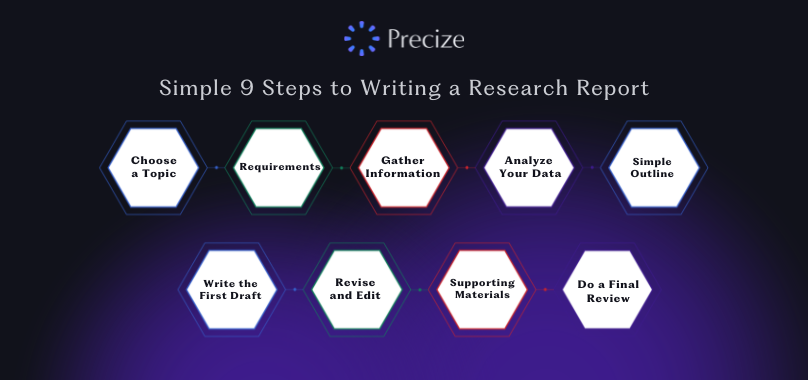
Writing a research report is about presenting your work and findings in a clear and organized way. To make the process easier, here are some simple steps you can follow:
Step 1: Choose a Topic and Define the Purpose
Start by picking a topic that interests you and fits the goal of your assignment or research. Be clear about what you want to achieve, whether it’s to inform, explain, or solve a problem. This will guide your entire report.
Step 2: Understand the Requirements
Read the instructions carefully. Note key details like word count, deadline, format, and any specific guidelines. Create a checklist to make sure you don’t miss anything.
Step 3: Do Background Research and Gather Information
Before you begin writing, read up on your topic. Use reliable sources such as books, articles, and trusted websites. Look for important facts, statistics, and previous studies that are relevant to your research.
Step 4: Organize and Analyze Your Data
Once you’ve collected your information, group it into main ideas and supporting points. Look for patterns or trends in the data. This step helps you make sense of the information and decide what to focus on in your report.
Step 5: Create a Simple Outline
Plan the structure of your report with a basic outline. Include all the major sections like Introduction, Methodology, Results, Discussion, and Conclusion. This helps your report flow smoothly from start to finish.
Step 6: Write the First Draft
Start writing based on your outline. Begin with the introduction, then move through each section. Use simple, clear language to explain your ideas and findings. Don’t worry about making it perfect, just focus on getting your thoughts down.
Step 7: Revise and Edit
Read your draft carefully. Make sure your points are clear and well-explained. Fix any grammar, spelling, or formatting issues. Check that your report makes sense and follows a logical flow.
Step 8: Add References and Supporting Materials
List all the sources you used in the correct citation format (such as APA or MLA). If you have additional materials like surveys, raw data, or charts, add them to the appendix.
Step 9: Do a Final Review
Before submitting, give your report one last check. Make sure everything is neat, labeled correctly, and meets all the requirements. A clean and well-organized report leaves a strong impression.
Following the right steps is important, but knowing what not to do is just as crucial.
Common Mistakes to Avoid When Making a Research Report
Avoiding common mistakes while writing your research report can help you create a clear, professional, and impactful document. Here are the major pitfalls you should look out for:
Unclear Research Purpose
Starting without a well-defined research question or objective often leads to confusion and a lack of direction. Always be clear about what you're trying to achieve from the beginning.
Poor Research Quality
Using outdated, limited, or unreliable sources weakens your report. Make sure your information comes from credible, recent, and relevant sources to back up your findings.
Including Irrelevant or Excessive Information
Too much unnecessary content can distract from your main points. Stick to what directly supports your research and use visuals like charts or tables to simplify complex data.
Not Considering Your Audience
Using overly technical or overly simple language without considering who will read your report can make it hard to understand. Adjust your tone and level of detail based on your audience.
Weak Structure and Organization
A report that jumps between topics or lacks a logical flow becomes difficult to follow. Use clear headings and sections like introduction, methodology, results, and conclusion to guide the reader smoothly.
Lack of Analysis and Interpretation
Presenting data without explaining what it means is a common mistake. Always interpret your findings and connect them back to your research question.
Improper or Missing Citations
Failing to give credit or using the wrong citation format can lead to plagiarism. Always cite your sources correctly using the required style, like APA or MLA.
Ignoring Guidelines and Instructions
Not following the required format, word count, or submission rules, even if the content is good, can result in your work being rejected or penalized. Always double-check the instructions.
Skipping Revisions and Proofreading
Submitting your first draft without reviewing it can leave in grammar mistakes, unclear sections, or formatting errors. Always revise your work and proofread it carefully before submission.
Plagiarism
Plagiarism means using someone else’s words, ideas, or visuals without giving them proper credit. It’s one of the most serious and common writing mistakes. If your work looks original but lacks proper citations, it can be considered unethical and even a copyright violation. Always make sure to credit your sources clearly.
Steering clear of mistakes is important, but the right support tools can take your report from good to great.
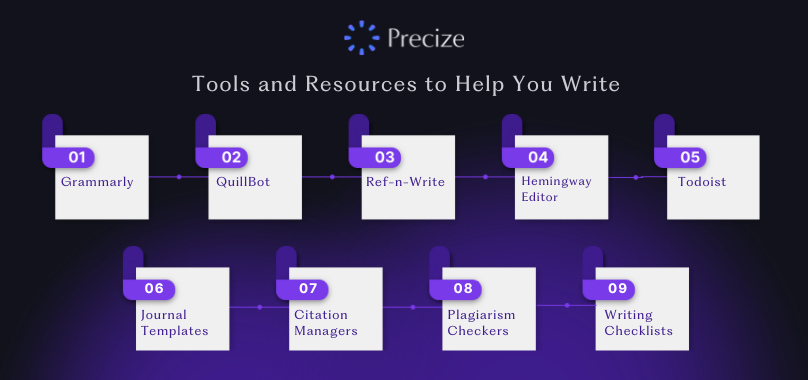
When you're working on a research report, the right tools can help you write faster, avoid errors, and stay organized. Here are some of the most useful resources you can use, especially helpful for students, professionals, and researchers in India:
Grammarly
Grammarly checks your grammar, spelling, punctuation, and clarity in real time.
It also helps you avoid plagiarism and suggests better word choices to improve your writing.
This tool is great for keeping your report clean, professional, and easy to read.
QuillBot
QuillBot helps you rephrase sentences, summarize content, and fix grammar mistakes.
It’s also useful for improving vocabulary and managing citations.
If you're looking to polish your report or make it sound more natural, this is a solid option.
Ref-n-Write
This tool gives you access to an academic phrase bank and paraphrasing help.
It offers writing suggestions and makes it easier to cross-reference content.
You can even use it directly within Microsoft Word, which makes editing smoother.
Hemingway Editor
Hemingway checks how easy your writing is to read.
Todoist
Todoist helps you plan and organize your research tasks.
Article and Journal Templates
Using ready-made templates saves time when formatting your report.
Citation Managers (like Zotero or Mendeley)
These tools help you collect and organize all your research sources in one place. They also let you create proper citations and bibliographies with just a few clicks.
Plagiarism Checkers (like Turnitin)
These tools scan your report to make sure it's original. They help you catch any unintentional copying and keep your work ethical and plagiarism-free.
Writing Checklists
A simple checklist helps you cover all key parts of your report, like the abstract, introduction, methods, findings, and references.
Once you’ve used the right tools to improve your writing, the next step is to make sure your references are formatted correctly.
When writing a research report, including properly formatted references is a must. It shows that your work is original and based on credible sources. If you're unsure how to do this, here’s a simple guide to help you stay clear, consistent, and correct:
Choose the Right Citation Style
Pick a citation style based on your field of study or what your institution asks for. The most common ones include:
APA (American Psychological Association): Used in social sciences.
MLA (Modern Language Association): Used in humanities.
Chicago Manual of Style: Used in history or general writing.
IEEE or Harvard Style: Often used in technical and scientific writing.
Always stick to just one style throughout your report.
In-text Citations
Use short citations within the body of your report to credit ideas or facts taken from another source. These usually include:
Author’s last name
Year of publication
Page number (if needed)
Example (APA style):
According to Sharma (2021), Indian startups have grown rapidly in recent years.
Full Reference List or Bibliography
At the end of your report, list all sources you used in a separate “References” or “Bibliography” section. Arrange them alphabetically by the author's last name. Each style has its own format for listing books, websites, or articles.
Example (APA style):
Sharma, R. (2021). The Startup Growth in India. Delhi: Business Press.
Keep It Consistent
Once you pick a citation style, use it consistently. Don’t mix different styles or change formats for different sources.
Use Citation Tools
To save time and avoid errors, use free tools like:
These help you store, manage, and format references easily.
6. Double-Check Before Submitting
Always check your final report to make sure all sources you quoted or paraphrased are properly cited and listed. Even if you used just one sentence from a book or article, it needs a citation.