Figuring out which number truly shows your real growth can get confusing, and that’s where most people get stuck. You might look at your returns and keep wondering whether IRR or CAGR tells the full story.
The truth is, both seem alike but measure performance in completely different ways, often leaving room for doubt. That’s why understanding IRR vs CAGR for investors is so important; it helps you see what each metric actually means and how to use them the right way for clearer financial insights.
In this blog, you’ll understand what CAGR reveals about consistent annual growth and its hidden pros and cons. You’ll also explore IRR (Internal Rate of Return), which goes deeper into cash flows and timing for a more accurate view of performance.
Keep scrolling!
CAGR shows steady annual growth, ideal for consistent, long-term returns.
IRR considers the timing of cash flows, suitable for projects with irregular inflows and outflows.
CAGR is simple to calculate; IRR is more complex but gives a detailed view of actual returns.
Use CAGR for comparing stable options and IRR for evaluating complex or multiple-cash-flow scenarios.
CAGR shows the average yearly growth of an amount over a period of time. It smooths out fluctuations and gives a single rate that represents overall growth from start to end.
For example, if an amount grows from ₹1 lakh to ₹2 lakh in five years, CAGR shows the steady annual rate that caused this increase. It doesn’t reflect yearly ups and downs but gives a clear view of long-term growth, making comparisons easier.
Knowing the definition of CAGR helps, but it’s equally important to see the advantages it brings to decision-making.
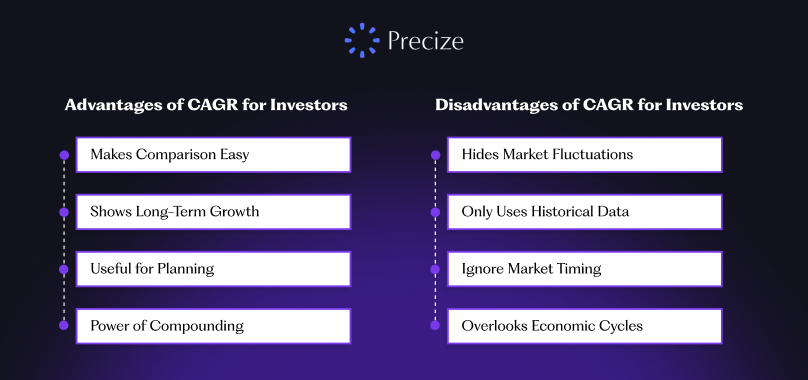
CAGR offers several practical benefits for understanding growth over time:
Makes Comparison Easy: CAGR helps compare growth rates of different assets over the same period, giving a single annual rate for each, so you can see how they performed over the years.
Shows Long-Term Growth: It smooths out short-term ups and downs, showing steady growth over the period without focusing on yearly fluctuations.
Useful for Planning: An annual growth rate makes it simple to set financial goals and track progress without getting distracted by market swings.
Power of Compounding: CAGR reflects compounding, so it shows how returns build up year after year, highlighting the benefits of staying invested over time.
CAGR also has some limitations to keep in mind:
Hides Market Fluctuations: It assumes steady growth and doesn’t show sudden rises or falls, so actual volatility during the period is missed.
Only Uses Historical Data: CAGR is based on past performance and cannot predict future results, so relying on it alone can be misleading.
Ignore Market Timing: It doesn’t consider when money is added or withdrawn, which may not suit situations with frequent changes or unstable periods.
Overlooks Economic Cycles: CAGR does not account for different economic or market conditions, giving a simplified view of growth.
Because CAGR smooths out fluctuations, it may miss real variations in performance. IRR provides a more detailed perspective for such cases.
IRR, or Internal Rate of Return, is the rate at which the total value of all cash inflows and outflows becomes zero. It shows the effective annual growth rate of a series of cash flows, considering their timing.
For example, if you put ₹1 lakh into a project and receive ₹30,000 each year for 4 years, the IRR tells you the annual rate that balances your initial outflow with these inflows.
Knowing how IRR works helps set the stage for seeing why it’s a valuable metric for financial decisions.
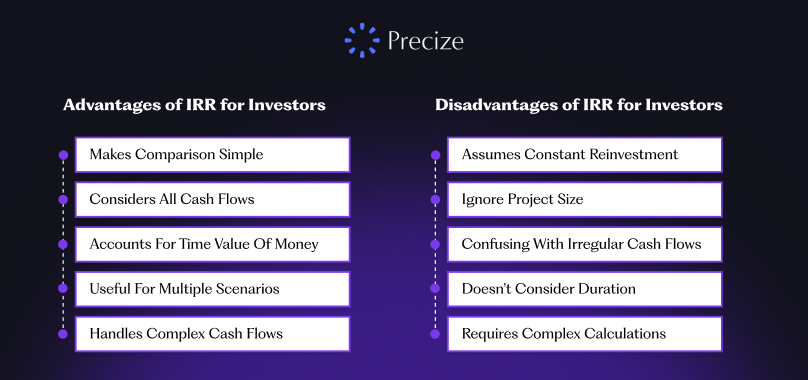
IRR offers several benefits that make evaluating projects or plans easier:
Makes Comparison Simple: IRR gives a single percentage, so you can quickly rank different options and see which one offers better growth for your money.
Considers All Cash Flows: It takes into account every cash inflow and outflow, giving a complete picture of how money moves over time.
Accounts for Time Value of Money: IRR factors in that money today is worth more than money received later, helping you make more informed choices.
Useful for Multiple Scenarios: Businesses use IRR to assess long-term plans, like new projects or expansions, and it can also help compare personal savings or financial plans.
Handles Complex Cash Flows: For projects with uneven or irregular cash movements, IRR manages these variations better than simple growth measures.
Although IRR can be very useful, there are certain drawbacks to keep in mind.
Despite its advantages, IRR has some limitations:
Assumes Constant Reinvestment: IRR works on the assumption that every rupee earned will continue to grow at the same rate, which may not be realistic.
Ignore Project Size: It shows only a percentage, not the total returns. A small project with a high IRR may generate less total money than a larger project with a lower IRR.
Can Be Confusing with Irregular Cash Flows: Projects with multiple inflows and outflows may produce more than one IRR, making interpretation tricky.
Doesn’t Consider Duration: IRR treats short-term projects with quick returns the same as long-term projects with steady growth, which can be misleading if duration matters.
Requires Complex Calculations: Finding IRR often needs special tools or software, unlike simple methods such as CAGR, which are easy to calculate manually.
Before deciding which metric to use, it helps to look at the key differences between IRR and CAGR.

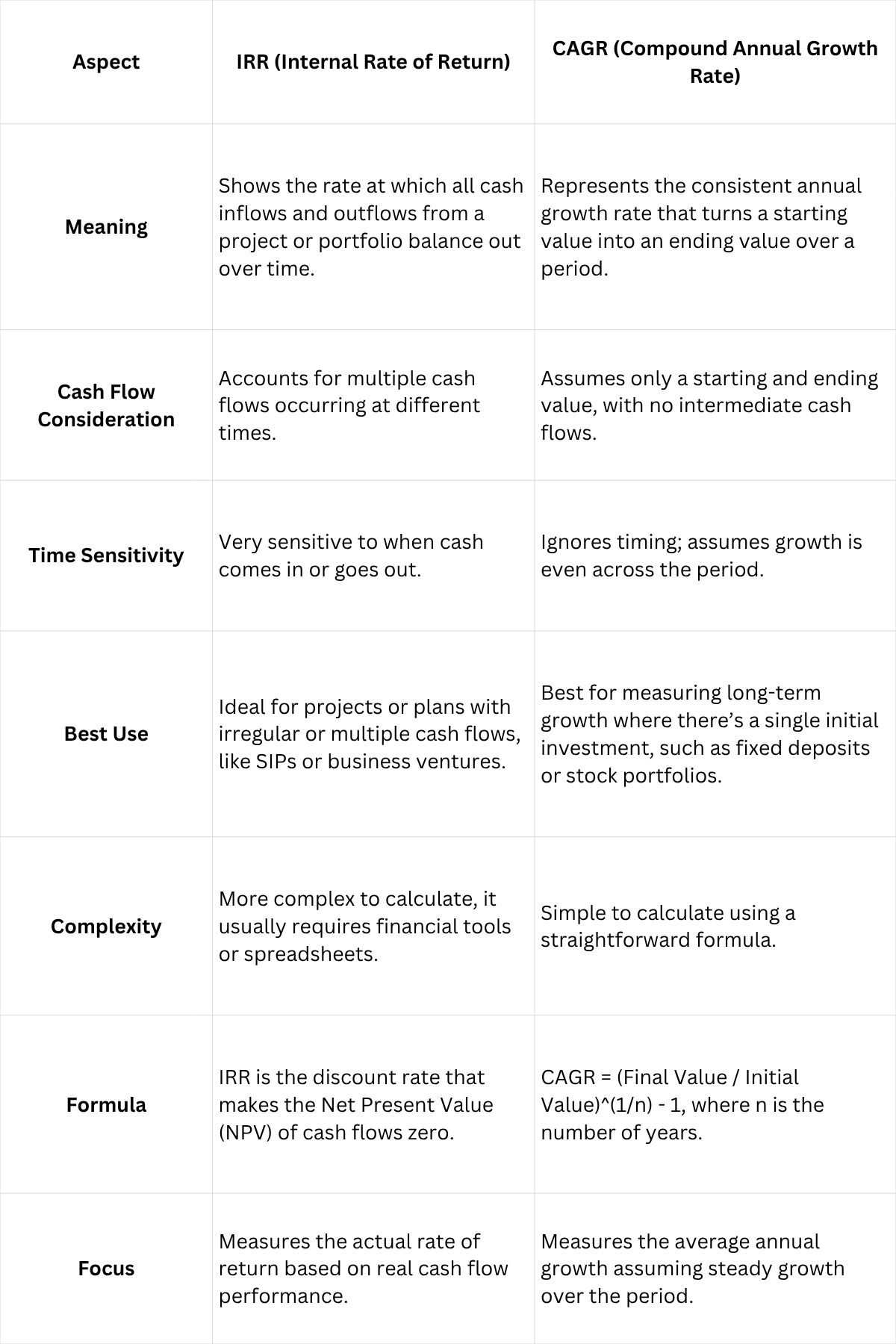
Both IRR and CAGR help track how money grows over time, but they work differently. Here is a comparison to make it easier to understand:

With the differences clear, the next step is learning how to choose between CAGR and IRR, depending on your goals and cash flow patterns

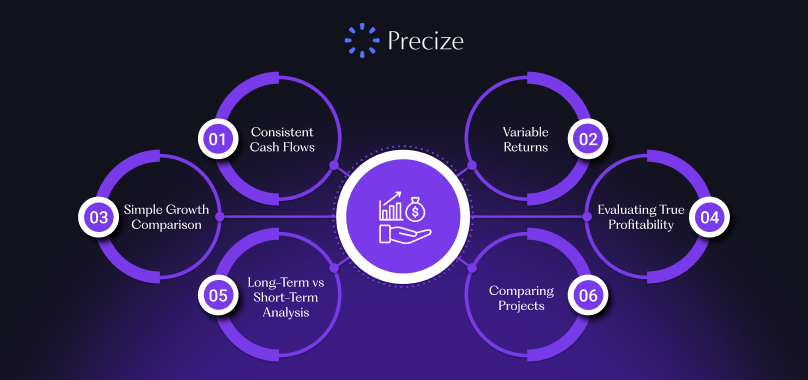
Choosing between CAGR and IRR depends on the purpose of your analysis. Here is when each makes sense:
Consistent Cash Flows
CAGR works best when returns come at regular intervals and amounts stay stable. It’s useful for tracking steady growth over time and understanding long-term trends.
Variable Returns
IRR is better when cash inflows and outflows are uneven or occur at different times. It accounts for timing, making it suitable for projects or portfolios with multiple transactions.
Simple Growth Comparison
Use CAGR when you need a straightforward metric to compare performance across assets over the same period. It smooths out fluctuations and provides an easy-to-understand annual growth rate.
Evaluating True Profitability
IRR is ideal for understanding the actual profitability of a project by considering both the size and timing of all cash flows. It’s commonly used for capital planning or ranking multiple opportunities.
Long-Term vs Short-Term Analysis
CAGR is suitable for analyzing long-term growth with stable returns. IRR works better when short-term variations or time-specific returns are important.
Comparing Projects or Portfolios
When two options have different durations or irregular cash flows, IRR gives a more accurate comparison. CAGR is best when both options have similar timelines and consistent returns.
As explained in this blog, understanding IRR and CAGR is key to evaluating growth accurately. CAGR works well for steady, predictable growth, while IRR captures the real performance when cash flows are uneven or occur at different times. Using the right metric can help make more informed decisions and assess opportunities effectively.
For those looking to go beyond conventional options, Precize offers access to private equity and private credit opportunities in India, giving you a chance to diversify and strengthen your portfolio.
Reserve access today to explore these alternatives and diversify your portfolio!
1. Which is better for tracking long-term growth, IRR or CAGR?
CAGR is generally better for tracking long-term growth when returns are consistent over time. It provides a single annual growth rate, making it easier to compare multiple assets or plans over several years. IRR is more suitable when cash flows are irregular or vary in timing.
2. Can IRR be negative, and what does it mean?
Yes, IRR can be negative if the total outflows exceed the inflows over the period. A negative IRR indicates that the project or plan is losing value, and the money is not generating positive returns based on the cash flow timing.
3. How does IRR handle multiple inflows and outflows?
IRR takes into account the timing of every cash inflow and outflow. This makes it useful for projects with uneven payments, as it calculates a rate that balances all cash movements, giving a more accurate picture of overall returns.
4. Is CAGR affected by market volatility?
CAGR smooths out market fluctuations, so it does not reflect short-term ups and downs. While this makes it easier to see long-term trends, it can hide periods of high risk or sudden losses, meaning it may not show the complete picture in volatile markets.
5. Can both IRR and CAGR be used together for decision-making?
Yes, using both together can provide a fuller understanding. CAGR gives a simplified view of long-term growth, while IRR shows actual returns considering cash flow timing. Together, they help compare options with steady growth versus those with irregular cash flows.
The content in this blog is meant for general information and learning purposes only. It explains financial concepts like IRR and CAGR to help you understand how growth and cash flows work, but it is not financial advice. Individual results may vary based on personal consideration, market conditions, and other factors. Always do your own research and consider consulting a qualified financial professional before making any financial decisions.

Join our newsletter for exclusive access to thoughtfully curated content and we promise, no spam
Company
Our Office
Office No. 1219, The Summit Business Park, Andheri Kurla Road, Andheri East, Mumbai, Maharashtra - 400093
Find us on Googlesupport@precize.in
+91 7738336457
All trademarks and logos or registered trademarks and logos found on this Site or mentioned herein belong to their respective owners and are solely used for informational and educational purposes.
The material presented in this advertisement is for informational purposes only and should not be construed as investment advice or investment availability. It is not a recommendation of, or an offer to sell or solicitation of an offer to buy, any particular unlisted share, security, strategy, or investment product. Investing in the private market and securities involves risks, including the potential loss of money, and past performance does not guarantee future results. Market trends, data interpretations, graph projections are provided for informational and illustrative purposes and may not reflect actual future performance. Nothing on this website should be construed as personalized investment advice or should not be treated as legal, financial, or any other form of advice. Precize is not liable for financial or any other form of loss incurred by the user or any affiliated party based on information provided herein.
Precize is neither a stock exchange nor does it intend to get recognized as a stock exchange under the Securities Contracts Regulation Act, 1956. Precize is not authorized by the capital markets regulator to solicit investments. The securities traded on these platforms are not traded on any regulated exchange.
The website will be updated regularly.
Copyright © 2026 - Precize - All Rights Reserved