When you invest in stocks, mutual funds, or a business, you want to know how much your investment grows over time. This is where Compound Annual Growth Rate (CAGR) becomes useful. CAGR gives you the average yearly growth of your investment over a specific period, assuming the profits are reinvested every year.
In this blog, we'll break down what CAGR means, how to calculate it using a simple formula, and go through practical examples that will make the concept easy to understand.
What is CAGR?
CAGR (Compound Annual Growth Rate) is the rate at which an investment would have grown each year if it had grown at the same rate every year, compounding annually. It helps investors understand the smooth average growth over a period, even if the actual growth varied from year to year.
Key Points:
It’s not the actual return in a given year, but an average annual growth rate.
Useful for comparing the performance of different investments.
Works well for long-term financial planning.
CAGR Formula
Where:
Ending Value = Final value of the investment
Beginning Value = Initial investment value
n = Number of years
How to Calculate CAGR: Step-by-Step
Step 1: Identify your beginning and ending value
Suppose you invested ₹1,00,000 in 2020 and its value grew to ₹1,80,000 by 2024.
Step 2: Use the formula
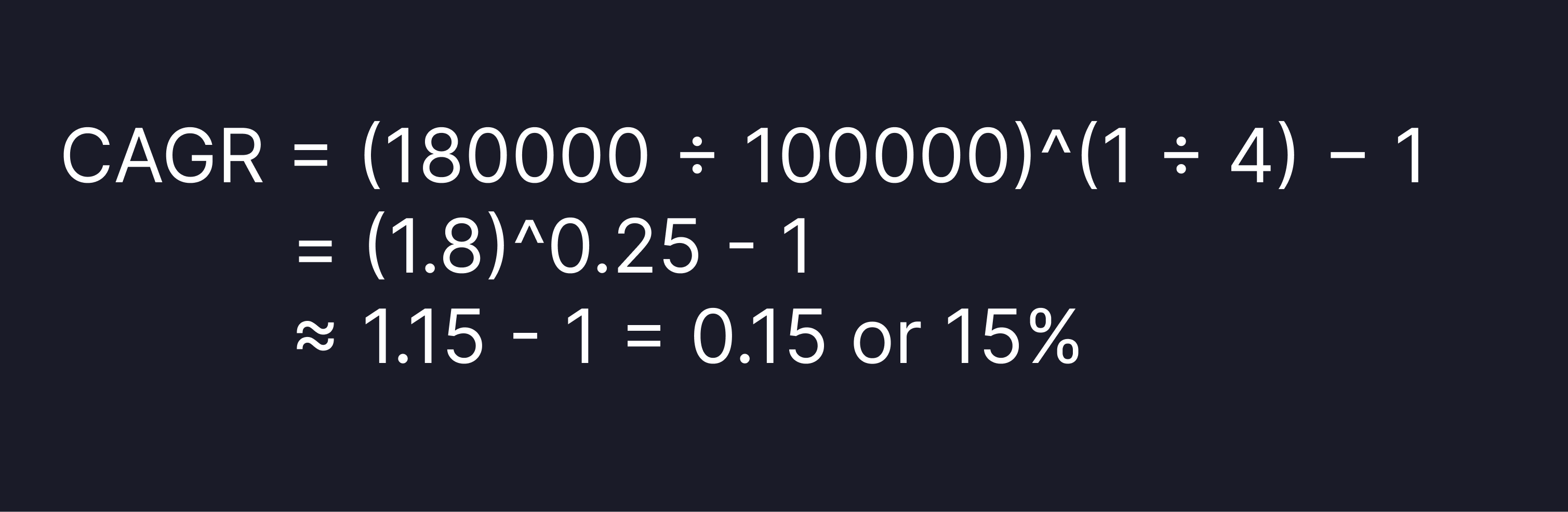
So, the CAGR is 15%.
This means your investment grew at an average annual rate of 15% over 4 years.
When Should You Use CAGR?
CAGR is a handy tool, but it’s not ideal for all types of investment tracking. Here are the situations where CAGR works best:
1. Long-Term Investments
If you're looking at returns over 3–10 years or more, CAGR gives a clearer picture of how steadily your investment has grown.
2. Stable Growth Tracking
CAGR is effective when the investment doesn’t have huge year-on-year fluctuations. For example, blue-chip stocks or established mutual funds.
3. Comparing Investment Options
Want to compare two mutual funds or stocks over 5 years? CAGR helps you decide which one delivered better, consistent growth.
4. Business Revenue Analysis
Businesses use CAGR to show how their revenue, customer base, or profit grew over several years, especially in pitch decks or investor reports.
CAGR Example: With Comparison
Let’s compare two investments:
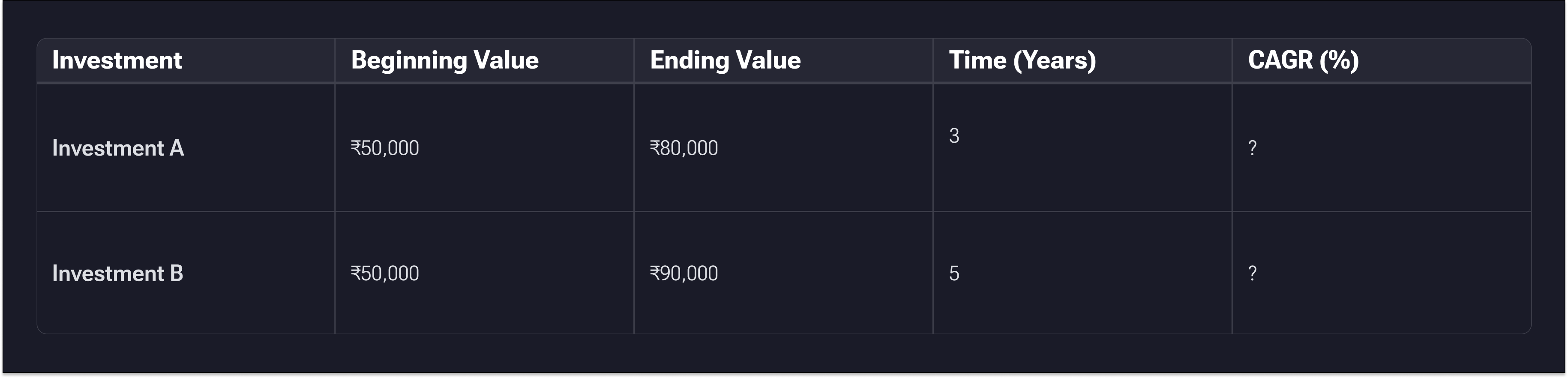
For Investment A:
CAGR = (80,000 / 50,000) ^ (1 / 3) - 1
= (1.6)^0.333 - 1
≈ 0.1709 or 17.09%
For Investment B:
CAGR = (90,000 / 50,000) ^ (1 / 5) - 1
= (1.8)^0.2 - 1
≈ 0.1257 or 12.57%
Even though Investment B gave higher total returns, Investment A has a higher CAGR, meaning it grew faster annually.
Limitations of CAGR
While CAGR is useful, it has some limitations:
It assumes constant growth, which rarely happens in real life.
It doesn’t reflect year-to-year volatility.
It may not be accurate for short-term investments.
Conclusion
Understanding CAGR helps you make better investment decisions by showing how your money grows over time. It helps minimize short-term fluctuations, offering a more accurate view of your investment’s long-term performance
Whether you're tracking your mutual fund, business growth, or stock portfolio, CAGR is a key metric every investor should know.
If you're looking to explore alternative investment avenues, Precize offers a seamless platform that grants access to pre-IPO shares and global trade finance opportunities. Starting with an investment as low as ₹10,000, these opportunities are accessible to a wide spectrum of investors looking to grow their wealth. Backed by a focus on security and data-driven insights, Precize empowers you to make well-informed investment choices.
So, take the first step toward diversifying your portfolio by Reserving your access on Precize today.
(Disclaimer: This blog is intended solely for informational purposes and should not be interpreted as financial advice. Investors are encouraged to assess their own financial objectives and risk appetite before making any investment decisions. For personalized guidance, please consult a licensed financial advisor.)