


According to The Economic Times, investors are pegging the company's valuation at approximately $2.1–2.3 billion. The reported development follows multiple changes to the company's earlier listing plans, including revised fundraising requirements and financial restructuring.
The development has brought attention back to upcoming IPOs in India, particularly as OYO reports stronger financial performance and continues expanding its international hospitality operations.
OYO IPO: Proposed ₹3,350 Crore Fresh Issue
The proposed PRISM IPO has also undergone changes in its fundraising structure. According to an October 2026 report by The Economic Times, the company plans to reduce its proposed fresh issue from ₹6,650 crore to ₹3,350 crore.
The proposed offering is expected to comprise an entirely fresh issue of equity shares, without an Offer for Sale (OFS) component. A fresh issue allows a company to raise new capital by issuing additional shares, with the proceeds going directly to the business.
In contrast, an Offer for Sale allows existing shareholders to sell their holdings, with the proceeds going to those selling shareholders rather than the company. The revised issue size follows an improvement in the company's cash generation and balance-sheet position, which reportedly reduced its fundraising requirements. Most of the proposed proceeds are intended for repayment or prepayment of borrowings.
This change is important because the company's future debt-reduction strategy will depend not only on IPO proceeds but also on its ability to generate sufficient cash from business operations.
Check OYO latest share price: https://portal.precize.in/companies/INE561T01021?utm_source=marketing&utm_medium=blogs&utm_campaign=blogs_24112026&utm_content=oyo
OYO Financial Performance: Revenue Reaches ₹9,358 Crore in FY26
The financial performance of PRISM has become an important part of its public-market narrative, particularly as the company attempts to demonstrate sustainable growth and profitability.
According to its FY26 annual report, PRISM recorded consolidated revenue from operations of ₹9,358 crore, representing approximately 49.7% growth compared with FY25. Its EBITDA more than doubled to ₹2,594 crore, while reported net profit increased to ₹994 crore from ₹245 crore in FY25.
The key financial highlights are:
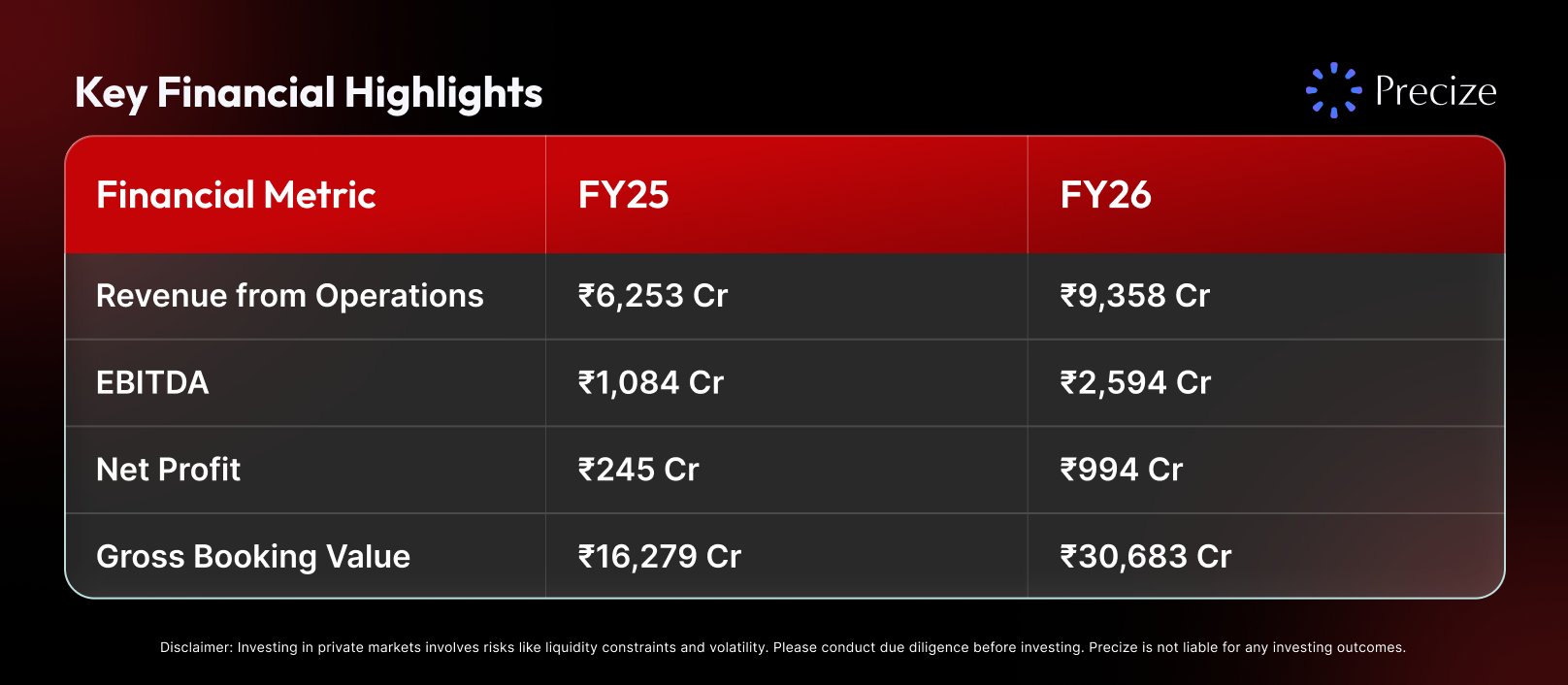
Source: PRISM FY26 annual report and company disclosures. Figures rounded.
However, FY26 net profit included a deferred tax credit of ₹678 crore. This is an important consideration when evaluating the sustainability of reported earnings. Investors should examine operating profitability and cash generation alongside net profit.
The company's revenue growth was supported by higher business volumes, increased contributions from premium and company-serviced hotels, operating leverage across markets and the full-year contribution from its US-based G6 Hospitality acquisition.
Another important metric is Gross Booking Value (GBV), which represents the value of bookings generated through the platform. OYO's GBV increased to ₹30,683 crore in FY26 from ₹16,279 crore in FY25, indicating an expansion in booking activity across its hospitality network.
These developments suggest that OYO has strengthened its business scale and operating performance. However, investors will need to examine whether the company can maintain this growth while converting improved EBITDA into consistent cash generation. Understanding a company's cash flow statement is particularly important because reported profits and actual cash generated from operations are not always the same.
OYO's Valuation Journey
The OYO valuation journey has changed considerably over the years, reflecting shifts in investor expectations, business performance and market conditions.
During its earlier growth phase, OYO attracted significant investor interest through its rapid international expansion and technology-driven hospitality model. In 2021, the company was reportedly targeting a valuation of up to $12 billion during its initial IPO preparations.
However, the COVID-19 pandemic severely disrupted the global travel and hospitality industry. Declining hotel occupancy, travel restrictions and operational challenges affected the company's business and growth plans. Subsequently, its valuation expectations underwent a substantial correction.
The latest reported valuation expectation of ₹20,000–22,000 crore ($2.1–2.3 billion) represents a significant difference from its earlier public-market ambitions. This valuation journey highlights the difference between private-market expectations, and the valuation investors may be willing to assign to a company during a public offering.
Understanding stock valuation methods can help investors assess whether a company's proposed valuation is supported by its earnings, revenue and business fundamentals.
For potential investors, the key consideration will be whether the proposed valuation is justified by OYO's revenue growth, profitability, debt position and future business prospects.
What Is Driving OYO's Business Growth?
The OYO business model has evolved beyond its original budget-hotel positioning. The company has expanded its hospitality portfolio through international acquisitions, premium hotel offerings and technology-enabled accommodation services.
1. International Expansion
OYO has built an international presence across multiple markets, including India, Europe, Southeast Asia and North America. Its diversified geographical presence provides access to different travel markets and customer segments.
2. G6 Hospitality Acquisition
The acquisition of US-based G6 Hospitality, which operates Motel 6 and Studio 6, strengthened OYO's North American presence. According to FY26 disclosures, G6 Hospitality contributed significantly to the company's international business and booking value.
3. Premium Hospitality Offerings
OYO has increased its focus on premium and company-serviced hotels. This strategy aims to improve the quality of its property portfolio, strengthen customer experience and increase revenue generation.
The wider shift towards premium accommodation can also be seen in developments such as Sunday PropTech's acquisition of an 89-room hotel in Kolkata, reflecting growing activity in India's organised hospitality market.
4. Technology and Operating Efficiency
The company's asset-light business model relies on partnerships with property owners rather than owning most of the hotel infrastructure. Its technology platform supports reservations, pricing, revenue management and customer services, allowing it to expand while limiting direct investment in physical properties.
These initiatives have contributed to OYO's expansion and its efforts to improve operating leverage across markets.
What Does OYO's Reported IPO Valuation Mean for Investors?
The reported valuation of ₹20,000–22,000 crore will be an important benchmark for investors evaluating OYO's potential public offering. However, assessing an IPO requires looking beyond the headline valuation and examining the underlying financial performance.
Some important factors investors should monitor include:
1. Sustainability of Profitability
Although OYO reported a net profit of ₹994 crore in FY26, the deferred tax credit included in the reported figure makes it important to examine recurring earnings. Investors should therefore consider EBITDA, operating cash flow and recurring profitability alongside net profit.
2. Revenue Growth and International Operations
The company's international expansion and G6 Hospitality acquisition have supported its revenue growth. However, investors should assess whether these businesses can maintain growth and generate sustainable returns.
3. Debt and Interest Costs
The company's outstanding borrowings and associated interest expenses remain important considerations. Its ability to strengthen its balance sheet and manage financing costs could influence future financial performance.
4. Final IPO Valuation
The reported valuation is not the final offer valuation. Investors will need to compare the eventual pricing with the company's earnings, growth prospects, debt levels and relevant hospitality-sector peers.
5. IPO Structure and Regulatory Updates
The final offer documents will provide greater clarity on the issue size, shareholding structure, risk factors and use of proceeds. Investors can also follow Amagi Media Labs' IPO developments to understand how other technology-driven businesses approach their transition to public markets.


Conclusion:
OYO's reported IPO plans mark another important development in the hospitality company's journey towards the public markets. Its FY26 performance reflects substantial revenue growth, higher EBITDA and improved reported profitability, supported by international expansion and the G6 Hospitality acquisition.
However, the reported valuation of ₹20,000–22,000 crore will need to be assessed against the company's earnings quality, debt obligations and ability to sustain cash generation. The impact of the deferred tax credit on FY26 net profit also makes it important to look beyond headline profitability.
For investors tracking upcoming public listings, OYO remains a company worth monitoring as further details emerge. The final listing timeline, issue structure and valuation will determine how the market receives its next public-market attempt.
Investors can explore companies preparing for public listings through the Precize Upcoming IPOs Screener and track developments across India's unlisted market.
Explore unlisted companies on Precize
FAQs:
OYO is reportedly targeting a January–March 2027 listing, although the company has disputed the reported timeline.
The reported valuation expectation is ₹20,000–22,000 crore, equivalent to approximately $2.1–2.3 billion.
The proposed fresh issue was reportedly reduced to ₹3,350 crore in October 2026.
PRISM reported consolidated revenue from operations of ₹9,358 crore in FY26, approximately 49.7% higher than FY25.
The reported offering is expected to comprise an entirely fresh issue without an OFS component. Final details remain subject to updated offer documents.
OYO's parent company is PRISM, formerly known as Oravel Stays.