Discover High Return, High Risk Stocks in India 2025

Discover top high-risk, high-return stocks in India 2025. Know key sectors, examples, strategies, and risks to make informed stock market choices.
10 min read
high risk stocks

Every investor dreams of finding that one stock that can multiply wealth in a short time, but in reality, such opportunities usually come with big risks. In 2025, India’s market is full of companies that promise high growth but also carry high uncertainty, often called high risk stocks. 

To help you make sense of this space, this blog will walk you through what high-risk, high-return stocks actually mean, why they are being talked about more in 2025, and which sectors in India show the most potential. 

You’ll also see examples of such stocks this year, ways to evaluate them carefully, strategies investors often use, and the risks you must be aware of while exploring them. 

Let’s get into it to explore!

 Quick Insights

  • High-risk, high-return stocks can swing sharply, giving you big gains or sudden losses.

  • These usually belong to startups, tech, fintech, or emerging industries in India.

  • Risks include market volatility, regulatory changes, liquidity issues, and company performance.

  • You need constant tracking and awareness, as these stocks react quickly to news and events.

What Are High-Risk, High-Return Stocks?

High-risk, high-return stocks are shares of companies that have the potential to deliver very high profits but also come with a strong chance of losses. These stocks usually belong to businesses that are either growing fast, entering new markets, or operating in industries with high uncertainty. In India, such stocks are often found in sectors like technology, biotech, renewable energy, fintech, and small-cap or mid-cap companies.

Once you’re clear on what these stocks mean, the next step is to understand why they are gaining attention.

Why Consider High-Risk Stocks in 2025?
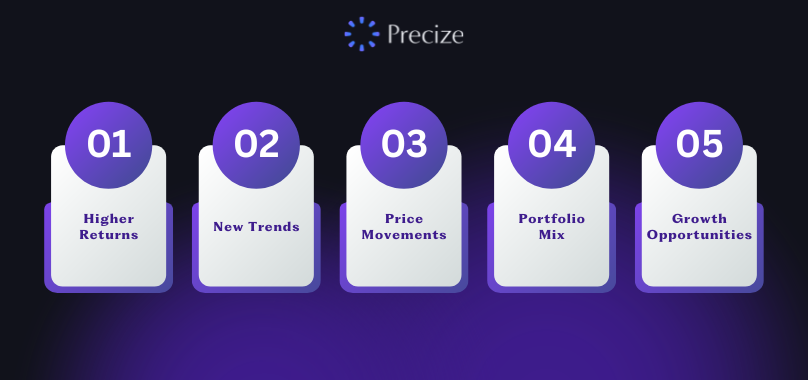
High-risk stocks stand out because they move faster and sharper than regular stocks, making them an important part of market discussions in 2025. Here are some key reasons why high-risk stocks are worth considering:

  • Potential for Higher Returns: These stocks can grow at a faster pace during bullish market conditions or when the economy is strong.

  • Opportunity to Follow New Trends: Many high-risk stocks are linked to emerging sectors such as IT, clean energy, and healthcare, which are expected to expand further in the coming years.

  • Short-Term Price Movements: Their frequent ups and downs attract traders who focus on short-term opportunities or daily price changes.

  • Portfolio Diversification: Combining high-risk stocks with more stable options can help spread overall exposure.

  • Access to Growth Opportunities: In a rapidly growing market like India, these stocks provide exposure to industries that could drive the next wave of value creation.

With the ‘why’ clear, it’s time to explore the ‘where’, the sectors in India that stand out for high risk and high return this year

Top Sectors With High-Risk, High-Return Potential in India 2025

In 2025, you’ll find that some sectors in India offer both big opportunities for growth and higher levels of risk. The main areas to watch include technology, renewable energy, pharmaceuticals and healthcare, electric vehicles, infrastructure, and financial services.

1. Technology and IT

When you look at technology and IT, you see rapid changes driven by 5G rollout, AI adoption, and digital transformation across industries. Stocks in this space often rise or fall sharply, which makes the sector risky but also capable of strong returns.

2. Renewable Energy

If you follow renewable energy, you’ll notice India’s strong push toward clean power backed by government initiatives. While the growth story is clear, sudden policy changes and tough competition can make this sector unpredictable.

3. Pharmaceuticals and Healthcare

In healthcare and pharma, you benefit from rising exports, higher medical spending, and demand for innovation. At the same time, regulatory hurdles and global supply chain issues can quickly impact stock prices, making this space both rewarding and risky.

4. Electric Vehicles (EVs)

As you explore the EV sector, you’ll see it expanding fast with government incentives and consumer demand for green transport. Still, challenges like changing regulations, battery technology shifts, and raw material costs bring in more risk.

5. Infrastructure

When it comes to infrastructure, urban growth and the need for better roads, housing, and transport create strong opportunities. But issues like funding gaps, project delays, or regulatory changes can affect stability in this sector.

6. Financial Services

If you look at financial services and fintech, you’ll notice rising digital adoption and an increasing customer base. However, the sector reacts sharply to economic shifts and regulatory changes, making it one of the riskier but promising areas in 2025.

After looking at the sectors driving high-risk opportunities, it becomes easier to connect them with real companies that reflect this trend.


Examples of High-Risk, High-Return Stocks in India (2025 Picks)

When you look at India’s market in 2025, some names instantly stand out in conversations about high-risk, high-return stocks. From tech and travel to healthcare, defence, and beverages, here are a few unlisted companies with their share prices as of 4 October 2025.

1. Imagine Marketing (boAt) – Consumer Durables

  • Price Per Share: ₹1,359.00

  • Market Cap: ₹20,474.58 Cr

  • P/E Ratio: 335.56

  • Revenue YoY: -0.01%

  • Why High-Risk: Extremely high valuation with flat revenue growth.

  • Why High-Return: Leading brand in wearables and consumer electronics, strong demand in India’s youth market.

2. Oravel Stays (OYO Rooms) – Hospitality

  • Price Per Share: ₹27.00

  • Market Cap: ₹16,363.42 Cr

  • P/E Ratio: 75.00

  • Revenue YoY: -1.38%

  • Why High-Risk: Unstable profitability and high dependency on travel demand.

  • Why High-Return: One of India’s largest hospitality tech platforms with wide market reach.

3. Pine Labs – Financial Technologies

  • Price Per Share: ₹332.00

  • Market Cap: ₹27,845.32 Cr

  • P/E Ratio: -148.88

  • Revenue YoY: 2.27%

  • Why High-Risk: Consistent net losses and negative profitability.

  • Why High-Return: Strong position in digital payments and merchant fintech solutions.

4. Pharmeasy – Healthcare

  • Price Per Share: ₹6.55

  • Market Cap: ₹4,104.56 Cr

  • P/E Ratio: -1.61

  • Revenue YoY: -14.75%

  • Why High-Risk: High losses and revenue decline in 2025.

  • Why High-Return: Leading player in India’s online pharmacy and e-health services.

5. B9 Beverages (Bira 91) – FMCG

  • Price Per Share: ₹236.00

  • Market Cap: ₹1,127.33 Cr

  • P/E Ratio: -2.53

  • Revenue YoY: 14.67%

  • Why High-Risk: Loss-making company despite rising revenues.

  • Why High-Return: Youth-focused beer brand with strong market presence and growth potential.

6. Goodluck Defence and Aerospace – Defence

  • Price Per Share: ₹389.00

  • Market Cap: ₹708.76 Cr

  • P/E Ratio: 385.15

  • Revenue YoY: 0.00%

  • Why High-Risk: Very high P/E ratio and limited financial performance visibility.

  • Why High-Return: Positioned in India’s growing defence and aerospace sector.

7. Polymatech Electronics – Electronics

  • Price Per Share: ₹68.00

  • Market Cap: ₹2,637.04 Cr

  • P/E Ratio: 10.99

  • Revenue YoY: 88.08%

  • Why High-Risk: Early-stage company with volatile earnings.

  • Why High-Return: Strong growth in semiconductor and electronics manufacturing, an emerging Indian sector.

(Source: Financial Reports)

Examples highlight the possibilities, but careful evaluation is what helps you separate strong opportunities from weak ones.

How to Evaluate High-Risk Stocks Before Considering

When you look at high-risk stocks, it’s important to study them closely before making any move. These stocks can bring sharp ups and downs, so knowing what to check makes a big difference. Here are some key points you can focus on:

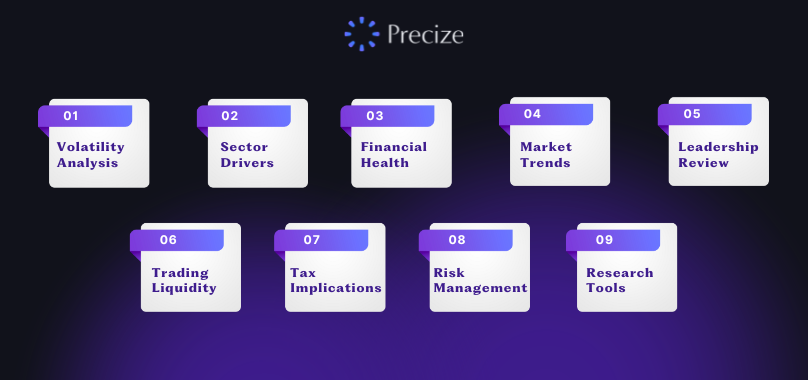
  1. Analyze Volatility and Beta

High-risk stocks usually swing more in price than others. One way to measure this is through beta, which shows how much a stock moves compared to the overall market. A beta above 1 often signals higher volatility. You can easily find this data on stock screening platforms like Precize.

  1. Consider Sector and Growth Drivers

The sector a company belongs to plays a big role. Areas like technology, renewable energy, pharma, and electric vehicles are fast-changing and full of opportunities, but they also carry more uncertainty. Factors like government policies, global demand, or innovation often drive these risks and returns.

  1. Review Financial Health

Go through the company’s financial reports to check for stable profits, debt levels, and cash flow. Some high-risk companies might be in expansion mode or restructuring, which can make their financials uneven. Understanding this helps you see how strong the company is.

  1. Watch Market Trends and News

High-risk stocks are sensitive to news and market updates. Policy changes, new regulations, or global events can quickly affect prices. Staying updated with reliable financial news helps you keep track of such developments.

  1. Evaluate Management and Leadership

A company’s future often depends on its leaders. Look at the management team’s track record, decision-making, and overall credibility. In industries that are uncertain or evolving, strong leadership becomes even more important.

  1. Assess Liquidity and Trading Volume

Liquidity shows how quickly a stock can be bought or sold without affecting its price. Some high-risk stocks may have low trading volumes, which means it can be harder to exit quickly if the market turns against you.

  1. Understand Tax Implications

Taxes also matter. For example, in India, short-term capital gains on equities are taxed at 20%, while long-term gains above ₹1.25 lakh are taxed at 12.5%. For other asset classes like crypto, the tax rate is higher. Knowing this helps you plan better.

  1. Diversification and Risk Management

Avoid putting all your money into one high-risk stock. By spreading investments across different sectors or companies, you reduce the chances of facing heavy losses from a single stock.

  1. Use Research Tools

Platforms like Precize and other financial portals give you detailed insights on volatility, balance sheets, and analyst reports. Combining this with regular tracking of market and sector news gives you a clearer view before you make decisions.

Knowing how to evaluate is essential, but equally important is applying strategies that align with your financial goals and risk appetite

Investment Strategies for High-Risk Stocks in India

Once you’ve done your research and shortlisted high-risk stocks, the next step is to plan how to invest in them. Here are some smart strategies you can use:

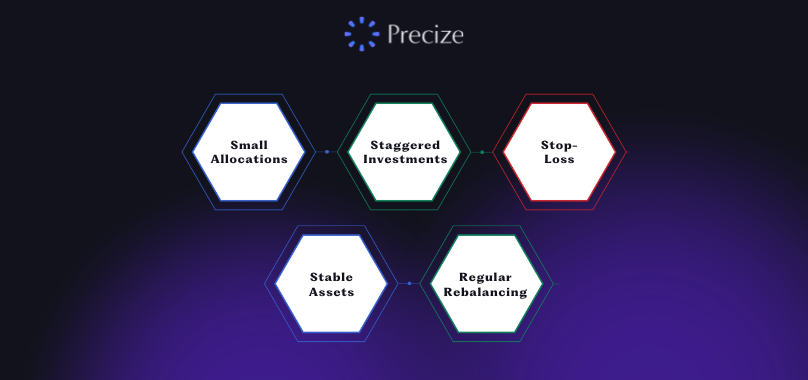
  • Start with Small Allocations: Instead of putting a big chunk of money at once, begin with smaller amounts. This helps you test how the stock behaves without risking too much.

  • Use a Staggered Investment Approach: Avoid putting all your money into a single stock at one price. By entering in parts during dips and rises, you can average out your cost and reduce losses from sudden market swings.

  • Keep Stop-Loss Orders in Place: High-risk stocks can move sharply in a single day. By setting stop-loss orders, you protect yourself from large, unexpected falls.

  • Balance with Stable Assets: Mix your high-risk stocks with safer options like blue-chip stocks, mutual funds, or fixed deposits. This way, you enjoy potential high returns without putting your entire portfolio at risk.

  • Rebalance Regularly: Keep checking if high-risk stocks are taking up too much of your portfolio. Rebalancing ensures you stay in control and aligned with your comfort level on risk.

A strong plan is important, but without understanding the risks, it may not be enough to handle market uncertainties.

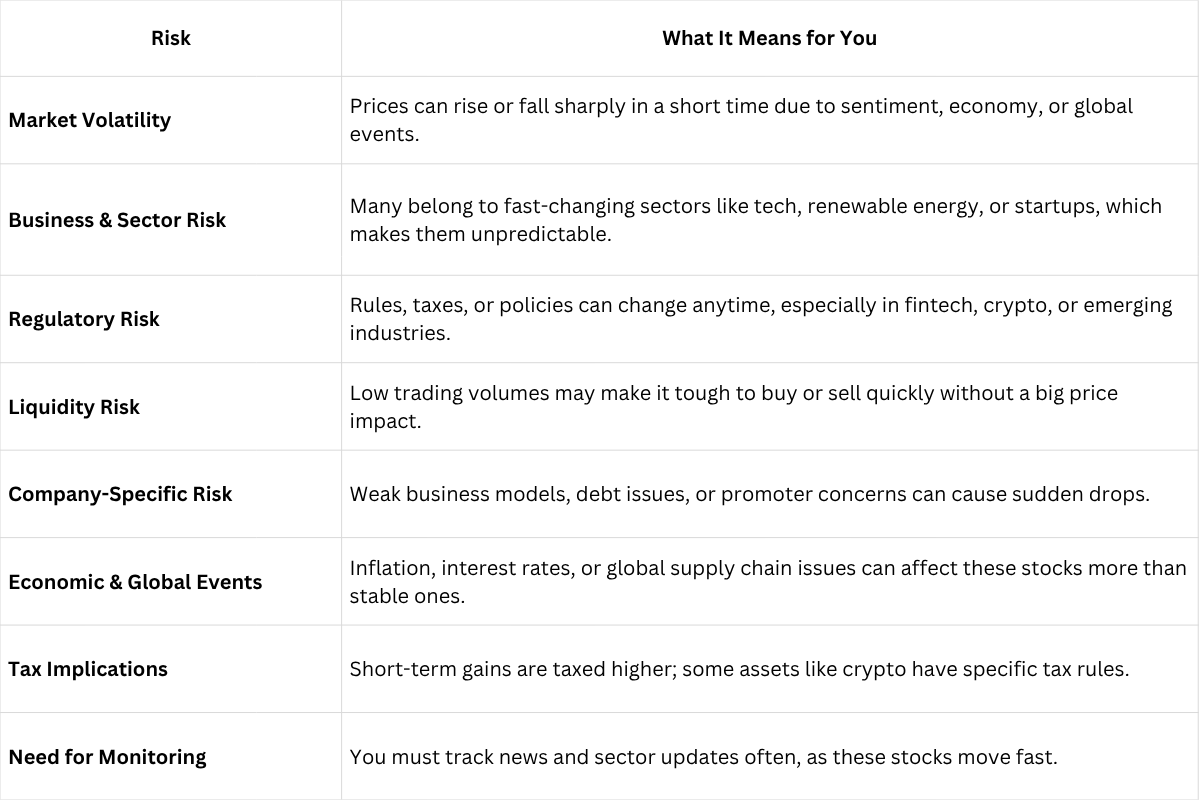
Risks to Consider When Exploring High-Risk Stocks in India

When you look at high-risk, high-return stocks in India, it’s important to understand the risks that come with them. These stocks can bring big opportunities, but they also carry challenges you need to be aware of.

Conclusion

High-risk, high-return stocks in India 2025 continue to draw attention because of their potential to deliver strong rewards, but they also carry uncertainties that require awareness and caution. In this space, platforms like Precize bring new ways to explore opportunities. 

You get access to leading private companies. Precize also opens the door to unique global finance opportunities, helping you diversify your portfolio with alternative fixed-income options.

What makes it even more approachable is the low minimum threshold of ₹10,000, along with a user-friendly platform where you can track past price performance of unlisted companies and stay updated with the latest market trends and news.

Reserve access now with Precize and unlock a diversified portfolio!

FAQs 

1. Do high-risk stocks pay dividends?

Most high-risk stocks, especially small-cap and fast-growing companies, don’t usually give regular dividends. They often use their earnings to expand the business instead of sharing profits.

2. Are these stocks good for beginners?

High-risk stocks can be tricky because they move fast and need close tracking. If you’re just starting, it’s better to focus on stable options and slowly learn how to handle market ups and downs.

3. How does diversification help with risk?

When you spread your money across different sectors and stock types, a loss in one area doesn’t hit your whole portfolio too hard. Diversification balances the risk.

4. How can you stay updated on the market? 

Following trusted financial news sites and reliable platforms helps you keep track of trends, rules, and opportunities in the market.

Disclaimer 

The details provided here are for informational use only and should not be treated as financial advice. Prices and company data mentioned are based on information available as of September 1, 2025, and may change with time. Everyone’s financial situation is different, so it’s important to review information carefully and consult reliable sources before making decisions. This content does not represent any kind of recommendation or endorsement. The responsibility for any action taken based on this information rests solely with the reader.

Precize
Precize
Content Strategy and Research Analyst

Stay in the Loop

Join our newsletter for exclusive access to thoughtfully curated content and we promise, no spam

The next generation of asset classes in India

Resources

Our Office

Office No. 1219, The Summit Business Park, Andheri Kurla Road, Andheri East, Mumbai, Maharashtra - 400093

Find us on Google

support@precize.in

+91 7738336457

All trademarks and logos or registered trademarks and logos found on this Site or mentioned herein belong to their respective owners and are solely used for informational and educational purposes.

The material presented in this advertisement is for informational purposes only and should not be construed as investment advice or investment availability. It is not a recommendation of, or an offer to sell or solicitation of an offer to buy, any particular unlisted share, security, strategy, or investment product. Investing in the private market and securities involves risks, including the potential loss of money, and past performance does not guarantee future results. Market trends, data interpretations, graph projections are provided for informational and illustrative purposes and may not reflect actual future performance. Nothing on this website should be construed as personalized investment advice or should not be treated as legal, financial, or any other form of advice. Precize is not liable for financial or any other form of loss incurred by the user or any affiliated party based on information provided herein.

Precize is neither a stock exchange nor does it intend to get recognized as a stock exchange under the Securities Contracts Regulation Act, 1956. Precize is not authorized by the capital markets regulator to solicit investments. The securities traded on these platforms are not traded on any regulated exchange.

The website will be updated regularly.

Copyright © 2026 - Precize - All Rights Reserved