In the quiet lanes of Tier-3 towns and the bustling WhatsApp groups of home-based sellers, a quiet commerce ripple has become a market wave. Meesho’s platform now serves some 187 million annual transacting users in India, reaching deep into smaller towns and tier-2/3 areas. With the IPO now open, the spotlight has shifted: what was once speculation is now real price discovery and listing performance.
By FY25, Meesho was estimated to hit a US$6.2 billion GMV run-rate, underscoring the platform’s scale and potential. As Meesho makes its public market debut in December 2025, the real questions are no longer just “how much could it be worth?” — but “why now?”, “How is the valuation justified?”, and “What underpins the price investors are paying?”
In this blog, we trace Meesho’s rise from a grassroots social-commerce network to a full-fledged marketplace challenger and now a public company. We unpack the key valuation levers, the IPO details, and the structural risks to watch. What you read here is not a forecast, but a guide to understanding what matters now that the IPO is live.
Scale & Reach: Meesho serves 187 million annual transacting users, making it one of India’s largest value-commerce platforms in Tier-2 and Tier-3 markets.
Financial Growth: FY25 revenue has reached ₹9,390 crore with operating losses narrowing, showing stronger efficiency and a clearer path to profitability.
IPO Details: The Meesho IPO closed on 5 December 2025 with a confirmed issue size of ₹5,421.20 crore and a price band of ₹105–₹111 per share.
Valuation Insight: At the upper price band, Meesho commands a market valuation of around ₹50,000 crore, reflecting investor confidence in its scale and monetisation.
What to Watch: Listing-day performance, unit economics stability, competitive pressures and execution in newer verticals will determine long-term success post-IPO.
Meesho was founded in 2015 in Bengaluru by IIT Delhi alumni Vidit Aatrey and Sanjeev Barnwal. The duo began with a simple insight: millions of small sellers and home-based entrepreneurs across India lacked access to scalable online commerce tools.
They pivoted from a hyper-local fashion model into a social commerce marketplace that empowers individuals and micro-entrepreneurs. Over time, Meesho has transformed into a full-scale value commerce platform with deep penetration across Tier-2 and Tier-3 cities, putting affordable products and digital earning opportunities within reach for millions.
Below are the core facets of Meesho’s model, strategy, and current standing. Each of these elements now plays an essential role in how the market is evaluating the company during its live IPO and ongoing price discovery.
Business model evolution: Meesho shifted from a reseller-driven social commerce model to a full marketplace with direct consumer sales. This helped the platform focus on affordability and a deeper reach across smaller towns.
Zero-commission positioning: The platform follows a zero-commission structure for many sellers, making entry easier for MSMEs. Instead, Meesho earns through logistics, advertising, and paid seller services.
Monetisation mix: Key revenue drivers include logistics margins, supplier fees, and advertising tools. This model scales with GMV while keeping seller costs low.
Logistics and operations push: Meesho has strengthened its logistics capabilities, including its own fulfilment network. This improves delivery control, return handling, and overall unit economics.
Seller enablement ecosystem: The platform supports sellers through onboarding tools, catalogue features, and credit/working-capital partnerships. These enablers help micro-entrepreneurs list consistently and grow.
Tech and product focus: Meesho invests in discovery algorithms, AI-led personalisation, and catalogue automation. These tools enhance conversions, lower acquisition costs, and encourage repeat purchases.
Capital structure and listing readiness: The company has reorganised under an India-domiciled structure and initiated its DRHP/confidential filing process. This prepares Meesho for governance and reporting requirements ahead of its 2025 listing plans.
Risk management levers: To improve margins, Meesho is reducing return rates and making logistics more cost-efficient. It is also shifting its revenue mix toward higher-margin services like ads and last-mile efficiencies.
With a clear view of how Meesho operates today, the next step is to understand how the company has been performing financially.
Meesho’s financial performance over the past year reflects a platform that is scaling with stronger operational discipline. The company has strengthened its revenue engine, increased order volumes, and improved its cost structure. These results are now central to how the market is valuing Meesho during its live IPO.
Here is a quick look at the key numbers that are shaping the Meesho IPO valuation narrative:
Annual Transacting Users (ATUs): 187 million, reported for the nine months ended Dec 2024.
Orders Placed: 1.3 billion orders in the nine months ended Dec 2024.
Revenue from Operations (FY24): ₹7,615.1 crore for the year ended March 31, 2024.
Revenue from Operations (FY25): ₹9,390 crore for the year ended March 31, 2025.
Net Loss (FY25 – Restated After Adjustments): ₹3,941.7 crore.
Loss Before Exceptional Items (Core business — FY25): ₹108.4 crore loss, indicating near operational break-even.
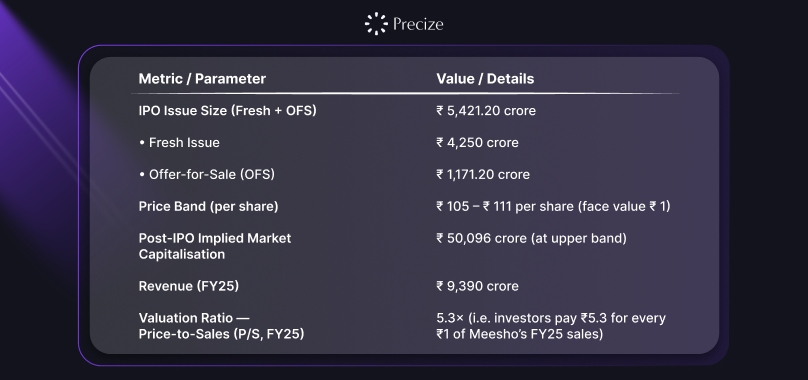
IPO Total Issue Size (Fresh Issue + OFS): ₹5,421.20 crore, including ₹4,250 crore fresh issue and ₹1,171.20 crore OFS.
Also Read: Understanding How to Analyse a Company’s Financial Statements
These financial trends set the foundation for what the market may expect next: Meesho’s potential IPO valuation.
With the IPO now live and book-building underway (price band ₹105–₹111), the market is discovering the valuation in real time.
Meesho has already completed its updated regulatory filings, received SEBI approval and opened its public issue for subscription. The fresh issue and the Offer for Sale by existing investors are now being executed through the IPO process.
The company’s financial performance, rising revenue, sharper cost control, and large user base are key contributors to shaping investor sentiment and valuation during this stage of price discovery.
Below is a table with the confirmed data points that define Meesho’s valuation during its December 2025 listing.
Also Read: Understanding Pre‑IPO Investing: Definition and Process
Now that the valuation picture is clearer, it’s important to look at the strategic objectives behind Meesho’s IPO.
Below are the key objectives Meesho intends to achieve through its upcoming public offering.
Upgrade the cloud infrastructure of its subsidiary Meesho Technologies Pvt Ltd (MTPL) to support scale and data capacity.
Invest in the Machine Learning, AI, and technology teams through MTPL, including hiring and technology development costs.
Allocate funds for marketing and brand-building initiatives to deepen Meesho’s presence across India’s smaller cities and towns.
Use remaining proceeds for acquisitions, strategic investments, and general corporate purposes, giving the company flexibility in future growth moves.
Understanding why the IPO matters sets the stage for another important detail: the expected schedule ahead.
Meesho’s public listing has now moved past the filing and approval stages, and the subscription window has been completed. The regulatory compliance and updated filings paved the way for a December 2025 launch and allowed the IPO to proceed smoothly.
Here is a clear timeline of the finalized schedule and key IPO milestones:
Updated DRHP Filing: Meesho submitted its Updated Draft Red Herring Prospectus (UDRHP) to SEBI on 7 October 2025, outlining the revised offer structure and updated financials.
Regulatory Approval: SEBI’s observation/approval for Meesho’s IPO was issued in October 2025, clearing the company to move ahead with its public issue.
IPO Opening Window: The Meesho IPO is open now. The subscription window opened on 3 December 2025 and was scheduled to close on 5 December 2025.
With the expected timeline now clear, it’s equally important to look at the factors that could influence Meesho’s journey to the public markets.

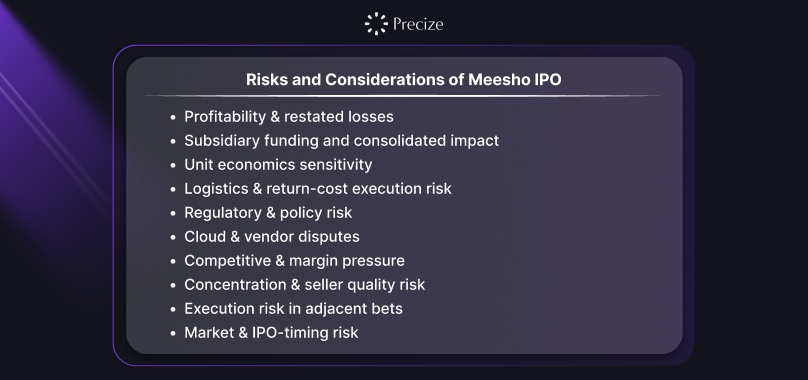
Meesho’s DRHP and recent filings highlight a business that is scaling rapidly while managing several operational and accounting complexities. As the IPO has entered the market and price discovery is underway, investors should carefully consider company-specific and market-wide risks that may influence valuation and post-listing performance.
Below are the key risks and considerations identified from Meesho’s updated filings and recognised industry reporting.

Profitability and restated losses: Meesho has reported a large restated net loss for FY25 after one-time adjustments, even though adjusted operating losses have narrowed. The difference between headline losses and underlying operational improvement remains a key area of scrutiny as the company enters the public market.
Subsidiary funding and consolidated impact: Several subsidiaries in logistics, grocery and fintech are still loss-making and may need continued capital support, which can weigh on consolidated cash flows and delay overall margin improvement.
Unit economics sensitivity: Meesho’s progress toward order-level breakeven depends on further reductions in fulfilment costs and stable average order values. Any reversal in these metrics can quickly widen losses in a value-commerce model.
Logistics and return-cost execution risk: The expansion of in-house logistics through Valmo is designed to improve economics. However, managing last-mile efficiency and controlling return rates in low-ticket categories remain challenging execution areas.
Regulatory and policy risk: Any changes in India’s e-commerce regulations or enforcement of marketplace policies could impact pricing models, seller terms or fulfilment operations. These concerns are highlighted in the company’s filings.
Cloud and vendor dispute risk: A dispute with a major cloud provider over invoicing and commitments has been disclosed. Unresolved vendor disputes can affect platform reliability and increase technology costs.
Competitive and margin pressure: Strong competition from other value-focused marketplaces may lead to pricing pressure and sustained discounting. This can influence contribution margins in a high-volume, low-price segment.
Seller concentration and quality risk: Meesho relies heavily on a large base of small sellers. Variability in product quality and catalogue accuracy can impact return rates and customer satisfaction, which in turn affects unit economics.
Execution risk in adjacent bets: Emerging initiatives in grocery, fintech, and logistics are strategically important but early in their lifecycle. These new business lines may need more time and investment before they contribute meaningfully to profitability.
Suggested Read: Effective Strategies for Investing in IPOs: A Comprehensive Guide
With these risks in mind, the next stage for investors is to track the allotment process and listing timeline now that the subscription window has closed.
With the Meesho IPO subscription window open from 3 to 5 December 2025, most investors now want to know two things: when will I know my allotment status and when will Meesho list on the exchanges. The good news is that the key dates and tracking methods are already available through brokers, registrars and market data platforms.
Below is a clear breakdown of what happens after the issue closes and how to track every stage, based on the latest information available as of 5 December 2025.
Most leading IPO trackers and brokers are aligned on the standard T+ timeline for Meesho:
IPO close date: 5 December 2025
Basis of allotment finalisation (tentative): 8 December 2025
Refund initiation / UPI unblocking (tentative): 9 December 2025
Credit of shares to Demat accounts (tentative): 9 December 2025
Listing date on NSE and BSE (tentative): 10 December 2025
These dates are described as tentative because the exchanges and registrar can adjust them slightly for operational reasons, but multiple brokerages and research platforms are currently guiding investors to this schedule.
Once allotment is finalised, three things typically happen in sequence for Meesho IPO applicants:
Refunds or UPI unblocking (9 December 2025, tentative)
If you did not receive any allotment, the blocked amount in your bank / UPI will be unblocked.
If you received a partial allotment, only the excess amount will be released.
You can track this in your UPI app or bank statement under “mandate” or “blocked amount”.
Credit of shares to your Demat account (also 9 December 2025, tentative)
Allotted shares are credited to your linked Demat account on or around the same day as refunds.
You can verify this by checking your holdings in your broker app or CDSL / NSDL consolidated account statement.
Listing on NSE and BSE (10 December 2025, tentative)
Meesho shares are expected to start trading on both NSE and BSE on 10 December 2025.
On listing day, live price action will reflect how the market is reacting to Meesho’s valuation, business model, and subscription strength.
Many investors also track the grey market premium (GMP) leading up to listing as an informal sentiment indicator, though it is not an official or guaranteed measure.
The Meesho IPO has already become one of the most closely followed listings of 2025. Strong user scale, improved financial performance and a deeper push into value commerce have created significant interest from investors. With the subscription period now closed, the focus has shifted to allotment status, post-listing market sentiment and how the public exchanges respond to Meesho’s business model.
All the key details such as the price band, lot size, issue size and schedule are now confirmed. What matters next is how the market values Meesho once trading begins on the NSE and BSE, and whether the company can continue improving its margins and operational efficiency as it enters its next phase of growth as a listed entity.
Beyond public listings, platforms like Precize open access to opportunities outside traditional markets. Precize helps in facilitating participation in leading private growth companies, where you can buy and sell unlisted and pre-IPO shares.
Reserve your access with Precize and explore a broader range of alternative market opportunities!
Disclaimer: This blog is for informational purposes only, and all IPO details are subject to official updates from the company and regulatory authorities.
Q1. When was the Meesho IPO open and what was the price band?
The Meesho IPO opened for subscription from 3 December 2025 and closed on 5 December 2025. The price band was ₹105–₹111 per share.
Q2. What was the total issue size and lot size for Meesho IPO?
The total issue size was ₹5,421.20 crore — including a fresh issue of ₹4,250 crore and an Offer-for-Sale (OFS) of ₹1,171.20 crore. The lot size was 135 shares, which meant a minimum retail application amount of around ₹14,985 (at upper band).
Q3. When will Meesho shares get allotted and when will listing happen?
As per the latest public timelines, the allotment was expected around 8 December 2025, with refunds/UPI unblocking and share credit in Demat accounts around 9 December 2025. Listing on the NSE / BSE were expected on 10 December 2025.
Q4. What kind of valuation does the IPO imply for Meesho based on price band and FY25 revenue?
With the price band of ₹105–₹111, the post-IPO implied market capitalisation at the upper band works out to roughly ₹50,000+ crore. Given FY25 revenue of ~₹9,390 crore, that implies a price-to-sales (P/S) multiple of around 5.3×.
Q5. If I applied for the IPO, how do I check whether I got allotment, and what happens next?
You can check allotment status on the registrar’s website or through your broker’s app under the IPO section. If shares are allotted, they will be credited to your Demat account. If not, the blocked amount will be released automatically.

Join our newsletter for exclusive access to thoughtfully curated content and we promise, no spam
Company
Our Office
Office No. 1219, The Summit Business Park, Andheri Kurla Road, Andheri East, Mumbai, Maharashtra - 400093
Find us on Googlesupport@precize.in
+91 7738336457
All trademarks and logos or registered trademarks and logos found on this Site or mentioned herein belong to their respective owners and are solely used for informational and educational purposes.
The material presented in this advertisement is for informational purposes only and should not be construed as investment advice or investment availability. It is not a recommendation of, or an offer to sell or solicitation of an offer to buy, any particular unlisted share, security, strategy, or investment product. Investing in the private market and securities involves risks, including the potential loss of money, and past performance does not guarantee future results. Market trends, data interpretations, graph projections are provided for informational and illustrative purposes and may not reflect actual future performance. Nothing on this website should be construed as personalized investment advice or should not be treated as legal, financial, or any other form of advice. Precize is not liable for financial or any other form of loss incurred by the user or any affiliated party based on information provided herein.
Precize is neither a stock exchange nor does it intend to get recognized as a stock exchange under the Securities Contracts Regulation Act, 1956. Precize is not authorized by the capital markets regulator to solicit investments. The securities traded on these platforms are not traded on any regulated exchange.
The website will be updated regularly.
Copyright © 2026 - Precize - All Rights Reserved