What Standalone & Consolidated Financial Statements Really Reveal About a Company

Understand standalone vs consolidated financial statements, scope, complexity, and stakeholders. Clarify accounting standards and investment insights. Click to explore now!
9 min read
standalone vs consolidated financial statements

Ever felt lost trying to make sense of a company’s financial reports? You look at the parent company’s numbers and wonder how the subsidiaries’ performance fits in. That’s where understanding standalone vs consolidated financial statements becomes really important.

In this blog, you’ll explore what standalone financial statements are, their components, and the advantages and limitations they bring. Then, we’ll move to consolidated financial statements, explain their components, and discuss the benefits and challenges that come with them.

By the end, you’ll easily grasp the key differences between standalone and consolidated financial statements, making it simpler to understand any company’s financial record.

Let’s get started!

Key Takeaways

  • Standalone financial statements show the performance and financial position of a single company independently.

  • Consolidated financial statements combine the parent company and all subsidiaries, providing a complete view of the group’s overall performance.

  • Standalone statements are simpler and easier to analyze, while consolidated statements are more complex but offer a broader perspective.

  • Each type has its advantages and limitations depending on whether you want to focus on one company or the entire group.

What Are Standalone Financial Statements?

Standalone financial statements are the financial reports of a single company prepared on its own, without including any subsidiaries or group companies. They show the company’s individual assets, liabilities, revenues, and expenses. These statements help you understand the company’s performance and financial position independently.

Next, explore the essential components that form a complete standalone financial statement.

Components of Standalone Financial Statements

When you look at a company’s standalone financial statements, it’s important to understand the different components that make up these reports, as each part gives a clear view of the company’s financial position and performance.

Balance Sheet

The balance sheet provides a snapshot of what the company owns and owes at a specific point in time. It lists assets, liabilities, and shareholders’ equity. Assets can include cash, receivables, property, and equipment, while liabilities cover loans, payables, and other obligations. The difference between assets and liabilities represents the company’s net worth.

Income Statement

Also known as the Profit and Loss Statement, this shows how much the company earned and spent during a period. It includes revenue, Cost of Goods Sold (COGS), gross profit, operating expenses, and net profit. This statement helps you understand whether the company made a profit or faced a loss.

Cash Flow Statement

The cash flow statement tracks the movement of cash over a period, covering three areas:

  • Operating Activities: day-to-day business income and expenses.

  • Investing Activities: cash spent or received from buying or selling assets.

  • Financing Activities: funds received from or paid to lenders and shareholders.

Statement of Changes in Equity

This statement shows how the company’s equity has evolved over time. It includes profits retained, dividends paid, new shares issued, and other adjustments. It helps you track changes in shareholder contributions and retained earnings.

Notes to Financial Statements

These notes provide additional details and explanations for the figures in the main statements. They cover accounting policies, depreciation methods, contingent liabilities, and other important information, ensuring transparency and making the financial data easier to understand.

With the key components in mind, it’s easier to see the advantages of looking at a company’s standalone financials.
Pros of Standalone Financial Statements

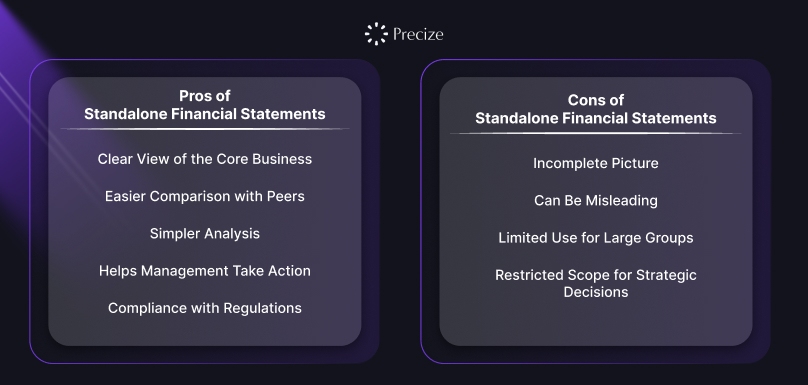
Some key advantages of standalone financial statement include:

  • Clear View of the Core Business: You can see how the company is performing independently, without the results of subsidiaries or related businesses affecting the picture.

  • Easier Comparison with Peers: Since the data reflects only one company, comparing performance with other similar companies becomes straightforward.

  • Simpler Analysis: Focusing on a single entity makes it easier to track profits, debts, and cash flows without unnecessary complexity.

  • Helps Management Take Action: Owners and managers can use this information to plan budgets, monitor operations, and make decisions for the main business without distractions from group companies.

  • Compliance with Regulations: Standalone financial statements follow legal and accounting requirements, providing a standard and reliable view of the company’s individual performance.

Despite these benefits, there are some drawbacks you should be aware of before relying solely on standalone statements

Cons of Standalone Financial Statements

While standalone statements are useful, they also have some limitations:

  • Incomplete Picture: They do not include subsidiaries or affiliated companies, so the full impact of the group’s operations is not visible.

  • Can Be Misleading: Ignoring the performance of subsidiaries may give an inaccurate view of overall financial health, especially if these entities are profitable or loss-making.

  • Limited Use for Large Groups: For business groups, standalone statements alone are not enough to understand the performance of the entire group.

  • Restricted Scope for Strategic Decisions: These statements may not provide enough insight for institutional or global decision-making, as they do not show the complete strength, risks, or potential of all companies under the parent.

Standalone statements focus on a single entity, but to understand a group’s overall performance, we need to look at consolidated financial statements next.

What Are Consolidated Financial Statements?

Consolidated financial statements are reports that combine the financial results of a parent company and all its subsidiaries into a single view. They show the overall financial health and performance of the entire group, rather than just one company. By looking at consolidated statements, you can see the total impact of all the companies under the parent, giving a clearer picture of the group’s strength, risks, and profitability. These statements help you understand how the entire business group is performing as a whole.

To get a clearer view of how the group’s finances are reported, it helps to look at the main components of consolidated statements.

Components of Consolidated Financial Statements

When you review consolidated financial statements, it’s important to understand the key components that show the combined financial position and performance of the parent company along with all its subsidiaries.

  1. Consolidated Balance Sheet

This shows the combined assets, liabilities, and equity of the entire group. It provides a snapshot of the group’s overall financial position at a specific date.

  1. Consolidated Income Statement

This statement sums up all revenues, expenses, and profits for the parent and its subsidiaries. It reflects the group’s total earnings and operating results as one entity.

  1. Consolidated Cash Flow Statement

This tracks all cash inflows and outflows across the group, including operating, investing, and financing activities. It helps you understand how the group manages its cash collectively.

  1. Statement of Changes in Equity

This shows how equity has changed for the parent and subsidiaries during the period, including profits, dividends, share issues, or adjustments like currency translation.

Notes to Consolidated Financial Statements

These provide additional details, explaining accounting policies, significant transactions, and other key information. The notes make it easier to understand the consolidation process and clarify the numbers in the statements.

Having gone through the key components, let’s discuss the main advantages of using consolidated financial statements.
Pros of Consolidated Financial Statements

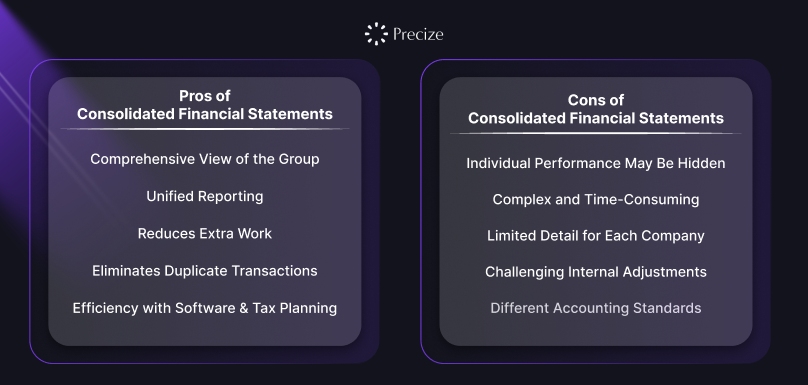
Key advantages of consolidated financial statement include:

  • Comprehensive View of the Group: You can see how the entire group is performing, not just the parent or a single subsidiary, giving a full perspective on the company’s strength.

  • Unified Reporting: All financial information from different businesses is merged into one report, making it easier to understand the overall impact of each part of the group.

  • Reduces Extra Work: Since everything is combined, you don’t need to prepare separate statements for each subsidiary, which saves time and effort.

  • Eliminates Duplicate Transactions: Internal transactions between the parent and subsidiaries, like intercompany sales, are removed, providing a clearer picture of actual performance.

  • Efficiency with Software and Tax Planning: Accounting software can simplify consolidation, and the group structure can help balance profits and losses across entities for potential tax benefits.

While consolidated statements offer many benefits, it’s also important to understand their limitations.

Cons of Consolidated Financial Statements

While consolidated statements are useful, they also come with certain challenges:

  • Individual Performance May Be Hidden: If one subsidiary is underperforming, it may be difficult to notice because the group results blend all companies together.

  • Complex and Time-Consuming: Preparing consolidated statements can be complicated, especially when dealing with multiple subsidiaries or international operations.

  • Limited Detail for Each Company: It can be harder to see the performance of individual units since the focus is on the group as a whole.

  • Challenging Internal Adjustments: Managing and eliminating internal transactions between different companies in the group can make the process more difficult.

  • Different Accounting Standards: For companies operating globally, varying accounting rules in different countries can complicate the consolidation process.

Having looked at what makes each type of statement useful and where they fall short, the next step is to compare them side by side.

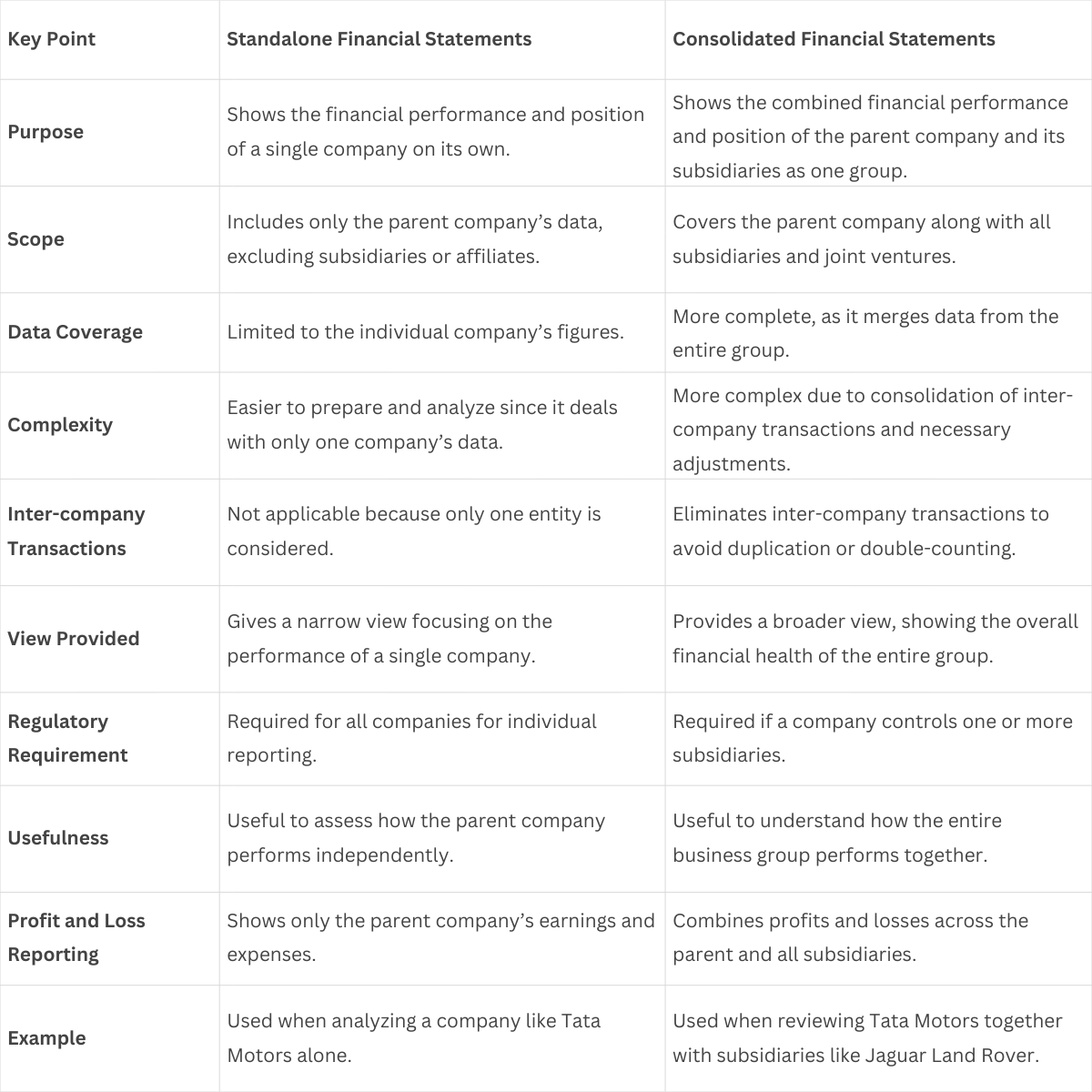
Key Differences Between Standalone and Consolidated Financial Statements

Understanding the key differences between standalone and consolidated financial statements helps you see how a company performs on its own versus how the entire group performs together.
Conclusion 

Now that you’ve gone through the key differences between standalone and consolidated financial statements, you can better understand how to assess a company on its own or as part of a group. Standalone statements give you the performance of a single company, while consolidated statements combine the parent and its subsidiaries for a complete group view.

Beyond analyzing financial statements, Precize facilitates access to leading private growth companies, allowing you to buy and sell unlisted shares and pre-IPO shares. It also opens doors to global finance opportunities, helping you diversify with alternative fixed-income options.

Reserve your access with Precize today and explore these investment opportunities!

FAQs

  1. Can I just look at standalone financial statements if the company has no subsidiaries?

Yes, standalone statements are sufficient when the company doesn’t have any subsidiaries or joint ventures. They report the company’s financial performance and position independently. Once subsidiaries are involved, consolidated statements become necessary to reflect the combined results of the group.

  1. How do inter-company transactions affect consolidated financial statements?

In consolidated statements, transactions between the parent and subsidiaries, such as sales or loans, are removed. This prevents duplication and ensures that the group’s reported results accurately reflect its overall operations. Without this adjustment, the figures could be misleading.

  1. Which financial statements should I refer to for understanding a group’s overall performance?

You should review consolidated statements because they combine the parent company’s results with those of its subsidiaries. This allows you to see the total financial performance, including how the subsidiaries contribute to revenues, expenses, and overall outcomes.

  1. Are standalone financial statements enough to meet regulatory requirements in India?

Yes, every company in India is required to prepare standalone statements that comply with legal reporting standards under the Companies Act. They show the company’s individual performance. Consolidated statements are needed only when the company controls subsidiaries.

  1. Can consolidated financial statements hide issues in some subsidiaries?

Yes, consolidated statements may mask problems in individual subsidiaries. While the group as a whole may appear to be performing well, some subsidiaries might be underperforming. Checking both standalone and consolidated statements helps understand the performance of each entity within the group.

Disclaimer 

The content in this blog is intended for informational and educational purposes only. It does not constitute financial, legal, or professional advice. While we strive to provide accurate and up-to-date information, readers should consult qualified professionals before making any decisions based on the content. Examples used are illustrative and may not apply to all companies or situations.

Precize
Precize
Content Strategy and Research Analyst

Stay in the Loop

Join our newsletter for exclusive access to thoughtfully curated content and we promise, no spam

The next generation of asset classes in India

Resources

Our Office

Office No. 1219, The Summit Business Park, Andheri Kurla Road, Andheri East, Mumbai, Maharashtra - 400093

Find us on Google

support@precize.in

+91 7738336457

All trademarks and logos or registered trademarks and logos found on this Site or mentioned herein belong to their respective owners and are solely used for informational and educational purposes.

The material presented in this advertisement is for informational purposes only and should not be construed as investment advice or investment availability. It is not a recommendation of, or an offer to sell or solicitation of an offer to buy, any particular unlisted share, security, strategy, or investment product. Investing in the private market and securities involves risks, including the potential loss of money, and past performance does not guarantee future results. Market trends, data interpretations, graph projections are provided for informational and illustrative purposes and may not reflect actual future performance. Nothing on this website should be construed as personalized investment advice or should not be treated as legal, financial, or any other form of advice. Precize is not liable for financial or any other form of loss incurred by the user or any affiliated party based on information provided herein.

Precize is neither a stock exchange nor does it intend to get recognized as a stock exchange under the Securities Contracts Regulation Act, 1956. Precize is not authorized by the capital markets regulator to solicit investments. The securities traded on these platforms are not traded on any regulated exchange.

The website will be updated regularly.

Copyright © 2026 - Precize - All Rights Reserved

What Standalone & Consolidated Financial Statements Really Reveal About a Company